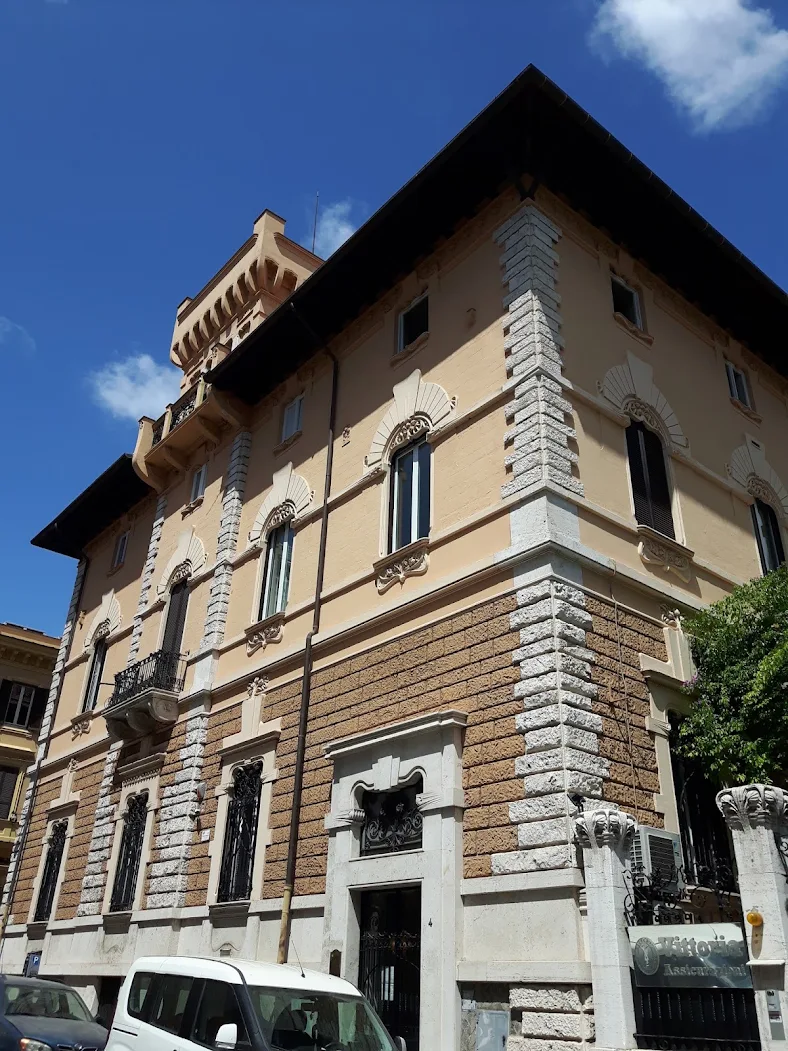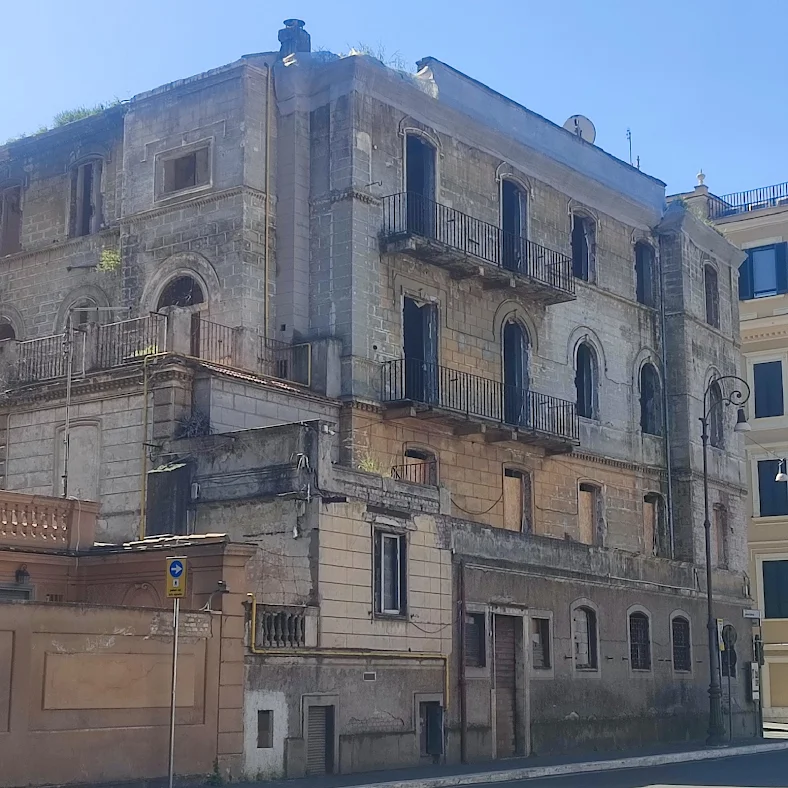
Standing vacant for years at the corner of Via Sgambati and Via Pinciana, the building that hosted hospitality operations for decades is now a protected cultural asset and a potential component of the Galleria Borghese expansion plan. A parametric simulation shows why, following the 2025 heritage designation, the sustainable acquisition price for a hotel reconversion may fall dramatically — and which investors could still make the numbers work.
The question
Some properties are difficult for the market to price because they sit precisely at the intersection where location value, hotel use, heritage protection and permitting risk compete for the same square metre.
Villino Pincherle, at the corner of Via Giovanni Sgambati and Via Pinciana, opposite one of the monumental entrances to Villa Borghese, is one of them.
For much of the twentieth century, the building was used for hospitality purposes. Today it is vacant, protected by Italy’s Ministry of Culture and part of the public debate surrounding the potential expansion of the Galleria Borghese, as an alternative to building new volumes inside the park.
For anyone investing in hospitality real estate, the key question is simple:
under what economic conditions could this building become a hotel again?
The answer is now very different from the one an investor might have given before March 2025.
And that is precisely what makes this case interesting.
The point is not to determine what Villino Pincherle is “worth” today — an assessment that would be impossible without technical documentation and direct access to the property — but to understand how a heritage designation imposed after an investment scenario has been conceived can radically alter hotel underwriting.
The property
The villa was built in 1906 to a design by engineer and architect Carlo Pincherle, on land acquired the previous year from the Società Italiana per le Imprese Fondiarie.
The street, now named after composer Giovanni Sgambati, was known at the time as Via Sesia.
Pincherle was among the professionals active in Rome during the Umbertine and Giolittian periods and designed several villas as part of the urban development of the Villa Ludovisi area.
He was also the father of Alberto Moravia. The building is associated with the writer’s childhood, although reconstructions differ as to the precise location of his birth, a matter that was also subject to documentary checks during the administrative review.
Architecturally, the building follows a Neo-Renaissance language, with smooth rusticated cladding, a main elevation running longitudinally along the street facing the park, round-arched windows on the piano nobile and decorative bas-relief elements. The entrance is located on the garden side.
During the 1930s, the property acquired a hospitality use and operated as a boarding house.
Its hotel function continued in subsequent decades under names linked to nearby Villa Borghese, with distribution platforms historically reporting a property of around thirty rooms over three floors, together with bar and restaurant facilities.
The hotel business has since ceased and the building is currently unused.
Timeline of the administrative process
2022 — A permit is issued for the demolition and reconstruction of the building.
2024 — The owner files a SCIA, the Italian certified notice procedure, to proceed with the works.
October 2024 — The appearance of construction-site notices triggers a report by Italia Nostra. Rome’s Municipio II launches an archival review into the authorship of the building; the Archivio Storico Capitolino produces the original drawings. A 1946 building application also emerges, helping reconstruct the historic ownership of the property by the Pincherle family.
November 2024 — Rome’s municipal heritage authority reports that the building’s classification under the Carta della qualità, the city planning instrument used to catalogue assets of urban and architectural interest, had meanwhile changed. On the basis of the revised framework, the municipal administration declares the SCIA no longer effective and requests intervention by the state heritage authority.
14 March 2025 — By decree of the Regional Commission for Cultural Heritage of Lazio, following proceedings initiated by Rome’s Special Superintendency, the villa is declared a cultural asset of particularly significant interest pursuant to Article 10, paragraph 3, of Italy’s Cultural Heritage and Landscape Code.
The reasons cited include the historic and artistic qualities of the elevations and the urban significance of the setting beside the monumental entrance to Villa Borghese.
From that point forward, a development strategy based on full demolition is no longer compatible with the new heritage regime.
May-July 2026 — The property becomes part of the debate surrounding the expansion of the Galleria Borghese. Municipal and city representatives identify it as a potential alternative to constructing new volumes inside the park. The institutional discussion includes both the possibility of an agreed acquisition and, more generally, the public-law instruments available in relation to protected cultural assets.
Municipio II also approves a resolution seeking to avoid additional building volumes within Villa Borghese and to prioritise the reuse of existing public and private buildings.
All the elements above derive from administrative records and press reports published by national and local media between October 2024 and July 2026.
What changes economically once a heritage restriction is imposed
The critical issue is not merely that the restriction changes what can be built.
It changes what an investor can afford to pay.
Before a heritage designation, an underwriting model may assume a certain degree of freedom in space planning, floorplate efficiency, services distribution and achievable room count.
Once the property is protected, those variables become subordinate to the conservation of the building and to the approval process.
In a hotel investment, this can have a far greater impact than the increase in construction cost alone.
What the heritage designation means in technical terms
Since the March 2025 decree, at least three factors affect the property’s investment profile.
Permitting regime
Works affecting the property are subject to the approvals required by Italy’s Cultural Heritage Code.
This is not simply an administrative formality.
It can affect internal layouts, building services, structural alterations, openings, vertical circulation and decorative elements.
In a hotel, those variables directly influence:
-
room count;
-
average room size;
-
the ratio of revenue-generating space to common areas;
-
circulation efficiency;
-
MEP costs;
-
hotel category and positioning.
Pre-emption rights
In the event of an onerous transfer of a protected cultural asset, the Cultural Heritage Code imposes specific notification requirements and, where the statutory conditions are met, allows designated public authorities to exercise pre-emption rights.
For an investor, this means that closing and transfer of title must be structured around an additional process that would not apply to an ordinary real estate transaction.
Potential public-sector intervention
The Cultural Heritage Code also regulates the expropriation of cultural assets where the statutory conditions are met and where the transaction serves a significant public interest connected to conservation or public access.
In the case of Villino Pincherle, the debate surrounding the expansion of the Galleria Borghese therefore introduces an additional variable: alongside the private investor, there may also be a public-sector interest in the asset.
Any eventual compensation would have to be considered by reference to the property in its actual legal and planning context, not against a hypothetical scenario of unrestricted demolition and redevelopment.
Economically, that distinction matters.
The three possible paths
From this point forward, the potential outcomes can broadly be grouped into three scenarios.
1. Private hotel reconversion
A hotel use remains theoretically possible, but any project would have to comply with the heritage protection regime.
The core question would therefore not simply be whether planning consent can be secured, but how many rooms, what type of product and what level of profitability can actually be generated within the retained historic envelope.
2. Public acquisition
The property could become part of the Galleria Borghese expansion project through an agreement with the owner or through the mechanisms provided for under Italian law.
In that scenario, hotel investment logic would naturally cease to be the principal driver.
3. Stalemate
This is a frequent outcome for complex protected properties.
The owner does not accept the price that an investor can economically justify; the investor cannot meet the owner’s expectations; and the public sector does not complete an acquisition.
The result is that nobody moves.
Meanwhile, the asset remains unused and the conservation of the building itself becomes an increasingly significant issue.
Parametric simulation: how much can heritage protection affect the economics?
The following is an illustrative exercise based on a hypothetical property, not a valuation of Villino Pincherle.
We do not have verified surveys, confirmed areas, architectural plans, quantity surveys, permits, financial documentation or direct access to the building.
The sole purpose of the model is to measure how much the maximum sustainable acquisition price may change when a hotel project moves from a relatively flexible redevelopment scenario to a conservation-led restoration scenario.
Assumptions:
Hypothetical building envelope: 1,400 sq m of gross floor area, four above-ground floors plus basement, external courtyard, positioned as an upper-upscale hotel in a prime central Rome location.
Capex structure
| Item | Scenario A — new build | Scenario B — conservation-led restoration |
|---|---|---|
| Gross floor area per key | 50 sq m | 62 sq m |
| Keys achievable | 28 | 22 |
| All-in capex per key | €260,000 | €360,000 |
| Total capex | €7.28m | €7.92m |
| Capex per sq m GFA | €5,200 | €5,657 |
| Construction period | 24 months | 34 months |
The restoration scenario incorporates three factors that are typically material in protected buildings:
-
greater use of specialist and craft-intensive works;
-
more complex MEP solutions;
-
higher contingency allowances for discoveries and variations during construction.
The model assumes a contingency of approximately 15%, compared with around 10% under the more standardised redevelopment scenario.
Stabilised operating performance
| Item | Scenario A | Scenario B |
|---|---|---|
| ADR | €390 | €420 |
| Occupancy | 75% | 76% |
| RevPAR | €292 | €319 |
| Total revenue | €3.74m | €3.13m |
| GOP margin | 41% | 38% |
| GOP | €1.53m | €1.19m |
| Net EBITDA | €1.29m | €0.97m |
The conservation scenario assumes a higher ADR.
It is reasonable to expect that a hotel located in a distinctive historic building in an exceptional location could achieve a rate premium over a more standard product.
But the pricing premium does not necessarily compensate for lower density.
With six fewer rooms and weaker operating efficiency, EBITDA falls from €1.29 million to €970,000:
approximately 25% lower.
And this is where the heritage designation begins to affect value in a meaningful way.
The residual value of the property
By setting a target yield on cost and deducting capex, we can estimate the maximum theoretical acquisition price that an investor could support in this parametric model.
| Target yield on cost | Scenario A | Scenario B |
|---|---|---|
| 6.5% | €12.53m (€8,949/sq m) | €6.97m (€4,978/sq m) |
| 7.0% | €11.11m (€7,939/sq m) | €5.91m (€4,218/sq m) |
| 7.5% | €9.89m (€7,063/sq m) | €4.98m (€3,560/sq m) |
At a 7% target yield, the theoretically sustainable acquisition price falls from approximately €11.1 million to €5.9 million.
That is a difference of almost €5.2 million.
Or, expressed per unit of area:
from approximately €7,900 to approximately €4,200 per sq m of gross floor area.
But the most interesting point is another one.
The additional capex under the conservation scenario is approximately €640,000.
The total reduction in acquisition capacity is approximately €5.2 million.
The higher construction cost therefore explains only around 12% of the loss in purchasing capacity.
Almost nine-tenths of the difference comes from the lower income-generating capacity of the hotel and the capitalisation of that reduced income.
This is one of the most important conclusions of the exercise.
Heritage protection does not primarily destroy value because the works cost more. It destroys value when it reduces room count and operational efficiency.
That is exactly the mistake often made in hotel underwriting: focusing on restoration cost while treating the room count as if it were already secured.
Exit value and sensitivity
Now consider the conservation scenario and assume an exit once the hotel reaches stabilisation.
| Exit cap rate | Exit value | Profit on cost |
|---|---|---|
| 5.00% | €19.36m | +40% |
| 5.50% | €17.60m | +27% |
| 6.00% | €16.13m | +17% |
The time horizon, however, is not short.
A 34-month construction period followed by approximately 24-30 months of hotel ramp-up pushes the investment towards a five-year holding period.
Including the operating cash flows generated during the stabilisation phase — rather than looking only at the difference between total development cost and exit value — the central case may result in an unlevered IRR in the region of 6-7% per annum, depending on the exact timing of cash flows.
That can make sense for long-term capital.
It is considerably harder to justify for a value-add investor facing planning risk, construction risk, limited scale and a long execution period.
How important is ADR?
The EBITDA sensitivity illustrates another key characteristic of the investment.
|
|
Occupancy 70% | Occupancy 76% | Occupancy 80% |
|---|---|---|---|
| ADR €380 | €0.79m | €0.87m | €0.92m |
| ADR €420 | €0.88m | €0.97m | €1.02m |
| ADR €460 | €0.98m | €1.07m | €1.13m |
Between the weakest and strongest points in the matrix, EBITDA moves by more than 40%.
With only twenty-two rooms, there is limited scope to compensate through volume.
The project is therefore heavily dependent on the ability to sell every room at the right price.
That means brand, distribution, revenue management, reputation and positioning become part of the real estate underwriting itself.
They cannot simply be addressed after the property has been acquired.
This is one reason why hotel management strategy and the operating structure must already be considered during the acquisition phase.
For further insight into these issues, Hotel Management Group focuses precisely on the development and management of hospitality models in which real estate strategy and operating performance must be considered together.
The Villino Florio precedent
Villino Pincherle is not the only case in Rome where an architecturally significant historic building intersects with the hospitality market.
On InvestimentiAlberghieri.it, we have also analysed Villino Florio in Rome and whether this Liberty masterpiece could become a hotel.
The two cases differ in legal, ownership and development terms, but they reveal the same underlying phenomenon.
Rome has a stock of relatively small properties in exceptional locations whose architectural identity may support highly differentiated, high-value hotel products.
The challenge is that the architectural value that makes the hotel commercially unique is often the same factor that limits design flexibility.
That contradiction is what the investor must turn into product value.
So, can it become a hotel again?
The numbers allow for a more precise answer.
Yes, potentially — but not for every investor and not at every price.
The simulated return profile tends to exclude purely opportunistic capital and a significant share of value-add funds, because the combination of permitting risk, investment duration and achievable return may not meet their target thresholds.
At least three investor categories could still be compatible.
Long-term private capital
Family offices, private investors and other capital sources focused on asset quality and scarcity may accept lower returns in exchange for ownership of a genuinely irreplaceable property.
Strategic hotel operators
A hotel group may assign a higher value to the asset than a purely financial investor if the property provides brand, positioning or portfolio benefits.
Investors able to monetise the heritage framework
Tax incentives, grants or other mechanisms compatible with the restoration of protected assets could materially improve the economics.
But one condition remains fundamental.
The acquisition price must reflect the project that can actually be delivered, not the project that could have been imagined before the heritage designation.
A value expectation formed in the 2022 environment cannot simply be carried forward into the post-March 2025 framework.
If the owner’s expectations and the investor’s purchasing capacity are based on two fundamentally different development scenarios, stalemate becomes the most likely economic outcome.
And there is a public-sector variable
The Galleria Borghese proposal makes this case even more unusual.
A private investor does not only need to ask:
“How much can I pay for this property?”
They also need to ask:
“What is the probability that I can actually complete the acquisition, secure the approvals and carry the project all the way to opening?”
Public-sector and permitting risk therefore feed directly into price.
Not because the outcome is predetermined.
But because in real estate underwriting, uncertainty always has a cost.
What this case teaches anyone buying a hotel
The Villino Pincherle case offers several lessons that extend well beyond this single building.
Assess heritage risk before closing
For historic buildings, the absence of a formal designation should not automatically be interpreted as an absence of risk.
The age of the property, authorship, architectural characteristics, urban context and historic significance should all form part of due diligence.
Review municipal heritage and planning registers
In Rome, the Carta della qualità is a critical source of information.
The relevant classification is the one in force when the investment is actually being completed, not simply the classification referred to in older permits or documentation.
Establish architectural authorship
In the Villino Pincherle case, archival research proved decisive.
For Roman properties dating from the late nineteenth century through the first half of the twentieth century, identifying the architect and locating original documentation can have a material impact on the risk assessment.
Underwrite the room count that can actually be approved
This may be the single most important financial lesson.
The business plan should not begin with the gross area and simply apply a standard square-metres-per-key ratio.
It should begin with the number of rooms that can realistically be delivered after all planning, architectural and heritage constraints have been taken into account.
The difference can be worth millions of euros.
Map the stakeholders
Heritage groups, municipalities, superintendencies, local committees and cultural institutions can materially influence the development process.
They are not background noise.
They belong in the risk register.
Structure the acquisition contract properly
Conditions precedent, price-adjustment mechanisms, allocation of permitting risk and due-diligence protections can help prevent the purchaser from absorbing risks that only emerge after signing.
Analysis comes before acquisition
Buying or taking over the management of a hotel is not simply a question of knowing the asking price.
An investor needs to assess, at the same time:
-
planning potential;
-
heritage restrictions;
-
achievable room count;
-
capex;
-
sustainable ADR;
-
occupancy;
-
GOP;
-
operating model;
-
investment return;
-
contractual structure;
-
exit value.
Investhotel.it focuses on hotels for sale, acquisitions, hotel management and the sourcing of hospitality investment opportunities.
InvestimentiAlberghieri.it analyses transactions, investors, valuations, hotel real estate and hospitality investment opportunities.
RobertoNecci.it provides further analysis of hotel strategy, management and business economics.
Hotel Management Group integrates advisory, hotel management and development, with the objective of connecting asset quality with the economic sustainability of the operation.
The broader picture
Rome retains a significant stock of small and medium-sized properties with historic hospitality use that are now vacant or underutilised, often located in areas of extremely high positional value and, at the same time, intense heritage protection.
At first sight, these assets may look like straightforward hotel conversion opportunities.
They often are not.
Their value depends on the ability to combine at least four capabilities:
real estate, planning, hotel operations and finance.
Villino Pincherle is useful precisely because it makes the friction between those four dimensions visible.
And it suggests a principle that should apply to every comparable transaction:
for a complex hotel asset, the business plan should not be adapted to the heritage constraints after acquisition. It should be built around those constraints before acquisition.
Are you assessing a hotel or a property for hotel conversion?
If you are considering the acquisition, sale, conversion, repositioning or management of a hotel, the asking price is only the starting point.
Before committing capital, it is essential to understand how many rooms can realistically be delivered, what capex will be required, what level of operating performance the property can support and, therefore, what acquisition price is economically sustainable.
For preliminary analysis, feasibility studies, economic assessments, hotel underwriting and hospitality investment projects:
info@investimentialberghieri.it
Methodological note
This article is based on publicly available administrative records and information already reported by the media. It does not contain assessments of the conduct of the parties involved, nor does it rely on confidential financial or asset information relating to the owner or any identified party.
The financial simulation is solely a parametric exercise based on a hypothetical property. Areas, room count, construction costs, operating assumptions and target returns are working assumptions used to illustrate the economic impact that different development constraints may have on a hotel investment.
The results do not constitute a valuation of Villino Pincherle or any other specific asset, nor do they represent an appraisal, investment advice or legal opinion.
Any assessment of a specific property requires direct inspection, access to technical documentation, verification of the actual condition of the building, planning and permitting due diligence and a dedicated financial analysis.
The editorial team is available to supplement or correct the article where documented information is provided by interested parties.