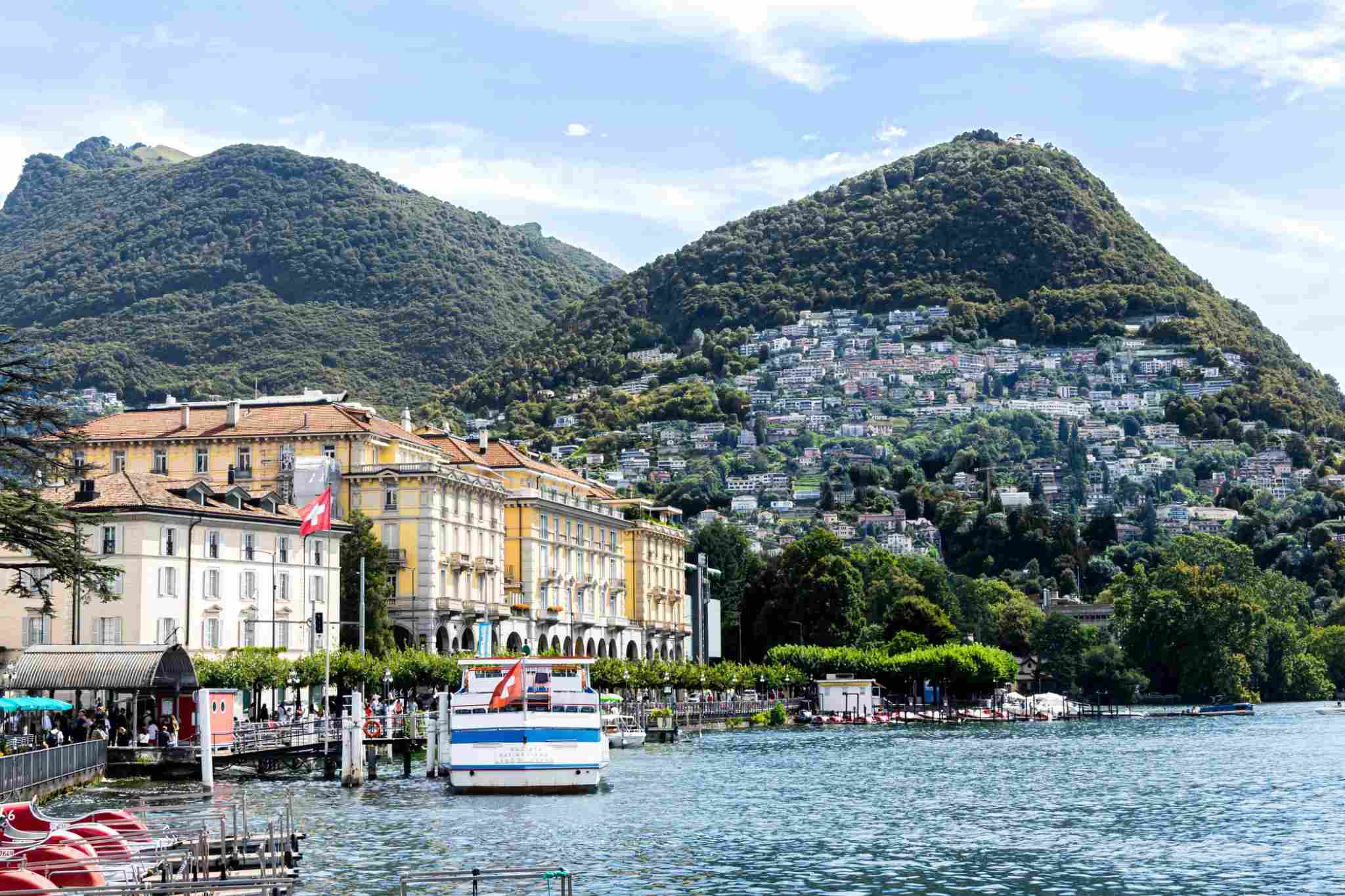
In just a few weeks, Lugano’s hospitality market has seen the sale of a landmark hotel, two residential conversions, an off-market transaction, the arrival of an international hotel chain, and several major refurbishment projects involving existing assets.
This is more than a local news story. It is a snapshot of a hotel market reallocating capital, changing the use of assets that are no longer competitive as hotels, and reinvesting in properties that continue to generate returns.
Above all, it offers a useful comparison with Italy, where similar economic forces often encounter far greater regulatory and planning constraints.
What happened
On 11 August 2026, the Corriere del Ticino mapped out the major changes currently taking place across Lugano’s hotel stock.
The most significant transaction is the sale of Hotel De La Paix by the Formenti family to ESMO — the European Society for Medical Oncology, an international non-profit organisation active in oncology and responsible for major scientific events in Lugano.
The buyer explained that it had been looking for a permanent venue for congresses, conferences and educational events, and identified a property capable of combining location, accommodation capacity and substantial meeting facilities.
The hotel use will be retained, while a comprehensive refurbishment has already been announced.
Several other assets are moving at the same time:
-
Hotel Bellevue → proposed conversion into seventeen apartments, with an investment reportedly in the region of CHF 40 million;
-
Hotel Nassa → expected to close at the end of the year and be converted into residential accommodation;
-
Hotel Parco Paradiso → sold, with residential conversion among the scenarios being considered;
-
Lido Seegarten → a sale is considered likely by market operators, with succession planning also emerging as a factor;
-
Villa Principe Leopoldo and Villa Sassa → refurbishment works on operating hotel assets that continue to reinvest in their competitive positioning.
These movements in the existing stock are accompanied by two new developments: a European hotel chain with an international footprint will occupy the West Tower of the Science and Technology Hub, while entrepreneur Christian Constantin is working on the relaunch of Capo San Martino.
Federico Haas, President of HotellerieSuisse Sottoceneri, also interprets the acceleration in private investment as a response to uncertainty surrounding the timing of the new Campo Marzio congress centre.
The message is straightforward: the market does not necessarily wait for the public planning process to be completed.
Deputy Mayor Roberto Badaracco has acknowledged that the De La Paix transaction also sends a signal to the city, while the zoning-plan amendment for Campo Marzio Nord, approved by the Municipality last March, is still awaiting the Canton’s opinion.
Source: Corriere del Ticino – Hotel in città: è tempo di grandi manovre, 11 August 2026
Why this matters to hotel investors
1. A strategic user-buyer has emerged, not simply a yield-driven investor
The most interesting aspect of the De La Paix transaction is not just the change of ownership. It is the identity of the buyer.
ESMO is not acquiring the hotel solely to generate a property or hospitality return.
It is acquiring a platform that supports its institutional activities, where hospitality becomes part of a broader ecosystem of conferences, education, professional networking and international presence.
This type of buyer is still too often overlooked in hotel sale processes.
Foundations, scientific societies, healthcare groups, universities, religious organisations, professional associations, business organisations and family offices may attribute a very different value to a hotel asset from that recognised by a traditional financial investor.
The distinction is fundamental.
A financial investor generally starts from the asset’s income-generating capacity, capitalises EBITDA, assesses future capex requirements and prices in operating risk.
A strategic user-buyer may also value benefits that never appear in the hotel’s profit and loss account: lower recurring expenditure on external conference venues, full control of the guest experience, institutional representation, operational continuity and brand identity.
As a result, in certain transactions, its willingness to pay may exceed the value derived from a purely financial underwriting of the asset.
For a seller, the implication is clear.
Building the buyer long list is a pricing decision, not an administrative exercise.
Restricting a competitive process to real estate funds, hotel operators or the usual pool of known investors can, in some cases, artificially narrow the market.
That is precisely where a hotel transaction advisory mandate differs from conventional brokerage.
2. Change of use is part of the asset’s value equation
In Lugano, several hotels are leaving the hospitality market and being converted to residential use.
From an economic perspective, there is nothing unusual about this.
When the value supported by an alternative use consistently exceeds the capitalised value of the hotel operation, and when repositioning would require capex that cannot be justified by the expected returns, conversion may be the most efficient allocation of capital.
What matters is what then happens to the market as a whole.
Assets that are no longer competitive as hotels can move into another use. Properties that remain in the hospitality sector attract new investment. New operators enter the market.
The hotel stock is not necessarily frozen in place: it is allowed to undergo selection.
This is where the comparison with Italy becomes particularly relevant.
In Italy, hotel-use restrictions are largely governed by regional legislation and local planning rules, with material differences from one jurisdiction to another.
In many cases, conversion can be difficult, lengthy or economically unviable.
The stated objective is generally to preserve accommodation capacity. Yet where a hotel has structurally lost its economic viability, preventing or severely restricting an alternative use does not automatically recreate tourism demand or restore profitability.
It can instead create real estate illiquidity.
The result may be a stock of closed, underused or progressively deteriorating properties that remain outside the ordinary market for years before eventually finding a viable economic solution.
The dossier on disused hotel properties in Italian municipalities prepared by our Observatory shows why the issue deserves a much broader discussion.
The real question, therefore, is not simply whether hotel-use restrictions should exist.
It is this:
when do they genuinely protect hospitality capacity, and when do they simply prevent capital from being reallocated without actually preserving the hotel business?
A more detailed analysis of this issue is available on robertonecci.it.
3. Capex on existing assets is one of the strongest indicators of sector health
One of the more technical observations in Federico Haas’s interview is also one of the most relevant for anyone looking at hotels as operating businesses rather than merely as real estate: several properties are refurbishing because they are performing well and reinvesting in their competitiveness.
The same dynamic is familiar in Italy.
Hotels are capital-intensive businesses.
Guestrooms, mechanical systems, common areas, food and beverage facilities, technology, distribution systems and brand standards require continuous investment.
A meaningful share of the operating margin therefore does not necessarily become distributable profit. It is reinvested into the asset.
This is why the economic contribution of a hotel cannot be assessed solely through the direct tax revenues generated by the operating company.
Its impact extends to employment, suppliers, restaurants, retail, transport, professional services, maintenance and the wider visitor economy.
For investors, however, the signal is even more significant.
A hotel able to finance its own refurbishment through operating cash flow is demonstrating both cash-generating capacity and the ability to defend its competitive position.
A construction site, therefore, is not necessarily evidence of distress.
It may be precisely the opposite.
4. Generational transition remains one of the main drivers of hotel deal flow
The Lido Seegarten case, where succession issues are cited among the factors that could lead to a sale, reflects a dynamic that is equally familiar in the Italian market.
Many hotel transactions do not begin with a financial decision.
They begin with a family discontinuity.
No next-generation family member willing to operate the business. Misalignment between family branches. Third-generation shareholders pursuing careers elsewhere. The need to monetise ownership stakes. Or simply declining appetite for an operating business that requires constant managerial involvement.
For this reason, hotel origination requires something different from simply identifying assets that are formally on the market.
It requires understanding when an owner may become a seller before that owner has publicly decided to sell.
That is the stage at which an orderly, competitive process can still be structured in a way that protects the value of the asset.
Once a sale becomes a necessity, the owner’s negotiating leverage begins to weaken.
In hotel transactions, the timing of the decision can be almost as important as the price itself.
5. Private capital prices public-sector delays into its investment decisions
The relationship between the De La Paix transaction and the future Campo Marzio congress centre provides one final insight.
Private operators are investing while part of the relevant public infrastructure is still moving through the administrative process.
This is not an exclusively Swiss phenomenon.
Across Italian cities, major urban projects, convention facilities, railway infrastructure, airports, regeneration schemes and planning amendments can require timelines far longer than those typically adopted by private capital.
Professional investors cannot simply wait.
They have to assign probabilities to different scenarios.
And that is precisely where value can emerge.
Buying after an infrastructure project has been completed generally means paying for at least part of the benefit that the infrastructure has already transferred into property values.
Positioning before completion means accepting execution risk in exchange for the potential future uplift.
That is not speculation on administrative timing.
It is risk analysis.
And it is a factor that should be incorporated systematically into hotel valuations whenever an asset is located within an area whose function, accessibility or ability to attract demand is expected to change.
The advisor’s perspective
The reshaping of Lugano’s hotel market does not necessarily point to a crisis in hospitality.
It tells a more interesting story: a market is selecting its assets.
Some properties are leaving the hospitality sector.
Others are being acquired by buyers with different strategic objectives.
Profitable hotels are reinvesting.
New operators are entering.
New capital is taking positions.
This is the normal process through which a mature real estate market reallocates resources toward their highest-value use.
The Italian market is subject to many of the same economic forces: strong residential values in certain central locations, complex family succession dynamics, rising capex requirements, and a widening gap between high-performing hotels and structurally marginal properties.
But the adjustment mechanism is not always as fluid.
When a hotel asset loses competitiveness and, at the same time, cannot easily be converted to another use, the risk is that the problem is postponed rather than resolved.
Sometimes for years.
Until what could have been an ordinary entrepreneurial decision turns into a financial problem.
This is how a portion of trapped real estate value may eventually be forced into insolvency procedures, distressed-credit situations or NPL/UTP transactions rather than being realised through an orderly market sale.
For hotel owners, this leads to one very practical conclusion:
the window for an orderly exit opens and closes, and it does not coincide with the moment when the problem becomes obvious.
It has to be identified earlier.
While the asset still has presentable operating results.
While it is still possible to create competition among different categories of buyers.
While ownership can still choose whether to sell, refinance, convert or reposition.
And, most importantly, while time is still on the seller’s side.
A sale, however, is not the only option.
Commercial repositioning, operating-model reviews, cost restructuring, revenue-management interventions, distribution optimisation, management changes and the renegotiation of hotel management agreements can materially alter the income-generating capacity of an asset.
These are the areas in which Hotel Management Group operates when the objective is to restore competitiveness and profitability before deciding whether to retain or dispose of the property.
When the decision is to sell, however, the work is fundamentally different.
The value must be defined. The right buyer universe must be built. Non-traditional buyers must also be identified. Documentation must be prepared properly. And, above all, the owner must avoid allowing a bilateral negotiation to turn the asking price into a price dictated by the only buyer at the table.
That is the domain of hotel transaction advisory.
The real lesson from Lugano
At its core, the De La Paix case contains a very simple lesson.
A hotel does not have a single value.
It has a value as an operating hotel business.
It has a value as real estate.
It may have one value to a hotel operator.
A different value to a financial investor.
A potentially higher value to a strategic buyer that sees the property as supporting a wider institutional or business purpose.
And it may have an entirely different value under an alternative use.
The advisor’s role is not to decide in advance which of these values is the “correct” one.
It is to structure the process that allows the market to reveal it.
Let’s discuss your asset
If you are considering the sale, enhancement or repositioning of a hotel property, the starting point should not be finding the first available buyer.
It should be understanding:
-
what the asset is really worth;
-
which categories of investors may attribute the highest value to it;
-
whether credible alternatives to a sale exist;
-
when the right time is to launch a process;
-
how to create genuine competition among potential buyers.
Confidential preliminary assessment of the asset and its potential value-creation alternatives.
Roberto Necci
Hotel transaction advisor — Investhotel Capital Partners
robertonecci.it · investhotel.it · investimentialberghieri.it · hotelmanagementgroup.it
Source of the original news report: Valentina Coda and Giona Carcano, “Hotel in città: è tempo di grandi manovre”, Corriere del Ticino, 11 August 2026. The analysis, interpretations and opinions expressed in this article are the author’s own and should not be attributed to the publication cited or to any of the individuals or organisations mentioned.