The fact: one sign, one site cabin, sixteen years
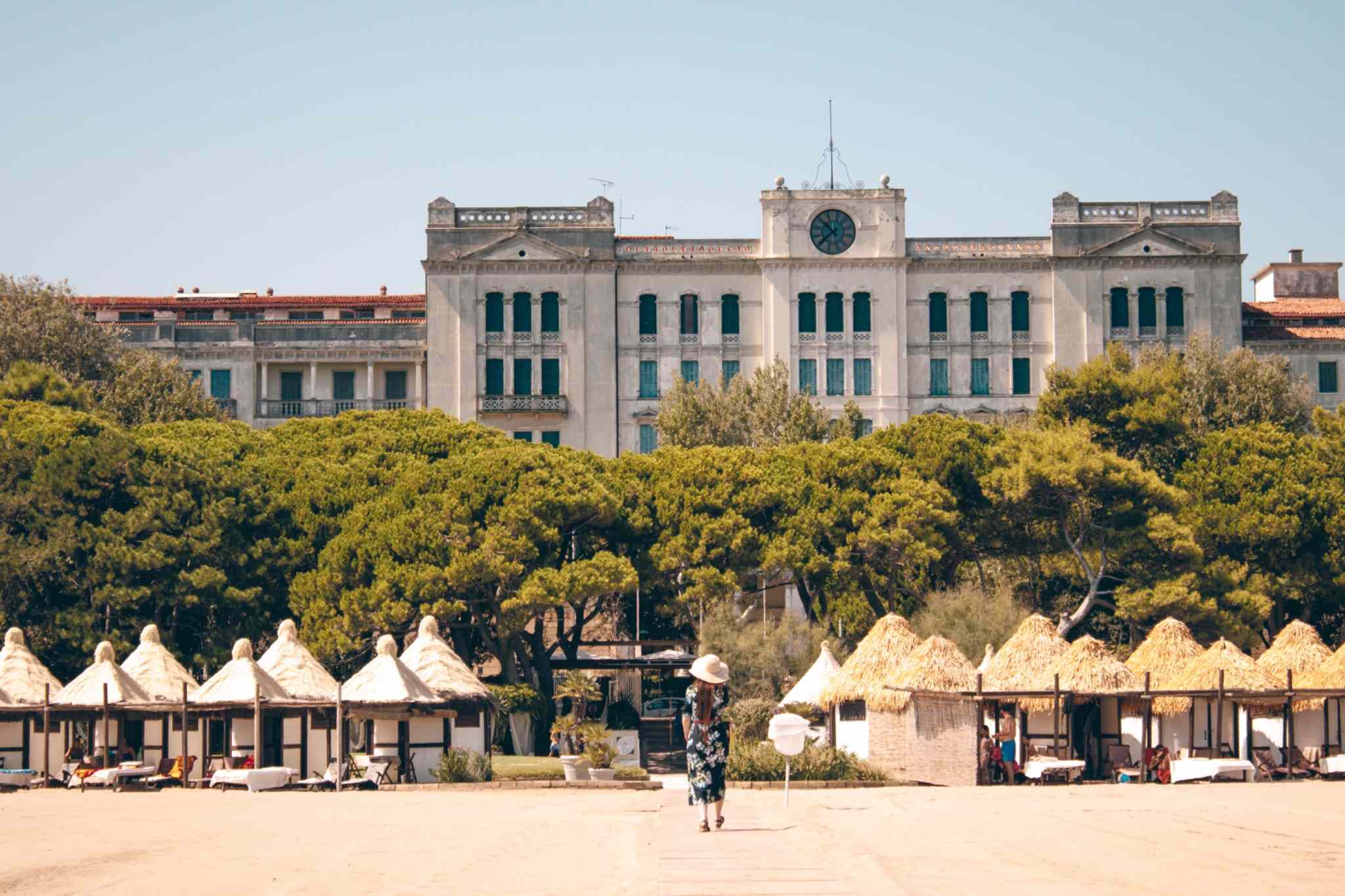
On Venice’s Lido, along Lungomare Marconi, two signs have appeared that, in real estate, can mean more than many press releases: a construction notice on the façade of the Grand Hotel des Bains and a site security cabin positioned beside the main staircase.
The news was reported on 12 August 2026 by Il Gazzettino, in an article by Lorenzo Mayer.
From a news perspective, it may look like a minor detail.
From a hospitality investment perspective, it is something else entirely: the first physically verifiable sign of movement in a story that has been stalled for sixteen years. The Des Bains has been closed since 2010.
The construction notice identifies COIMA SGR, acting on behalf of the COIMA Des Bains Fund, as the client and describes the current works as extraordinary maintenance. Design and overall works supervision are entrusted to Venetian architect Alberto Torsello.
This does not mean that the entire €200 million restoration programme has already entered full execution.
It does, however, mean something more significant from an investment standpoint: the Des Bains story has started moving from financial restructuring to the physical transformation of the asset.
That is precisely the transition that had failed to happen for sixteen years.
The deal does not start with the hotel. It starts with the debt
This is the part that matters to anyone investing in, financing or restructuring hotel assets.
The revival of the Des Bains did not begin as a conventional real estate acquisition.
It began with the acquisition of the debt.
The COIMA Des Bains Fund acquired 100% of the outstanding debt linked to the transaction, taking control of a claim with a nominal value of €54 million secured against the hotel.
The selling counterparties were:
-
Intesa Sanpaolo;
-
Altea SPV, the vehicle that had acquired the tranche originally extended by UniCredit and ultimately linked to CRC – Christofferson, Robb & Company, with Prelios Credit Servicing acting as servicer.
Precision matters here.
Acquiring secured debt does not automatically mean acquiring ownership of the underlying property.
But in a distressed transaction, concentrating the creditor position can provide the financial leverage required to make executable a business plan that had previously depended on multiple parties with different interests, time horizons and recovery strategies.
The logic is therefore clearly consistent with a loan-to-own approach: the strategic position around the asset is built through the debt and liability structure rather than through a conventional acquisition of the property itself.
And this is where the Des Bains becomes a broader market lesson.
In 2022, COIMA had already proposed a recapitalisation and redevelopment plan worth approximately €150 million. Earlier redevelopment scenarios had also been explored with lower capital requirements.
The problem was not a lack of ideas for the hotel.
The problem was aligning debt, equity, security, investors and the industrial plan.
In distressed hospitality, the project may create the value. But the liability structure determines whether that project will ever get off the ground.
As long as the debt remains fragmented among parties with different objectives, timelines and recovery strategies, even the strongest capex plan can remain purely theoretical.
Once the financial bottleneck is removed, the asset becomes transformable again.
That is why, in many distressed situations, the first question is not:
What is the hotel worth?
It is:
Who controls the debt secured against it?
For further analysis of this type of structure, Investhotel Capital Partners also works on the analysis and enhancement of value in hotel NPL and UTP positions, while Investimenti Alberghieri monitors closed hotels, insolvency situations, investors and special situations across the hospitality sector.
Who is providing the capital
The project will be financed through the COIMA Des Bains Fund, in which COIMA ESG City Impact Fund and Eagle Hills participate on an equal basis.
COIMA ESG City Impact Fund is backed by major Italian institutional investors, including Cassa Forense, ENPAM, Inarcassa, Cassa dei Dottori Commercialisti, Intesa Sanpaolo, Compagnia di San Paolo, Fondazione Padova e Rovigo, Fondo Pensione Monte dei Paschi di Siena and Fideuram Vita.
Eagle Hills, headquartered in Abu Dhabi, is led by Mohamed Alabbar, founder of Emaar Properties.
The transaction also includes a minority investment by Mavis, the investment vehicle of Federico Marchetti, founder of YOOX Net-A-Porter.
COIMA and Eagle Hills have also indicated that the fund may subsequently be opened to additional institutional and professional investors.
The capital structure is therefore significant: Italian institutional capital, Gulf capital, a dedicated investment vehicle and a distressed asset with exceptional international recognition.
The announced investment is approximately €200 million, covering the full restoration and modernisation of the hotel together with works on the surrounding park, public areas and beachfront.
But there is another point worth watching.
The Des Bains marked Eagle Hills’ entry into the Italian market. In November 2025, a second partnership with COIMA followed, this time involving the redevelopment of the former Guido Reni barracks in Rome.
The Des Bains therefore no longer looks like a one-off transaction.
It can be read as the first step in a broader investment relationship between COIMA and Eagle Hills in Italy.
For anyone originating hotel transactions, selling assets or raising international capital, that is a signal worth noting.
The next source of value will not be construction. It will be hospitality
Once the financial issue has been resolved and the real estate phase is under way, the next major question will determine a substantial part of the Des Bains’ terminal value:
Who will operate the hotel?
As of March 2026, the operator selection process was still ongoing.
And this is where the project once again stops being merely a real estate exercise.
A restored building is not yet a successful hotel investment.
It still has to become a business capable of delivering ADR, occupancy, GOP, international positioning and cash flow commensurate with the amount of capital invested.
At least four variables will therefore have to be defined for the Des Bains: positioning, brand, operating model and contractual structure.
The choice between a hotel management agreement, lease, franchise or hybrid structure is not an operational detail.
It changes the allocation of risk between owner and operator.
It changes the fee structure.
It changes the level of owner control.
It changes the asset’s future marketability.
And it can change the value of the hotel.
The key money question
For a project with this level of international visibility, it is reasonable to expect competition among luxury operators and brands.
One potentially important negotiation tool will be key money.
But the real issue will not simply be how much cash an operator is willing to contribute.
The key question will be the economic value of the entire contractual relationship: term, base fee, incentive fee, performance tests, termination provisions, capex obligations, possible clawbacks and the investor’s flexibility in the event of a future sale.
The operator does not merely determine how the hotel will be run. It helps determine how the market will value the hotel.
On a €200 million investment, even relatively small differences in operating profitability or contractual risk, capitalised over time, can translate into tens of millions of euros in value.
The management agreement is therefore part of the investment thesis.
It does not come afterwards.
Can four years be enough?
The current target for reopening remains 2030.
It is a plausible timeline, but not a generous one.
The Des Bains is a historic building that has been closed since 2010 and has endured years of exposure and deterioration. By March 2026, the need for preliminary structural consolidation before the full restoration programme was already apparent.
There are also the typical complexities of developing on Venice’s Lido: logistics, heritage constraints, permitting, procurement and the coordination of highly specialised works.
In projects of this kind, even hotel use restrictions and the planning framework become economic components of the investment because they affect the range of alternative uses and therefore the value of the asset itself.
The 2030 target is therefore not simply an opening date.
It is a financial model variable.
Every additional year means more capital tied up, higher financing costs, greater execution risk and delayed cash flow.
Why the Des Bains matters far beyond the Des Bains
The significance of the transaction lies not only in the future of one major Venetian hotel.
It lies in the financial model that is making its recovery possible.
1. Closed hotels can become investable again
The sequence is clear:
distressed debt → concentration of the creditor position → dedicated vehicle → fresh equity → capex → operator → relaunch.
The same structure will not apply identically to every transaction, but it contains an important lesson for the hundreds of Italian hotels that are closed, underused or trapped in unsustainable capital structures.
A distressed hotel is not necessarily a bad asset.
It may simply be a good asset with a bad financial structure.
That difference can be worth millions.
2. Eagle Hills is not buying stabilised income. It is entering by creating value
In the Des Bains transaction, Eagle Hills is not entering Italy by simply acquiring an operating, stabilised trophy hotel.
It is entering through the regeneration of a complex asset.
That is strategically different.
It is not simply buying existing income. It is buying the option to create it.
For advisers, operators and owners, this means that the map of international investors cannot be limited to groups seeking stabilised core hotel assets.
There is capital willing to accept transformation risk, execution risk and repositioning risk where the destination and the underlying asset justify it.
3. In distressed situations, control of the debt can matter more than legal title
When analysing a hotel in difficulty, looking only at the formal ownership of the property may not be enough.
The real analysis must identify:
who the creditor is;
who controls each debt tranche;
what security package exists;
who the servicer is;
what recovery strategy is being pursued;
which parties can actually enable or block a restructuring.
In distressed investing, the map of economic power does not necessarily match the land registry.
That is precisely why the hotel NPL and UTP market is one of the most useful places to identify future transactions before they become obvious to the wider market.
The Des Bains transaction at a glance
| Item | Details |
|---|---|
| Asset | Grand Hotel des Bains, Venice Lido |
| Closed since | 2010 |
| Debt acquired | €54 million nominal value |
| Selling creditors | Intesa Sanpaolo and Altea SPV |
| Altea SPV noteholder | CRC – Christofferson, Robb & Company |
| Servicer | Prelios Credit Servicing |
| Announced investment | Approx. €200 million |
| Vehicle | COIMA Des Bains Fund |
| Main investors | COIMA ESG City Impact Fund and Eagle Hills |
| Minority investor | Mavis – Federico Marchetti |
| Design and works supervision | Alberto Torsello |
| Positioning | High-end resort |
| Operator | Selection still ongoing |
| Target reopening | 2030 |
The real lesson from the Des Bains
For sixteen years, the Des Bains was simultaneously a major property, a major name and a potential redevelopment project.
That was not enough.
An asset may have history, location, international recognition and strong demand potential, yet remain frozen when capital, debt, ownership and the business plan fail to align.
That is exactly what the Des Bains story illustrates.
Real estate value alone does not reopen a hotel.
The project must first be made financeable.
The debt must be addressed.
Capital willing to assume transformation risk must be brought in.
And finally, a hotel business capable of generating returns on that investment must be created.
That is why the construction notice now hanging on the façade matters.
It is not the end of the story.
It is the moment when a financial restructuring stops being a press release and starts becoming a construction site.
In our industry, that distinction has been sixteen years in the making.
Further analysis and advisory
For hotel investments, valuations, acquisitions, distressed debt and restructuring: Investhotel Capital Partners.
For analysis of hotel contracts, valuations and ownership strategies: RobertoNecci.it.
For transactions, investors and distressed hospitality: InvestimentiAlberghieri.it.
For hotel commercial development and positioning: Hotel Marketing Lab.
For hotel operations and development: Necci Hotels.
For executive search and senior management recruitment: Vertex Executive Search.
For hospitality management training: Roberto Necci Academy.
These activities form part of the wider professional ecosystem of Hotel Management Group.
Do you own a closed hotel, a distressed debt position or a transaction blocked by leverage?
Waiting for the market to solve a broken capital structure rarely creates value.
If you are considering a sale, turnaround, debt restructuring, new equity partner or acquisition of a distressed hotel asset, contact me directly at r.necci@robertonecci.it.
Complex transactions should be analysed before the lender, insolvency process or counterparty ends up determining the value.
Primary source on the start of works: Il Gazzettino, North-East/Venice edition, 12 August 2026, Lorenzo Mayer. Financial structure and investment figures: COIMA SGR communications. Additional checks: corporate releases and specialist real estate and hospitality press.