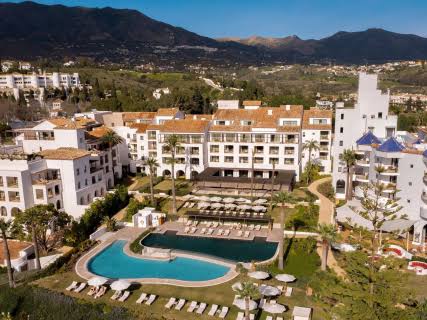
Hesperia has acquired La Zambra, a five-star Grand Luxury resort on the Costa del Sol, from Intriva Capital. Press reports put the transaction value at around €70 million. But the real story is not how much Hesperia paid for the hotel. It is how the value Hesperia is now acquiring was created in the first place.
La Zambra, located in Mijas, features 197 rooms and suites, a major wellness centre, multiple food and beverage outlets and extensive leisure facilities. It operates under The Unbound Collection by Hyatt.
If the reported €70 million transaction value is accurate, the acquisition implies a price of roughly €355,000 per key.
At first glance, that looks like a simple and useful benchmark.
It is also potentially misleading.
Because a hotel is not worth €355,000 per room.
A hotel is worth the cash flows that those rooms, together with the rest of the asset, can generate over time, adjusted for risk, future capital expenditure, operating structure, cost of capital and exit value.
Viewed through that lens, the La Zambra transaction becomes far more interesting than a straightforward hotel acquisition.
The deal in five numbers
-
approximately €70 million: reported transaction value;
-
197 rooms and suites;
-
approximately €355,000 per key;
-
2019: Intriva Capital acquires the former Byblos hotel;
-
2022: the property reopens as La Zambra following a major repositioning.
Those numbers, however, only describe the outcome.
To understand where the value was actually created, one has to look at what happened between 2019 and 2026.
Intriva did not buy a hotel. It bought a problem.
The property originally opened in the 1980s as Hotel Byblos and became one of the landmark hotels of the Costa del Sol.
Then came decline.
The hotel remained closed for more than a decade.
When Intriva Capital entered the transaction in 2019, it was therefore not buying a conventional operating hotel.
It was acquiring a property, a legacy, a location and, above all, a problem that had to be solved.
That distinction is fundamental.
A closed hotel carries a completely different risk profile from a refurbished, operating and stabilised property.
The investor has to fund the acquisition.
It has to redesign the product.
It has to finance the CapEx.
It has to manage construction risk, delays and potential cost overruns.
It has to define the positioning.
It has to select the right brand.
It has to reopen the hotel.
It has to rebuild demand, reputation and distribution.
And ultimately, it has to prove that the repositioned hotel works.
Intriva accepted all of those risks.
Hesperia is acquiring the asset after a significant proportion of them have already been removed.
That is the real transfer of value in this transaction.
Intriva bought risk and is selling stabilisation
The transformation from the former Byblos into La Zambra is almost a textbook example of hotel value creation:
acquisition → CapEx → repositioning → branding → reopening → stabilisation → exit.
This is very different from simply waiting for the underlying real estate to appreciate.
The value was actively created.
The refurbishment transformed the physical product.
The repositioning changed its addressable market.
Joining The Unbound Collection by Hyatt added international distribution, brand recognition, loyalty reach and commercial strength.
The reopening transformed a dormant hotel property into an operating business.
And as the business became established, the perceived risk of the asset progressively declined.
This is one of the most important principles in hotel valuation and investment.
A substantial part of hotel value creation can come from changing the risk profile of the asset itself.
€355,000 per key does not tell us whether Hesperia paid too much or too little
Dividing €70 million by 197 rooms produces an implied value of around €355,000 per key.
It is a convenient metric.
It is not a valuation methodology.
To determine whether Hesperia has made an attractive investment, we would need to know at least the hotel's normalised EBITDA, GOP, ADR, occupancy, RevPAR, contribution from non-room revenues, brand-related costs, future CapEx requirements, acquisition financing structure and expected return on invested capital.
Without those figures, it is impossible to say whether €70 million represents a high or low price.
We can only say how much was paid per key.
Those are two completely different things.
And this is one of the mistakes that frequently appears in hotel investment analysis, including in the Italian market: treating price per room as though it were a valuation method, when in reality it should mainly be regarded as a comparative benchmark.
Two 200-room hotels can have radically different values.
What ultimately matters is what those rooms, and the wider operation around them, are capable of producing economically.
Hesperia is buying the future, not the past
If Intriva completed the first phase of value creation, Hesperia now has to prove that there is a second one.
The new owner is not acquiring a development project.
It is acquiring an already transformed hotel.
The investment thesis therefore becomes predominantly operational.
The challenge will be to grow or defend ADR and occupancy, increase spend per guest, monetise gastronomy, wellness and golf, control labour costs and maintain the quality of the product without eroding profitability.
That is where the real return on the acquisition will be determined.
Luxury hospitality contains an inherent contradiction.
The more sophisticated the product becomes, the greater its revenue potential. But the cost of maintaining that sophistication also rises.
A large spa does not automatically create value.
A prestigious restaurant does not automatically create EBITDA.
A large resort does not automatically generate economies of scale.
Everything depends on the ability of management to convert services, space and positioning into operating profit.
Real estate and operations therefore cannot be considered separately, an approach that also sits at the core of Hotel Management Group.
Hesperia's real risk may be that it is buying an asset after the “easy” value has already been created
There is also a more critical interpretation of the deal.
An investor entering after refurbishment usually pays a higher price precisely because it is buying lower risk.
But lower risk often means that part of the upside has already been captured by the previous owner.
The question therefore becomes:
how much additional value can still be created after the hotel has already been refurbished, repositioned and connected to an international brand?
That may be the most important question in the entire transaction.
Hesperia will have to find the answer through operations.
If it can materially increase EBITDA, strengthen La Zambra's international positioning and expand ancillary revenues, it may be able to generate a second phase of value creation.
If, however, the hotel is already close to its operational potential, a significant proportion of the investment return will depend on maintaining current performance and on the asset's value at the next exit.
Those are two very different investment profiles.
Keeping Hyatt is a financial decision before it is a branding decision
Another important feature is that La Zambra will remain part of The Unbound Collection by Hyatt.
That choice illustrates how outdated it is to assume that ownership, operations and branding must always sit under the same corporate umbrella.
An investor can own the real estate.
An operator can run the hotel.
An international group can provide the brand and distribution platform.
The right structure is whichever configuration creates the greatest overall economic value.
A brand, therefore, should not be selected on perceived prestige alone.
It should be assessed in terms of potential ADR uplift, international demand generation, loyalty contribution, distribution power, affiliation costs, contractual restrictions and its possible effect on the value of the underlying real estate.
The same logic should apply when deciding whether to acquire, sell, lease or operate a hotel.
The brand is part of the financial model of the investment. It is not a decorative feature.
The mistake would be to assume that “luxury” automatically means “good investment”
La Zambra combines characteristics that are difficult to replicate: a Costa del Sol location, meaningful scale, a recognised history, a fully refurbished product, wellness, golf, food and beverage and international distribution.
But the market often makes a basic mistake.
It assumes that luxury automatically creates value.
A five-star hotel can be an outstanding investment.
It can also be an extraordinarily expensive business to operate.
Investment quality depends on the relationship between capital deployed and cash flow generated, not on the number of stars displayed at the entrance.
Luxury can support higher ADR.
But it also requires staffing, maintenance, FF&E, continual product renewal, demanding service standards and recurring capital expenditure.
This is why the value of the real estate must always be tested against the operating business's ability to support that value.
The most important lesson for the Italian hotel market
The La Zambra transaction should also be studied carefully by Italian hotel owners.
Italy has no shortage of extraordinary hotel properties in exceptional locations that nevertheless suffer from outdated operating models, inadequate capital structures or weak commercial positioning.
Owners often value hotels according to what the property could become.
Investors, however, have to pay for what the asset is today, after deducting the capital and risk required to deliver that future potential.
This is one of the main reasons why expectations between buyers and sellers frequently diverge.
The seller wants to be paid for value that the buyer still has to create.
La Zambra illustrates the opposite approach.
Intriva took on the transformation risk.
It invested.
It repositioned the asset.
It reopened the hotel.
It created a product that professional capital could once again understand, price and acquire.
Only then did it bring the asset back to market.
That is the difference between selling a problem and selling an investment.
Who got the better deal?
It is still too early to know.
Intriva appears to have successfully completed a classic investment cycle: acquisition of a distressed or problematic asset, transformation, stabilisation and exit.
Hesperia, however, may have a second value-creation phase ahead if it can materially improve the hotel's operating profitability.
That is precisely the point.
In hotel transactions, both buyer and seller can create value, but at different stages of the asset's life cycle and by assuming different types of risk.
Intriva primarily assumed development, real estate and repositioning risk.
Hesperia is primarily assuming operating, competitive and market risk.
The transaction price is simply the point at which those two risk profiles meet.
The real story is not the €70 million
The reported €70 million makes the headline.
It does not explain the deal.
The financially relevant story is that a hotel which had been closed for more than a decade was transformed into an internationally positioned luxury asset and subsequently sold to an industrial hotel operator.
The key transition was not:
property → more expensive property.
It was:
problematic asset → project → operating hotel → investable asset.
That transformation captures the distinctive nature of hotel investment.
A hotel is simultaneously real estate, an operating business, an organisation, a brand and a cash-flow-generating asset.
Assessing it purely on a price-per-square-metre or price-per-key basis therefore means analysing only the simplest part of the equation.
The decisive question remains:
how much EBITDA can this capital generate over the coming years, how much CapEx will be required to protect its competitive position, and what will the asset be worth at exit?
Everything else comes afterwards.
Considering a hotel acquisition? The asking price is not the valuation
Buying, selling or repositioning a hotel requires an integrated analysis of EBITDA, GOP, cash flow, CapEx, debt, positioning, management agreements, branding, real estate structure and the asset's prospective value.
For further insights and professional advisory:
RobertoNecci.it — hotel advisory, valuations and investment analysis
Investhotel.it — hotel operations, acquisitions, disposals and asset enhancement
Hotel Management Group — hotel management and development
If you are considering a hotel acquisition, disposal, management agreement or repositioning strategy, contact r.necci@robertonecci.it.