The sector is growing, but without management control, consolidation and a financial strategy, thousands of businesses risk remaining valuable properties with limited transferable enterprise value
by Roberto Necci
Italian agritourism has reached record levels.
According to the 2026 ISMEA Report on Agritourism and Multifunctionality, in 2024 the sector generated €1.934 billion in production value, with 26,360 authorised agritourism businesses, more than 4.7 million guests and approximately 17.2 million overnight stays.
Impressive figures.
But one number changes the perspective entirely.
Dividing €1.934 billion by 26,360 businesses produces a theoretical average of approximately €73,000 per business.
This is not the actual turnover of an individual property and should not be interpreted as such. It is a derived indicator.
But it illustrates the structural issue exceptionally well.
Italy has created an extraordinary agritourism and real estate asset base without creating, to the same extent, businesses of sufficient scale to be easily financed, valued and transferred.
Demand exists.
The product enjoys international recognition.
The assets are there.
The real question over the coming years will be different:
how much of that asset value is genuinely enterprise value?
1. The paradox of Italian agritourism
The sector combines two apparently contradictory characteristics.
On the one hand, it is growing.
On the other, it remains highly fragmented.
| Indicator | 2024 | Economic interpretation |
|---|---|---|
| Authorised agritourism businesses | 26,360 | highly fragmented market |
| Production value | €1.934bn | ≈ €73,000 theoretical average per business |
| Businesses offering accommodation | over 21,000 | approximately 81% of the total |
| Bed capacity | approximately 310,000 | very small average property size |
| Overnight stays | approximately 17.2m | significant but highly seasonal demand |
| International demand | majority of overnight stays | already a global market |
Comparing overnight stays with total accommodation capacity also produces a theoretical indicator of approximately 55 overnight stays per available bed per year.
This is not equivalent to a hotel occupancy rate: it does not account for actual opening days, individual business seasonality or regional differences.
Nevertheless, it highlights an important issue.
A substantial amount of capital is tied up in assets that are monetised for only part of the year.
And that is where any serious valuation should begin.
2. Real estate value is not enterprise value
In many agritourism transactions there is a significant imbalance between:
the value of the property
and
the business’s ability to generate income.
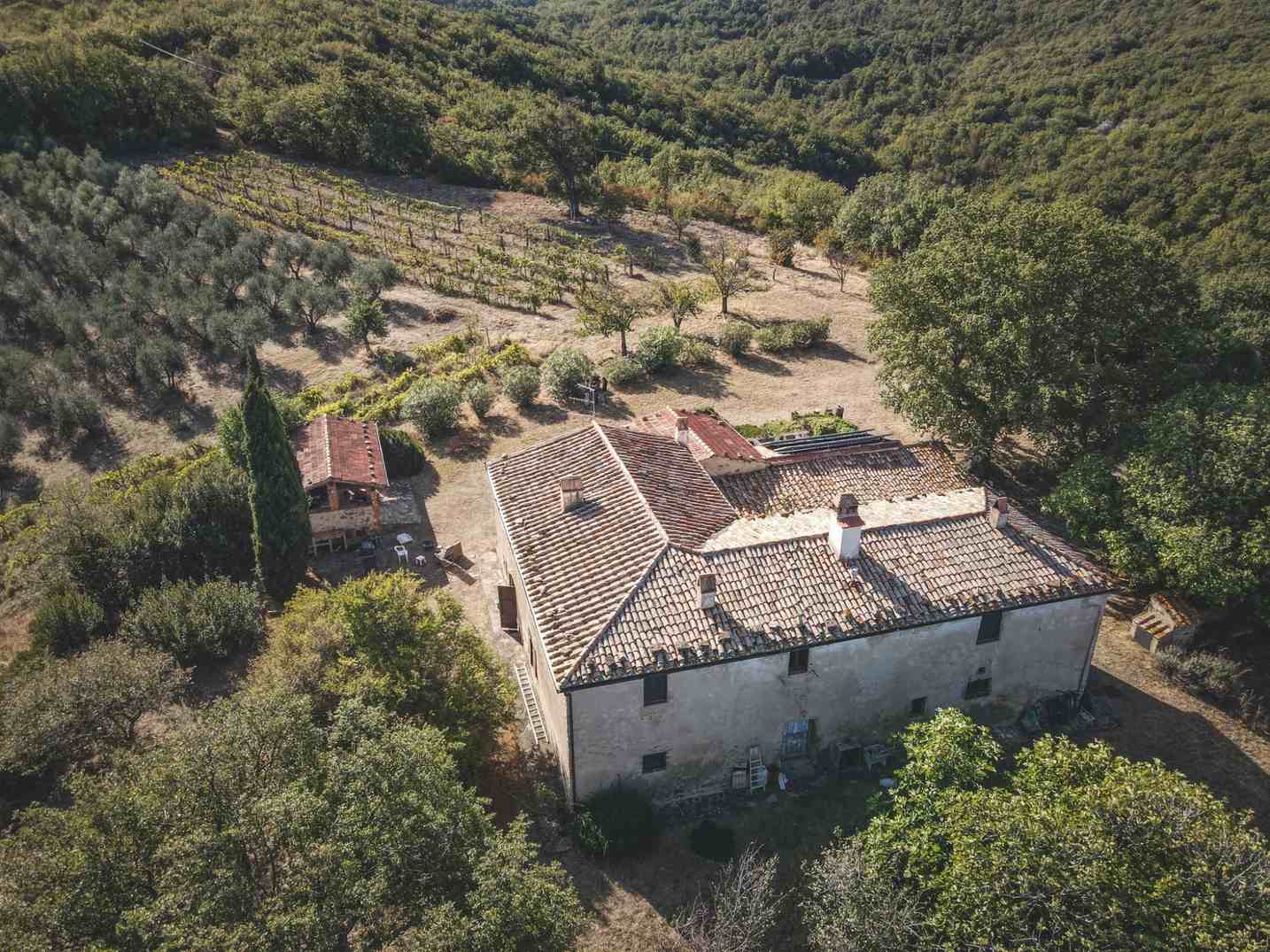
A country estate may be worth €1.5 million or €2 million.
It may include land, a swimming pool, vineyards, olive groves and an exceptional location.
But if the operation generates €70,000 or €100,000 in revenue with minimal normalised profitability, the capital employed is producing a very low return.
This is where one of the most common misunderstandings in negotiations begins.
The owner thinks:
“My property is worth €2 million.”
The investor thinks:
“What return does a €2 million investment generate?”
These are completely different questions.
And they often produce very different answers.
Real estate value is not enterprise value.
The ability to bridge that gap largely determines whether an asset is genuinely marketable.
3. Why many agritourism businesses appear more profitable than they really are
An agritourism business can operate under economic conditions that would be difficult to sustain in a conventional hotel.
Three factors explain much of this phenomenon.
Family labour
In family-run businesses, owners and relatives often perform a significant number of functions directly:
-
guest reception;
-
administration;
-
reservations;
-
breakfast service;
-
maintenance;
-
cooking;
-
product sales;
-
agricultural operations.
The economic cost of these activities is not always clearly reflected in the accounts.
For the current owner, this may not represent a problem.
For a buyer, it does.
An acquirer needs to understand what it would cost to replace the family’s labour with paid employees or professional management.
This is the concept of transferable profitability.
The property does not pay rent
When the estate belongs to the family, the operating business may not pay any rent.
This can make operating profitability appear stronger than it really is.
But it also prevents the owner from understanding the actual return generated by the real estate capital employed.
A proper valuation should therefore include a notional market rent.
Only then can one distinguish between:
real estate value
and
operating business value.
Tax accounting is not management accounting
Tax documentation is designed to determine taxable income and tax liabilities correctly.
An investor needs something different.
They need to understand:
-
revenue by department;
-
direct costs;
-
labour costs;
-
margins;
-
EBITDA;
-
required capital expenditure;
-
seasonality;
-
occupancy;
-
ADR;
-
OTA dependency;
-
cash-generating capacity.
For this reason, one of the first steps before selling, financing or opening the equity of an agritourism business should be the preparation of a reclassified management P&L.
4. How to reclassify the P&L of an agritourism business
An agritourism operation should not be analysed as a single activity.
In many cases, at least four different businesses coexist within the same economic entity.
| Profit centre | Revenue | Main direct costs |
|---|---|---|
| Accommodation | rooms, apartments, glamping | housekeeping, laundry, utilities, commissions |
| Food & beverage | restaurant, events, tastings | food cost, staff, energy |
| Production and retail | wine, olive oil, preserves, shop | production, packaging, logistics |
| Experiences | wellness, classes, trekking, activities | staff, materials, insurance |
If everything is included under a single revenue line, it becomes impossible to determine:
which activities create value and which absorb it.
The management accounts should therefore identify departmental margins before allocating:
-
administration;
-
marketing;
-
maintenance;
-
technology;
-
general overhead;
-
insurance;
-
property costs;
-
management costs.
The objective is to arrive at a normalised EBITDA that can genuinely be used for valuation purposes.
5. The three adjustments that can transform the valuation
5.1 Family labour
The work performed by owners and family members should be valued at the market cost of the functions they perform.
If three people work in the business without receiving market salaries, their contribution cannot also be assumed to be free for the future buyer.
An apparently strong operating result may fall considerably after this adjustment.
But greater transparency does not necessarily destroy value.
It reduces the investor’s perception of risk.
5.2 Agricultural products used internally
Wine produced by the estate and served in the restaurant has an economic value.
The same applies to:
-
olive oil;
-
vegetables;
-
meat;
-
cheese;
-
preserves;
-
other agricultural products.
They should be correctly allocated between the agricultural operation and the department consuming them.
Otherwise, food and beverage profitability can appear artificially high.
5.3 Notional property rent
This is the adjustment that allows a clear separation between PropCo and OpCo, real estate and operations.
The question is straightforward:
what rent could a third-party operator afford to pay for this property while keeping the business economically sustainable?
The answer helps determine:
-
operating business value;
-
real estate yield;
-
sustainable lease levels;
-
management contract structures;
-
the feasibility of separating ownership from operations.
For the preparation of business plans and financial feasibility studies for hospitality investments, this analysis can be developed using the methodologies applied by InvestHotel.it.
6. The metrics every owner should know
Before discussing price, an agritourism business should be able to produce at least the following metrics:
-
ADR;
-
occupancy based on actual opening days;
-
RevPAR, where meaningful;
-
average revenue per guest;
-
ancillary revenue per guest;
-
food and beverage margin;
-
retail product margin;
-
normalised labour cost;
-
EBITDA margin;
-
OTA incidence;
-
direct booking share;
-
customer acquisition cost;
-
projected CAPEX over the next three to five years.
The fundamental managerial shift is this:
stop asking only how much the business turns over and start asking what return it generates on the capital employed.
7. How much is an agritourism business worth?
A proper valuation cannot be based exclusively on price per square metre.
At least three approaches should be considered.
Income approach and DCF
A Discounted Cash Flow analysis assesses the business’s ability to generate future cash flows.
It requires:
-
normalised financial statements;
-
a business plan;
-
projected investment requirements;
-
working capital assumptions;
-
a discount rate;
-
terminal value.
Risk assumptions should also reflect characteristics such as limited scale, seasonality and potential dependence on the founder.
Market multiples
Comparable multiples should also be used cautiously.
A standalone agritourism business in which the owner personally performs five operational functions cannot automatically be benchmarked against a professionally managed hotel operation.
This is precisely where the consolidation thesis becomes relevant.
Ten small businesses operating within a single platform with professional management, financial reporting, distribution and governance do not represent the same investment proposition as the simple sum of the original ten businesses.
Risk changes.
Scalability changes.
The potential investor universe changes.
Asset-based valuation
Land, buildings, plant and equipment and other assets must obviously be valued.
For many businesses, the real estate component will represent a substantial proportion of overall value.
But one distinction remains essential:
an asset base without an adequate return remains an asset base; it is not necessarily an investable operating business.
8. The real opportunity: turning fragmentation into value
The sector’s small average scale is not only a weakness.
It can also represent an opportunity.
If many businesses are too small to support, individually:
-
professional management;
-
marketing;
-
revenue management;
-
technology;
-
management control;
-
access to structured capital;
then the answer may lie in sharing or consolidating these functions.
I see five potential models.
9. Model A: corporate consolidation through a NewCo
A group of geographically and commercially compatible businesses can be contributed into a newly established company.
Owners receive equity in the new vehicle based on the value of their respective contributions.
The real estate may:
-
be contributed;
-
remain with the existing owners;
-
be leased to the operating company.
The NewCo can centralise:
-
management;
-
marketing;
-
revenue management;
-
systems;
-
purchasing;
-
human resources;
-
administration;
-
finance.
Owners are no longer forced to choose between:
keeping everything
and
selling everything.
They can convert ownership of a relatively illiquid standalone business into a stake in a larger platform.
The most difficult part is governance.
The structure must clearly determine:
-
exchange ratios;
-
delegated powers;
-
voting thresholds;
-
distributions;
-
future capital expenditure;
-
exit mechanisms;
-
put and call options;
-
admission of new shareholders.
This is where the project is either created or destroyed.
10. Model B: business network and shared management company
This is often the easiest model for family owners to accept.
Each business remains independent while selected functions are shared.
For example:
-
brand;
-
marketing;
-
website;
-
booking engine;
-
revenue management;
-
procurement;
-
administration;
-
training;
-
management control.
A network can improve commercial capability and operating efficiency relatively quickly.
It does, however, have one important limitation.
Sharing functions does not automatically create a single enterprise value.
For this reason, a network can be the first stage of a deeper consolidation process.
11. Model C: separating ownership from operations
This is probably one of the most interesting solutions where succession is the central issue.
A family may own an excellent property but no longer wish to operate it directly.
In that case, the business can be separated into:
PropCo — the real estate ownership vehicle
and
OpCo — the operating business.
The family retains ownership of the property.
A professional operator manages the hospitality business under the most appropriate contractual structure.
The advantage is clear:
the family can stop operating the business without being forced to sell the real estate.
But the model only works if the operating business can support an appropriate return to the property owner.
Rent cannot be determined emotionally.
It must reflect the earning capacity of the business.
Operational structures and hospitality management models can be developed through Hotel Management Group.
12. Model D: upscale repositioning
In some cases, scale is not the real problem.
Positioning is.
An agritourism property with:
-
prestigious real estate;
-
a recognised destination;
-
wine production;
-
international clientele;
-
exceptional views;
-
substantial land;
may have significantly greater potential than its existing operating model suggests.
It may evolve towards:
-
a wine resort;
-
a country resort;
-
upscale rural hospitality;
-
a wellness retreat;
-
an experience-led hospitality concept;
-
a luxury countryside product.
The objective is not simply to increase room rates.
It is to increase the value generated by every guest.
This may be achieved through:
-
better rooms;
-
larger average room sizes;
-
restaurants;
-
wine experiences;
-
wellness;
-
activities;
-
product sales;
-
stronger distribution;
-
a higher proportion of direct bookings.
Repositioning, however, is not a refurbishment exercise.
It is an investment strategy.
And like any investment, it requires:
concept, CAPEX, business plan, expected return and a clear assessment of bankability.
13. Model E: club deals and turnaround opportunities
There are also businesses where the underlying property remains attractive but the financial or operating model is no longer sustainable.
The causes may include:
-
debt;
-
succession issues;
-
poor investment decisions;
-
undercapitalisation;
-
weak management;
-
excessive costs;
-
inadequate distribution;
-
incomplete development projects.
These situations can become attractive opportunities for private investors and club deals.
But a clear distinction must be made between:
a bad asset
and
a good asset with a bad financial structure.
The second can represent an investment opportunity.
The first remains a problem after the acquisition.
14. Who buys Italian agritourism businesses?
There is no single buyer profile.
Family offices and private investors
They may seek high-quality properties in internationally recognised destinations, often with a lifestyle component.
But even private capital wants to understand:
-
what it is buying;
-
what return it generates;
-
what investment will be required;
-
what risks exist.
Wine and food groups
For these buyers, hospitality can represent a natural extension of the brand.
The customer no longer buys only a bottle of wine.
They buy:
destination + experience + hospitality + product.
Where strong strategic integration exists, an industrial buyer may also assign value to synergies.
Hospitality operators
They may enter through:
-
management agreements;
-
leases;
-
business acquisitions;
-
joint ventures;
-
partnerships with property owners.
They do not necessarily need to acquire the underlying real estate.
Financial investors
Institutional and professional capital generally requires sufficient deal size to justify:
-
analysis;
-
due diligence;
-
structuring;
-
governance;
-
ongoing investment monitoring.
Fragmentation is therefore a structural constraint.
And for exactly the same reason, consolidation can become one of the sector’s most important value-creation strategies.
15. Succession will be one of the sector’s major challenges
Real estate can be inherited.
Operating capability is much harder to inherit.
An agritourism business requires, simultaneously:
-
agricultural expertise;
-
hospitality expertise;
-
commercial expertise;
-
financial expertise;
-
organisational capability;
-
administrative competence.
The next generation may have no desire to spend its life operating the family business.
That does not automatically mean the property should be sold.
Alternatives may include:
-
professional management;
-
bringing in an equity partner;
-
contributing the business to a larger vehicle;
-
consolidation;
-
leasing the operation;
-
separating ownership and operations;
-
selling.
The decision should ideally be taken before family urgency turns a strategic choice into a forced sale.
The advisory work developed through RobertoNecci.it begins precisely with this distinction: first determine what relationship the family wants to maintain with the asset, and only then identify the appropriate corporate or financial structure.
16. Due diligence comes before the sale
Transactions do not fail only because buyers and sellers disagree on price.
Very often the real problems emerge later.
In the documentation.
A proper investment file should be reviewed across at least four dimensions.
Financial
-
revenue;
-
margins;
-
EBITDA;
-
family labour;
-
CAPEX.
Asset-related
-
buildings;
-
land;
-
plant;
-
equipment.
Regulatory
-
licences;
-
permitted activities;
-
requirements;
-
compliance.
Financial and corporate structure
-
debt;
-
guarantees;
-
financing;
-
grants;
-
restrictions;
-
contracts.
The greater the uncertainty, the higher the return a buyer will require.
And therefore, the lower the price they will be prepared to pay.
A well-structured data room is not merely an administrative exercise. It is a value-creation tool.
17. The future of agritourism will not depend on tourism alone
Italian agritourism has already demonstrated that it has an exceptional product.
The market understands it.
International guests buy it.
The strongest destinations have developed global recognition.
Now the sector must enter a second phase.
One in which it learns to transform:
assets into returns
family businesses into organisations
revenue into EBITDA
property into investment
succession into governance
standalone businesses into platforms, where scale requires it.
The assets already exist.
The tourism market already exists.
Enterprise value, however, still has to be built.
And it is built primarily through three tools:
Management control
to understand what the business genuinely earns;
Structuring
to separate real estate, operations and capital correctly;
Consolidation
to achieve the scale required to attract professional management and investors.
The coming years will not necessarily reward the agritourism businesses with the most beautiful country houses.
They will reward those capable of turning land, real estate and hospitality into measurable, repeatable and transferable cash flows.
That is the real challenge.
And the real opportunity.
Frequently asked questions
How much is an agritourism business worth?
The value depends on the real estate, land, agricultural activities, hospitality profitability, normalised EBITDA, required investment and future earnings potential. There is no single multiple applicable to every business.
How do you value an agritourism business?
A proper valuation normally combines an asset-based approach, income/DCF analysis and market multiples, after normalising the P&L and appropriately accounting for family labour and the property component.
How do you sell an agritourism business in Italy?
Before approaching buyers, the owner should reconstruct the management accounts, assess the real estate, review the regulatory position, identify any restrictions and prepare the relevant documentation. Only then should the sale process be structured.
Can the family retain ownership of the property and appoint an operator?
Yes. In suitable cases, ownership and operations can be separated through PropCo/OpCo structures, business leases or management agreements. The appropriate structure depends on the individual asset and must be assessed from legal, tax, regulatory and financial perspectives.
Are investors interested in Italian agritourism businesses?
Yes. Potential buyers may include private investors, family offices, hospitality operators, wine groups and financial investors. The appropriate buyer profile depends on scale, location, profitability and transaction structure.
Is it better to sell an agritourism business or appoint a professional operator?
There is no universal answer. It depends on operating profitability, real estate value, family objectives, succession considerations and the amount of capital required to develop the property.
Do You Want to Know What Your Agritourism Business Is Really Worth?
Before selling an agritourism business, appointing an operator, bringing in an investor or dealing with succession, three questions should be answered separately:
What is the real estate worth?
What does the operating business genuinely earn?
Which structure can maximise the overall value?
Investimenti Alberghieri can develop a valuation and strategic review of an agritourism business across four stages:
1. Financial analysis
Reclassification of the P&L and identification of normalised profitability.
2. Valuation
Asset, income and financial analysis to establish a defensible valuation range.
3. Strategy
Sale, management, consolidation, PropCo/OpCo, equity investment or repositioning.
4. Transaction structuring
Data room preparation, counterparty identification, negotiation and support throughout the transaction process.
To submit an agritourism business or investment opportunity for an initial assessment
📩 info@investimentialberghieri.it
Roberto Necci — Advisor specialising in hospitality investments and special situations. Vice President of Federalberghi Roma and President of its Research Centre.
Industry data sources: ISMEA, “Agriturismo e multifunzionalità” Report 2026; ISTAT data on Italian agritourism businesses. Average indicators and ratios included in this article are analytical calculations based on sector-level data and should not be assumed to represent any individual business.