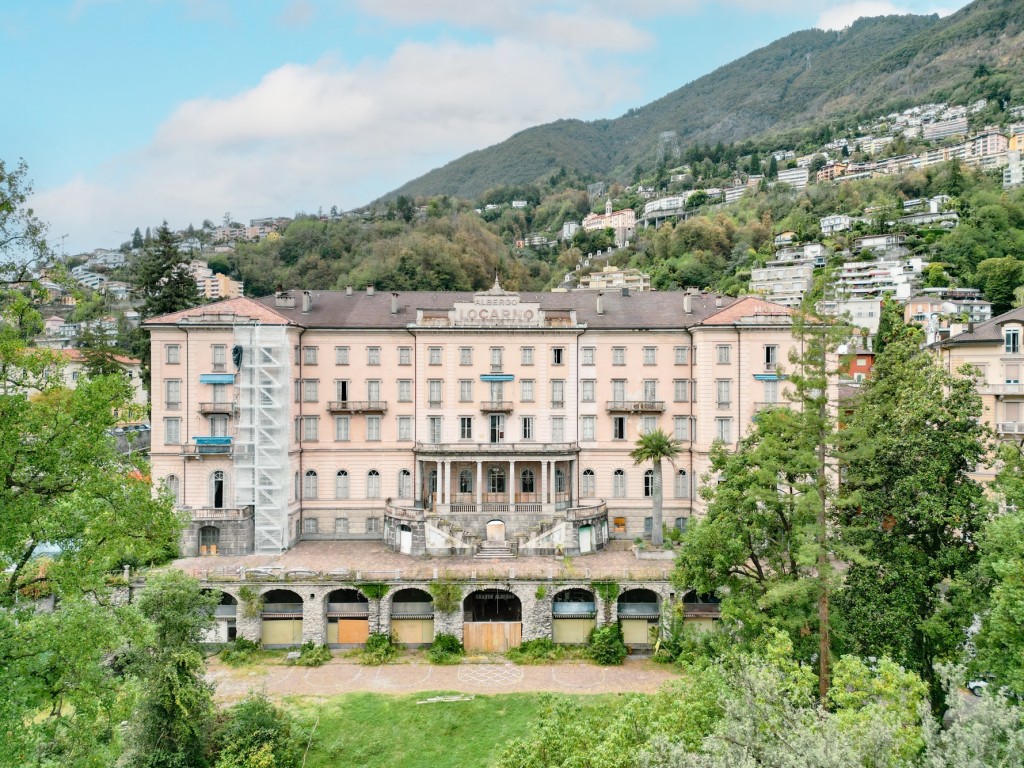
Muralto, Lake Maggiore. Closed since the end of 2005, acquired in 2022 for approximately CHF 23 million, undergoing a redevelopment program that could bring the total investment close to CHF 80 million, leased to Arabella Hospitality SE under Marriott’s The Luxury Collection brand, and scheduled to reopen in spring 2027.
Grand Hotel Locarno is not simply the restoration of a historic hotel.
It is a case study in how value can be created by acquiring an asset that the market can no longer price as an operating hotel and has started valuing almost exclusively as real estate or land.
More importantly, it shows who really captures the upside when a dormant hotel is brought back to life.
The most common interpretation of the transaction gets one crucial element wrong: it assumes that the arrival of an international hotel brand unlocked the project.
The timeline tells a different story.
Marriott came later.
The real risk — acquisition, permitting, heritage constraints, design development and construction — had already been taken by someone else.
And that is where the value was created.
1. Grand Hotel Locarno: twenty years of deadlock around an irreplaceable asset
Grand Hotel Locarno is a protected cultural property of cantonal significance.
Designed by Francesco Galli and built between 1874 and 1876, it was Ticino’s first luxury hotel. It hosted events that became part of European history, including the 1925 Locarno Conference, and in 1946 it was one of the places associated with the birth of the Locarno International Film Festival.
The property extends over almost 10,000 square meters in a location that would be virtually impossible to replicate today, between the railway station and Piazza Grande.
And yet the hotel closed at the end of 2005.
From that point onward, the story followed a pattern that anyone working with dormant hotels, protected buildings and complex hospitality transactions will recognize immediately.
In 2001, a proposed casino redevelopment fell through when, during the renewal of federal gaming concessions, the Grand Casino selected the Kursaal in Locarno instead.
In 2012-2013, HRS entered into a purchase option that was ultimately not exercised.
Meanwhile, ownership remained divided among several families, while the property continued to generate costs without producing income: interest expense, maintenance, security, insurance and basic utility charges.
The building deteriorated.
The market watched.
But no one closed a deal.
Price alone does not explain almost twenty years of inactivity.
The real issue was uncertainty.
How much could be demolished?
What had to be preserved?
How many rooms could actually be created?
Which uses would the authorities approve?
How much capital would the redevelopment really require?
Which operator would ultimately be willing to take the hotel?
And above all: what is a property worth today if no one yet knows what kind of business it will be allowed to generate tomorrow?
This is the same issue that repeatedly emerges in hospitality advisory and complex asset repositioning assignments.
A hotel can remain unsold for years not because the market fails to recognize the value of the location, but because no one has yet converted technical and regulatory uncertainty into an investment case that can actually be underwritten.
2. The timeline that changes the interpretation of the deal
To understand where the value was created, the sequence matters.
| Date | Event |
|---|---|
| End of 2005 | Hotel closes |
| October 2021 | Artisa Group / Stefano Artioli signs the purchase option |
| March 2022 | Option exercised and acquisition completed. Building application submitted |
| December 2022 | Building permit granted |
| August 2024 | Construction officially begins |
| December 13, 2024 | Lease agreement signed with Arabella Hospitality SE |
| May 18, 2026 | Marco Montagnani appointed general manager, effective June 1 |
| Spring 2027 | Planned reopening as a five-star hotel with 110 rooms and suites |
The sequence is decisive.
The property was acquired before the final building permit had been obtained.
The permit came roughly nine months later.
Construction started in August 2024.
Only four months after that was the lease agreement with Arabella Hospitality SE signed.
Marriott’s The Luxury Collection therefore entered the picture only after a substantial share of the development risk had already been assumed.
That changes the entire interpretation of the transaction.
3. Marriott did not unlock the deal. It validated it
Artioli acquired the property without an operator, without an international brand and without a final building permit.
That is the central point.
The transaction did not happen because a major hotel group guaranteed the project in advance.
It happened because an investor was willing to take on a level of risk that others had not been prepared to accept.
The acquisition price was reported at around CHF 23 million.
On top of that came a projected capex of approximately CHF 50-60 million, bringing the overall scale of the investment close to CHF 80 million.
The buyer therefore acquired a property that, after twenty years of inactivity, the market was increasingly valuing on the basis of its real estate and land characteristics rather than its hotel operating potential.
Then the buyer progressively created the answer:
design → approvals → capex → construction → operator → brand.
Not the other way around.
And this is the most important lesson for hotel investors.
The brand does not rescue the deal. It validates the deal once the project has already become credible.
Marriott did not create the building permit.
It did not bear the initial risk of buying a protected property without certainty over the final outcome.
And it did not, by itself, transform a closed hotel into an investable project.
It entered once that transformation was already underway.
Anyone structuring hotel acquisitions and disposals knows that sequence also determines who captures the margin.
The investor who enters before uncertainty has been resolved is also buying the risk.
But if that investor successfully resolves it, the same risk can become a source of value creation.
The investor who enters later, by contrast, buys an asset that is easier to understand, easier to finance and closer to generating income.
4. In dormant hotels, extraordinary returns are often created before reopening
This principle extends well beyond Grand Hotel Locarno.
In dormant hotel assets, exceptional returns rarely come from the future operating statement alone.
They come from the ability to:
buy a problem the market cannot properly value, transform it into a permitted, financeable and operable project, and move the asset into a lower-risk phase.
That is where the real revaluation occurs.
A closed, protected building with an uncertain future use is valued with a substantial discount for uncertainty.
A property with:
-
an approved development plan;
-
a defined design;
-
a verifiable capex;
-
a construction schedule;
-
an operator;
-
a contract;
-
an international brand;
is a fundamentally different investment product.
Even if physically it is still the same building.
The value is therefore created before the first room is sold.
5. Where a meaningful share of the margin may really sit: “La Residenza”
There is another particularly interesting element.
Alongside the hotel, Artisa has also developed a residential project known as La Residenza.
This deserves attention because investors frequently make the same mistake when evaluating historic hotels: they analyze the transaction exclusively through the future hotel operating statement.
RevPAR.
GOP.
Rent.
Yield.
But the real investment perimeter can be much broader.
In complex real estate developments, a luxury hotel can also act as a value generator for the entire surrounding environment.
The hotel upgrades the location.
The brand strengthens its positioning.
The redevelopment reduces perceived risk.
Adjacent real estate can then monetize that transformation through completely different return profiles and investment horizons.
Put simply:
the hotel creates the destination; the residential component can monetize part of the value created by that destination.
For this reason, the economics of the transaction should not be assessed exclusively through the future profitability of the hotel OpCo.
The analysis must cover the entire real estate development.
Residual development rights.
Annex buildings.
Alternative uses.
Residential.
Commercial areas.
Land value.
Exit value.
That is the type of analysis that should precede any investment decision involving a large dormant hotel asset.
6. PropCo and OpCo: why the lease structure matters
The transaction structure is equally interesting.
PropCo
The real estate is owned by GHL SA, within the Art Family Office SA structure controlled by the Artioli family.
Development
The development is being carried out by Artisa Group, led by Alain Artioli.
The architectural project is by Ivano Gianola.
Operator
The tenant and hotel operator will be Arabella Hospitality SE, a German hospitality group active in the upscale and luxury segments and already present in Switzerland.
Brand
The hotel will operate under Marriott’s The Luxury Collection.
From an investment perspective, the most important feature is the choice of a hotel lease rather than a management contract.
The distinction is not semantic.
It materially changes the allocation of risk.
Under a management agreement, the owner typically retains a significant share of the hotel’s economic risk while compensating the operator through management fees and incentive fees.
Under a lease, by contrast, a substantial share of operating risk is transferred to the tenant, while the owner receives rental income according to the agreed contractual structure.
For a family office with a predominantly real estate-driven investment model, that is a coherent choice.
Owning hotels does not mean having to become a hotel operator.
And a real estate investor without an established hospitality operating platform will not necessarily create more value by retaining in-house functions that a specialist operator can perform better.
The choice between a lease, management agreement, franchise and direct operation is therefore one of the central issues in hotel operating agreement negotiations.
There is no universally superior structure.
There is only the structure that best fits the owner’s:
capital base, capabilities, risk appetite, investment horizon and exit strategy.
7. The end product: fewer rooms, higher value per key
Once operational, Grand Hotel Locarno is expected to offer:
-
110 rooms and suites;
-
a spa and wellness area partly developed within the historic grotto spaces;
-
indoor and outdoor swimming pools;
-
Mediterranean and Asian dining concepts;
-
a lobby bar featuring a restored frescoed ceiling;
-
approximately 787 square meters of event space;
-
a park of approximately 4,000 square meters.
The original redevelopment plan included more rooms.
The reduction to 110 illustrates one of the recurring challenges of historic hotel redevelopment.
In a protected building, the design cannot be driven exclusively by maximizing key count.
Stucco.
Frescoes.
Existing geometry.
Staircases.
Ceiling heights.
Structural walls.
Heritage restrictions.
All of these factors reduce theoretical efficiency.
But fewer rooms do not necessarily mean lower value.
In luxury hospitality, the objective is not simply to maximize the number of keys.
It is to maximize:
average daily rate, product quality, guest experience, ancillary space, positioning and real estate value per key.
8. Switzerland has not simply lost hotels. It has concentrated capacity
The Swiss market provides useful context for understanding why transactions of this kind are becoming increasingly important.
Over the past several decades, the number of hospitality businesses has declined, while overall accommodation capacity has not followed the same downward trajectory.
The statistics need to be handled carefully, because different sources and classifications do not always use terms such as Hotelbetriebe and Beherbergungsbetriebe consistently.
The economic direction, however, is clear.
Fewer businesses, larger average properties, and greater concentration of capital and room supply.
This is not simply hotel mortality.
It is consolidation.
The properties that tend to disappear are those that are:
-
undercapitalized;
-
subscale;
-
without succession;
-
unable to sustain major capex programs;
-
lacking the management structure required to compete internationally.
They are replaced or absorbed by better-capitalized groups, investors and operators.
Italy is increasingly moving in the same direction.
And that is one reason why, over the next several years, it may be strategically more profitable to position oneself on the side of the consolidator rather than the consolidated.
9. What the Grand Hotel Locarno case teaches the Italian market
Italy has one of Europe’s most compelling inventories of historic hotel properties that are underutilized, financially distressed or completely closed.
Historic thermal hotels.
Belle Époque properties along the coast.
Hotels in mature resort destinations.
Former convents and religious properties suitable for hospitality conversion.
Protected buildings in historic city centers.
Assets trapped in insolvency proceedings.
Hotels stalled by family succession disputes.
The pattern is remarkably consistent:
prime location + complex property + heritage constraints + weak or fragmented ownership + substantial capex + uncertainty over future use.
The result is often paradoxical.
Everyone recognizes the quality of the asset.
Nobody buys it.
Grand Hotel Locarno offers at least four operational lessons.
1. Price is rarely the only problem. Uncertainty is
An asset may look overpriced simply because it cannot be properly underwritten.
Preliminary discussions with planning and heritage authorities.
Urban planning due diligence.
Heritage review.
Feasibility studies.
Room mix analysis.
Preliminary capex.
Operator assessment.
These activities can increase the likelihood of a successful transaction far more than another price reduction.
2. The investor who assumes permitting risk can capture the upside
If the investor enters only after approvals, design and operator selection have already been completed, that investor is buying a partially de-risked asset.
The Locarno model follows a different sequence:
acquire the risk → resolve it → contractualize the project → reduce the risk → create value.
Of course, this model requires capital, expertise and the ability to sustain long development periods.
But that is precisely why the potential return is different.
3. A brand does not create feasibility
An international hotel flag can improve:
-
credibility;
-
distribution;
-
access to international demand;
-
positioning;
-
financing prospects;
-
exit value.
But no logo can make a fundamentally flawed project viable.
First come:
the property, approvals, product, capex and capital structure.
The brand then amplifies the value that has already been created.
4. Valuation must include the entire real estate perimeter
A historic hotel should never be analyzed solely through its GOP.
The analysis should also consider:
-
residual floor area;
-
separate buildings;
-
development rights;
-
residential potential;
-
commercial space;
-
parking;
-
alternative uses;
-
divisibility;
-
the value created by the redevelopment of the surrounding area.
In some transactions, the hotel generates the recurring operating income.
In others, it is the catalyst that makes the wider development economically viable.
10. So who really makes the money?
The answer is more nuanced than it first appears.
The operator can benefit if it succeeds in building a profitable operating model consistent with the hotel’s luxury positioning.
Marriott benefits by expanding its distribution footprint in the high-end segment.
The destination benefits by bringing a landmark property back to life after twenty years.
But the most interesting share of potential value was created earlier.
By the party willing to acquire an asset the market considered too complex.
By the investor willing to commit capital before the hotel generated a single euro of revenue.
By the team capable of transforming heritage constraints, permitting risk and development complexity into an asset that the market could finally understand and underwrite.
That is the real lesson of Grand Hotel Locarno.
In hotel investment, the most attractive margin is often not in buying what already works. It is in making investable what everyone else still struggles to understand.
And this is likely to become an increasingly important part of the Italian hospitality investment market in the years ahead.
Contact
We advise on hotel acquisitions, disposals, repositioning strategies, debt restructuring and the negotiation of hotel management and lease agreements, working on both single assets and portfolios, including dormant, protected and distressed properties.
Additional research and market analysis are available through Investimenti Alberghieri, InvestHotel, Hotel Marketing Lab, Necci Hotels, Vertex Executive Search, Roberto Necci Academy and Hotel Management Group.
If you own a closed, underperforming, protected or apparently unsellable hotel, the right time to understand its value is not when a buyer arrives. It is before.
For a confidential asset review, transaction structure assessment or investment opportunity analysis:
Sources: Swiss Federal Statistical Office – HESTA, Arabella Hospitality SE, Artisa Group, Corriere del Ticino, laRegione, Ticinonews, RSI, Hotel Inside. Analysis by the editorial team of Investimenti Alberghieri.