From a 1930s seaside colony to a public healthcare property and, later, decades of progressive abandonment. Today, the former Santa Severa Colony is at the centre of a hospitality redevelopment project envisaging approximately 60 rooms, restaurant facilities, a swimming pool and a spa, with preliminary investment exceeding €12 million. It is a compelling case study in how the value of a hotel asset is determined not simply by the property itself, but by the ability to build a sustainable economic model around it.
In Santa Severa, along one of the most distinctive stretches of coastline north of Rome, stands a property whose history mirrors almost a century of evolution in Italy’s public real estate.
It is the former Santa Severa Seaside Colony, also known as the “Principi di Piemonte” Colony: a substantial waterfront complex originally developed for social and welfare purposes, subsequently incorporated into Italy’s public healthcare estate and eventually left unused for many years.
Today, the asset may be entering a new chapter in its history: its conversion into a tourism and hospitality property.
For InvestimentiAlberghieri.it, however, the significance of the project extends well beyond architectural restoration.
Santa Severa represents a tangible example of how a non-performing public property can potentially be repositioned as a hospitality asset, provided that use, CAPEX, concession duration, market positioning and operational strategy are economically aligned.
A Property Designed for Hospitality Almost a Century Ago
The complex was designed in the early 1930s by architects Luigi and Gaspare Lenzi and inaugurated in 1934.
Its original purpose reflected the traditional role of Italy’s seaside colonies of the period: accommodating children and young people as part of social welfare, health and educational programmes.
It was therefore not a hotel in the modern sense.
From a real estate perspective, however, the building presents a particularly interesting characteristic: it was originally conceived for collective accommodation.
The complex included several components:
-
the main building;
-
a gymnasium;
-
guest accommodation;
-
caretaker’s quarters;
-
communal areas;
-
kitchens;
-
dining facilities;
-
dormitories.
One of the main wings was largely dedicated to children’s accommodation, while another housed the kitchen and dining areas.
This distinction is far from academic.
When assessing a conversion project through Investhotel Capital Partners, one of the first questions concerns the compatibility of the existing property with the proposed hospitality model.
Many historic buildings possess considerable architectural appeal but have layouts that are extremely difficult to reconcile with contemporary hotel requirements.
In the case of the former Santa Severa Colony, however, the proposed hotel use could be seen, at least conceptually, as an evolution of the building’s original accommodation function.
From Social Infrastructure to Public Healthcare Real Estate
The ownership history of the property is closely linked to the development of Italy’s public healthcare system.
The complex originally belonged to the Pio Istituto Santo Spirito – Ospedali Riuniti di Roma.
Following the establishment of Italy’s National Health Service, ownership and responsibility subsequently passed through the USL and ASL healthcare structures before the asset was eventually transferred to the Lazio Region.
The Region formally took control of the property in 2011, by which time the complex had already fallen into substantial disuse.
This is where one of the recurring dynamics of public-sector real estate becomes particularly evident.
An asset may simultaneously retain:
-
real estate value;
-
historic value;
-
landscape value;
-
symbolic value;
while producing virtually no current economic value.
Indeed, where security, maintenance and deterioration continue to generate costs without corresponding income, a property can progressively shift from being an asset to becoming an economic liability.
The 1989 Restoration Did Not Solve the Fundamental Issue: Use
In 1989, the main building underwent a significant restoration programme.
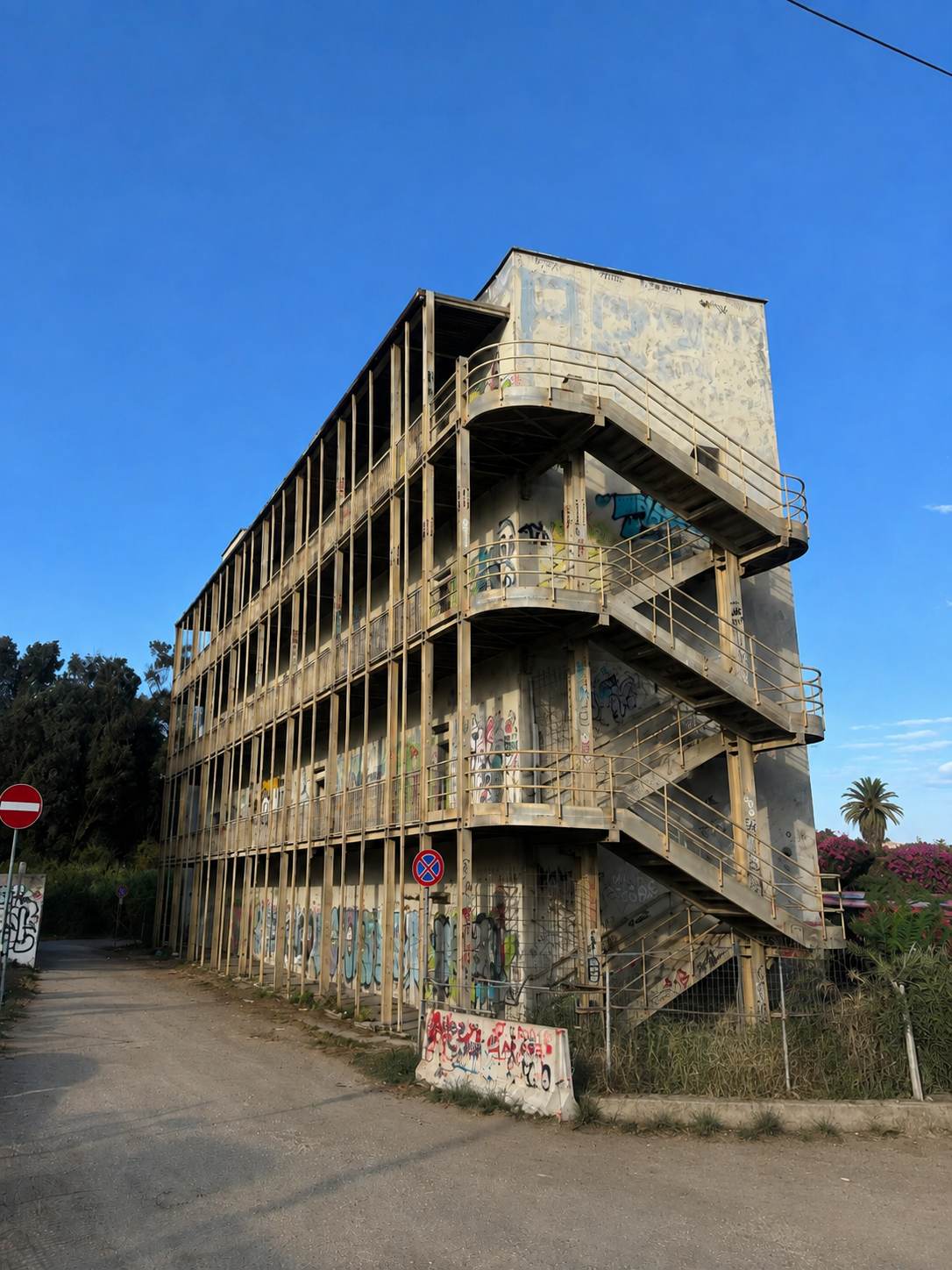
A number of openings were modified, parts of the building were redesigned, and the external metal staircase and walkways that remain clearly visible today were installed.
Yet the physical restoration failed to establish a stable new economic function for the property.
This is one of the most important lessons to emerge from the entire case.
Restoring a building is not the same as creating value.
Value creation begins only when physical regeneration is matched by a use capable of generating economic returns, public utility, or both.
The same principle applies not only to public assets but also to many real estate and hospitality investments discussed in the research and professional guides published on RobertoNecci.it.
An investment may be technically impeccable and still be economically unsustainable.
A Protected Historic Asset: CAPEX Cannot Be Benchmarked Against an Ordinary Hotel Development
In 2017, the complex was formally recognised as a property of cultural significance.
The protection applies to the building and the broader estate, directly affecting the parameters within which any future redevelopment can take place.
An investor is therefore not dealing with a conventional hotel development.
The project must address, simultaneously:
-
historic and architectural constraints;
-
permitting and approvals;
-
landscape protection requirements;
-
structural upgrades;
-
restoration of the existing buildings;
-
contemporary hotel standards;
-
accessibility;
-
building services and MEP systems;
-
safety requirements;
-
energy efficiency;
-
long-term maintenance.
There is also one particularly important factor: the asset’s immediate proximity to the sea.
Its coastal position is naturally one of the property’s strongest commercial advantages, but it also increases the environmental exposure of structures, equipment and materials.
It is a perfect example of a recurring hospitality investment paradox: the characteristic that enhances commercial value can simultaneously increase capital expenditure and long-term maintenance costs.
2019: Hospitality Becomes the Strategic End Use
A decisive turning point came in 2019, when the Lazio Region and the Municipality of Santa Marinella explicitly identified tourism and hotel use as a potential strategy for the complex.
The objective became the conversion of the former Colony into an accommodation property capable of preserving its historic significance while establishing a financially sustainable operating business.
In 2022, an initial public-private partnership procedure was launched.
The outcome was particularly revealing:
No proposals were submitted.
This deserves attention.
It demonstrates that:
A historic waterfront property does not automatically represent an attractive investment opportunity.
A prestigious location cannot indefinitely compensate for:
-
high capital expenditure;
-
heritage restrictions;
-
planning and permitting risk;
-
development timelines;
-
seasonality;
-
cost of capital.
Private capital enters when the relationship between risk and return becomes sufficiently transparent and attractive.
The Revised Concept: Approximately 60 Rooms, Restaurant, Spa and Swimming Pool
The project subsequently developed by the public authorities materially changed the economics of the proposed redevelopment.
The new concept envisages the restoration of the existing buildings together with the possibility of developing additional floor area required to support the financial sustainability of the project.
The indicative scheme includes:
Approximately 30 rooms within the historic building
The main building would accommodate a significant proportion of the guest rooms together with restaurant facilities.
Approximately 30 additional rooms
Further accommodation could be provided within new buildings designed to remain compatible with the surrounding context.
Overall room capacity would therefore reach approximately:
60 keys
Complementary facilities would include:
-
restaurant;
-
outdoor swimming pool;
-
spa;
-
wellness facilities;
-
communal areas;
-
event and conference spaces;
-
ancillary services.
This is precisely where the economics of the project become easier to understand.
With significant CAPEX and only around 60 rooms, the investment cannot be supported by room revenue alone.
More Than €12 Million of Investment: CAPEX per Key Becomes a Critical Metric
The preliminary economic feasibility assessment envisages total investment of approximately:
€12.82 million + VAT
The indicative breakdown is as follows:
| Investment Area | Estimated Investment |
|---|---|
| Restoration of the historic building | €6.00m |
| Additional development | €3.00m |
| Spa and swimming pool | €1.40m |
| Infrastructure and ancillary structures | €0.50m |
| Furniture and FF&E | €0.80m |
| Professional and technical fees | €0.87m |
| Proposal preparation costs | €0.25m |
| Total | €12.82m + VAT |
These figures are, of course, preliminary and should not be interpreted as the final development cost.
They nevertheless allow an initial investment assessment.
With approximately 60 rooms, the proposed investment equates to more than:
€210,000 per key
before taking into account potential project variations, contingencies, financing costs or possible construction-cost inflation.
CAPEX per key, considered in isolation, cannot determine whether the project is viable.
It does, however, force investors to assess whether the future hotel can generate ADR and EBITDA levels capable of supporting the capital committed.
The Real Business Model Cannot Depend on Rooms Alone
The preliminary financial assumptions are based on approximately 60 rooms and average occupancy of around 58%.
Indicative room rates are in the region of:
-
approximately €161 for double rooms;
-
approximately €214 for triple rooms.
On those assumptions, the hotel component could generate approximately:
€2.23 million in annual accommodation revenue.
Additional revenue streams have been estimated at approximately:
-
€340,000 from the spa;
-
€120,000 from events, meetings and ancillary services.
Total operating revenue could therefore reach approximately:
€2.69 million per year
This is the strategic heart of the project.
Santa Severa cannot be analysed simply as:
60 rooms × ADR × occupancy.
The future property will need to operate according to a Total Revenue Management model.
Rooms, food and beverage, wellness, events, potential seaside-related services and other revenue streams must collectively contribute to the profitability of the asset.
This is consistent with the approach adopted by Hotel Management Group in hotel operations, performance management and asset management: performance is not determined by a single KPI, but by the overall balance between revenue generation, cost control and the productivity of every square metre.
The Principal Operating Risk: Seasonality
The second major challenge is seasonality.
Santa Severa enjoys an obvious competitive advantage during the summer months.
The economic question is what happens during the rest of the year.
To support an investment exceeding €12 million, the hotel will probably need to generate demand extending well beyond traditional seaside tourism.
There are at least four potential demand drivers.
Wellness
The spa could become an important instrument for extending the operating season beyond the summer months.
Events
Weddings, private functions and corporate events could increase utilisation of the property and improve Total Revenue.
Food & Beverage
A restaurant capable of attracting external guests, rather than relying exclusively on hotel residents, could reduce dependence on room occupancy.
Heritage
The history of the property and its proximity to the Castle of Santa Severa could help create a product with a distinctive and defensible sense of place.
The strategic question therefore becomes:
Can Santa Severa become not simply a hotel by the sea, but a destination in its own right?
A substantial part of the future value creation will depend on the answer.
The Preliminary Financial Model: Attractive Returns, but Limited Room for Execution Error
The preliminary financial structure assumes a very long operating period, necessary to allow the investment to be amortised over time.
The model considers approximately 42 years overall, including the construction period and around 40 years of hotel operations.
Indicative financial metrics include:
Project IRR: 7.0%
Equity IRR: 9.2%
Average DSCR: 1.30x
These numbers require careful interpretation.
A DSCR of approximately 1.30x may provide adequate debt-service coverage, but it does not create unlimited capacity to absorb development or operating underperformance.
A material increase in CAPEX, ADR below expectations, more severe seasonality or higher-than-forecast operating costs could significantly compress investor returns.
The real challenge will therefore be to build sufficient resilience into the underlying business model.
In 2025, the Market Responds
The revised structure generated a very different response from the earlier unsuccessful procedure.
By the deadline, four proposals had been submitted.
In June 2026, the Lazio Region identified the proposal submitted by P&G as the one considered most closely aligned with the public interest, opening the way for the next stage of design development and authorisation.
It is important, however, to distinguish this phase from a final award.
The project must still pass through further technical, administrative and approval stages before its final configuration can be considered established.
Four Lives of the Same Property
The history of the former Santa Severa Colony can effectively be divided into four distinct phases.
1. Social infrastructure
The property was created to deliver social value through collective accommodation.
2. Public healthcare real estate
It became part of Italy’s healthcare and public administration property system.
3. Non-performing asset
It lost its stable function and progressively deteriorated.
4. Potential hospitality asset
The current strategy seeks to create a new economic function through tourism and hotel operations.
This is arguably the most interesting element of the entire case.
The very same building can have radically different values depending on the use that can realistically and sustainably be established within it.
What Is the Former Santa Severa Colony Really Worth?
That is the question an investor might initially ask.
But it is also the wrong question if asked in isolation.
The more relevant question is:
What is the former Santa Severa Colony worth once CAPEX, room inventory, development timelines, operating model, ADR, occupancy, EBITDA, concession duration and cost of capital have all been defined?
Until these variables are known, attempting to value the property exclusively through conventional real estate comparables would be highly reductive.
This is one of the principles repeatedly explored in the hospitality analysis and professional guides available on RobertoNecci.it: a hotel is not worth simply what its square metres are worth; its value is fundamentally linked to the cash flows those square metres can generate.
In a concession structure, this principle becomes even more important.
The investor is not simply purchasing a building.
The investor is acquiring an economic right to operate the property for a defined period and, within that timeframe, must recover:
-
investment capital;
-
financing costs;
-
equity;
-
an appropriate return for risk.
The Value Is Not in the Derelict Building. It Is in the Transformation
Viewed from the outside today, the former Colony may appear to be little more than a large, deteriorating waterfront property.
But that is only its physical condition.
Economically, it could become something entirely different:
60 rooms + restaurant + spa + swimming pool + events + heritage + waterfront location.
Between those two realities stand:
more than €12 million of CAPEX,
years of design development,
planning and permitting risk,
operating risk,
cost of capital,
seasonality,
and hotel management.
It is precisely within this gap that value is either created or destroyed.
The transactions and redevelopment opportunities examined by InvestimentiAlberghieri.it repeatedly demonstrate how often real estate potential is confused with the economic value of an investment.
They are not the same thing.
The former describes what a property might become.
The latter determines whether transforming it actually makes financial sense.
Santa Severa as a Case Study in Public-Sector Hospitality Redevelopment
The former Colony therefore represents much more than a restoration project.
It is a case study in how underutilised public real estate can potentially be transformed into tourism infrastructure.
For the project to succeed, at least five conditions will have to be met simultaneously.
1. CAPEX must remain under control
Heritage requirements cannot be allowed to produce uncontrolled increases in total development cost.
2. The positioning must justify the investment
CAPEX exceeding €200,000 per key requires a hotel capable of sustaining appropriate pricing.
3. Seasonality must be reduced
The business cannot depend exclusively on the summer season.
4. Ancillary revenues must be meaningful
The spa, restaurant and events business must operate as genuine profit centres rather than merely supporting amenities.
5. Hotel management must be of a high standard
Potential real estate value must ultimately be converted into EBITDA.
This is where real estate and hotel operations become inseparable.
Transactions of this nature require an integrated combination of valuation, advisory and deal structuring expertise, such as the capabilities developed through Investhotel Capital Partners, together with operational and hotel management expertise such as that provided by Hotel Management Group.
Conclusion
The former Santa Severa Colony was created almost a century ago to accommodate people.
After serving as a seaside colony, becoming part of the public healthcare estate and eventually turning into an underutilised public asset, it may now paradoxically return to its original underlying vocation:
hospitality.
This time, however, through an entirely different commercial model.
The real challenge will not simply be to restore the building.
It will be to transform more than €12 million of capital investment into a hotel business capable of generating sustainable returns over several decades.
Because a historic property, even in an exceptional waterfront location, is not automatically an investment.
It becomes an investment only when the property, the development concept, the market, the capital structure and the operating platform combine to generate a sustainable return.
That is the difference between restoring a building and creating a hospitality asset.
Hospitality Investments, Redevelopment and Asset Repositioning
For feasibility studies, hotel valuations, conversions, concessions, business lease transactions and the structuring of hospitality investment opportunities:
info@investimentialberghieri.it
Hospitality investment analysis and opportunities: InvestimentiAlberghieri.it
Advisory and hotel transactions: Investhotel Capital Partners
Hospitality research and professional guides: RobertoNecci.it
Hotel management and asset management: Hotel Management Group