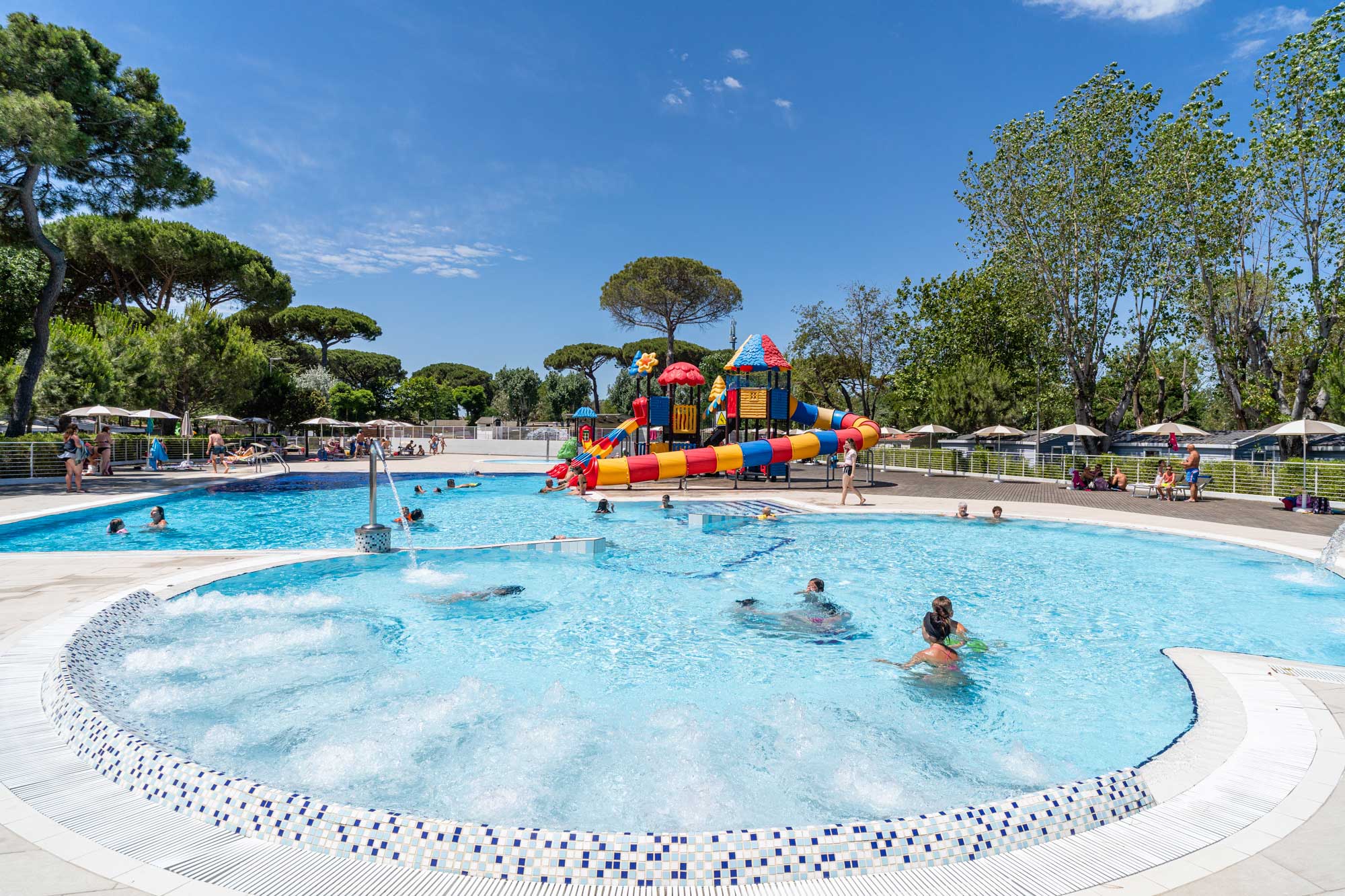
Five four-star holiday villages in Emilia-Romagna, more than 2,800 accommodation units, a 20-year firm lease and institutional capital moving into the real estate while the operator retains full control of the business. The transaction price has not been disclosed. But in this case, the most important figure is not how much was paid. It is how the deal was structured.
By selling the real estate component of five holiday villages to Swiss Life Asset Managers France while retaining operations under a long-term operating leaseback, Club del Sole has introduced into the Italian open-air hospitality market a structure that has already transformed the relationship between ownership, capital and operations in the hotel industry.
Club del Sole described the transaction as the first of its kind in the Italian open-air tourism sector. Communications from the seller refer to five villages and more than 2,800 accommodation units, while Edmond de Rothschild Corporate Finance, adviser to the buyer, refers to approximately 3,000 units and a firm 20-year lease, renewable for a further six years.
The purchase price has not been disclosed.
The structure follows the classic PropCo/OpCo model:
institutional capital owns the real estate;
the operator retains the business;
the lease connects property returns with operating performance.
This is not simply a transaction.
It is a precedent.
And for many Italian owners of holiday villages, camping resorts and open-air hospitality assets, it may become a more important model to study than the price Swiss Life actually paid.
the transaction
In March 2026, Club del Sole completed the sale of the real estate component of five assets in Emilia-Romagna to Swiss Life Asset Managers France.
Club del Sole will continue to operate the properties in full.
The portfolio consists of four-star holiday villages located directly on the coast or in its immediate vicinity, in areas where the scarcity of available coastal land represents a physical barrier to replication.
That point matters.
A resort can be refurbished.
A brand can be replaced.
An operator can be changed.
A seafront location cannot be recreated.
When an institutional investor acquires assets of this kind, it is therefore buying not only real estate, but scarcity.
The calibre of the advisers involved also confirms the institutional nature of the transaction.
Swiss Life Asset Managers France was advised by Clearwater and Edmond de Rothschild Corporate Finance on the financial side, alongside First Growth, Clifford Chance and Gleeds.
Club del Sole was advised by Mediobanca, Pedersoli Gattai, Ryze, Studio Scala-Giondi and Studio Notarile Marchetti.
But the advisers are not the point.
The structure is.
a 20-year firm lease does not automatically mean a fixed rent
There is an important distinction to make.
The available public information refers to a 20-year firm lease, renewable for a further six years.
That describes the contractual commitment period.
It does not necessarily mean that the nominal rent remains unchanged for 20 years.
The full rent structure — including indexation mechanisms, step-ups, caps, floors, variable components or other economic adjustments — has not been publicly disclosed.
This is precisely where an investment analysis must move beyond the press release.
To assess a sale-and-leaseback properly, it is not enough to know:
term + price.
You need to know:
price + rent + indexation + covenants + capex + guarantees + the tenant’s capacity to service the lease.
Without those elements, you are not calculating an investment return.
You are building an assumption.
why this transaction matters more for the market than for Club del Sole
For decades, the dominant model in Italian open-air hospitality was essentially indivisible.
The family owned the land.
It developed the holiday village.
It operated the business.
It reinvested the profits.
And it regarded the real estate and the operating company as a single asset.
That overlap had one major consequence: there was no genuine institutional market for the real estate component alone.
The two sides required to create such a market were largely missing.
On one side, investors willing to own the real estate without operating the business.
On the other, operators sufficiently structured and credible to act as independent tenants rather than owner-managers.
The Club del Sole–Swiss Life transaction breaks that model.
The structure becomes clear:
PropCo: owns the assets.
OpCo: generates the operating result.
Lease: determines how part of the value generated by the business remunerates the real estate capital.
The hotel industry has already gone through this transformation through real estate funds, leases, management agreements, international operators and the progressive separation of ownership and operations.
At InvestimentiAlberghieri.it, we have long analysed precisely this dynamic and, in particular, how the separation between PropCo and OpCo can change the risk, return and structure of a hospitality investment.
Italy’s open-air hospitality market now appears to be entering the same phase.
this is no longer a niche market
That is another reason why institutional capital entering the sector deserves attention.
According to data presented at the 2025 Forum Open Air by FAITA Federcamping, HBenchmark and CISET Ca’ Foscari, the sector recorded approximately 74 million overnight stays in 2025, up from 73 million in the previous year, while average occupancy increased by 3.3%.
Total direct and indirect economic output was estimated at around €8.5 billion.
Italy has approximately 2,600 open-air hospitality properties, more than 100,000 employees and total daily capacity of around 1.3 million bed spaces.
There is another figure that is particularly relevant from an investor’s perspective.
Within the sample analysed by FAITA and HBenchmark, mobile homes represented approximately 29% of units sold but generated 51% of revenue.
This tells us that the transformation of open-air hospitality is not simply about increasing demand.
It is about product evolution.
From camping to hospitality asset.
From pitch to accommodation unit.
From family-owned property to potentially investable platform.
And this is precisely the point at which institutional capital typically begins to pay attention to a sector.
what Swiss Life is really buying
Without knowing the purchase price and the full economics of the lease, it is impossible to calculate a meaningful cap rate.
But it is still possible to identify what is being acquired economically.
Not simply five properties.
Swiss Life is acquiring:
-
hospitality assets that are difficult to replicate;
-
coastal locations;
-
a very long contractual relationship;
-
an established institutional-scale operator;
-
exposure to a growing and increasingly professional open-air hospitality segment;
-
a real estate underlying asset that is distinct from pure operating risk.
Swiss Life Asset Managers has also stated that it has been actively developing its exposure to outdoor hospitality since 2018 and identifies scarce locations and the structural growth of the sector among the reasons for its interest in the asset class.
This leads to a central point.
In a sale-and-leaseback, the value of the real estate cannot be separated from the quality of the lease that supports it.
A property backed by a weak lease does not become safe simply because the tenant has signed for 20 years.
And an excellent lease attached to an illiquid or weak real estate asset does not automatically become an institutional investment.
Real estate value and operating value must be analysed together.
It is the same principle explored in our analysis of what a hotel is really worth and why asking price and economic value rarely coincide.
the four numbers that matter more than the headline price
To understand a sale-and-operating-leaseback transaction properly, at least four elements need to be known.
1. rent cover
This is probably the most important metric.
How much EBITDA does the operating business generate relative to the rent payable to the property owner?
Rent cover measures the operator’s ability to service the lease not only during strong trading years, but also through weaker phases of the cycle.
An aggressive rent can increase the apparent value of the property at closing.
But it can simultaneously weaken the OpCo.
And once the tenant becomes financially fragile, the value of both the lease and the property changes.
A 20-year lease with an operator under structural financial pressure is not necessarily a secure real estate investment.
It may simply be tomorrow’s restructuring embedded in today’s valuation.
2. indexation
Over a 20-year horizon, indexation is value.
Inflation, caps and floors, review frequency and adjustment mechanisms determine how macroeconomic risk is shared between landlord and operator.
A seemingly minor difference in annual rent growth can have a very significant cumulative impact over two decades.
This is why a “firm lease” and a “fixed rent” are not the same thing.
3. capex
In open-air hospitality, this issue is particularly important.
A substantial part of the guest product may consist of mobile homes, lodges, pools, restaurants, common areas and infrastructure with replacement cycles very different from those of a traditional hotel building.
The question therefore becomes unavoidable:
who funds the renewal of the product over the next 20 years?
The PropCo?
The OpCo?
Both?
Under what limits and according to which standards?
The answer can materially change the net return for both sides.
A lease that appears perfectly sustainable on paper may become onerous if capex obligations transferred to the operator are inconsistent with the available operating margin.
4. covenant strength
The fourth element is the quality of the tenant.
Balance sheet.
Equity.
Track record.
Scale.
Diversification.
Cash generation.
Guarantees.
In a lease-backed investment, the landlord is not simply buying a property.
It is also buying someone else’s future ability to pay the rent.
That is why tenant strength and contractual structure directly influence asset value.
The same principle applies to hotel management structures, as discussed in our guide to hotel management agreements and the clauses that can create or destroy value.
the real precedent concerns family owners
This is where the Club del Sole–Swiss Life transaction stops being a piece of financial news and becomes a model.
A large proportion of Italian open-air hospitality assets are still owned by families in which three things overlap:
real estate wealth, operating business and family wealth.
Many of these families now face the same combination:
valuable real estate;
a profitable operating business;
significant reinvestment requirements;
capital locked into property;
and a generational transition that is not always straightforward.
Historically, the choice was often binary:
sell everything or sell nothing.
Sale-and-leaseback introduces a third option:
monetise the real estate while retaining the business
That is a major shift in perspective.
A family can theoretically crystallise part of the property value accumulated over decades without necessarily giving up the operating business.
The capital released can be used to:
-
acquire additional properties;
-
grow the group;
-
reposition the product;
-
reduce debt;
-
buy out shareholders or family branches wishing to exit;
-
manage succession;
-
diversify family wealth;
-
turn a single asset into a scalable operating platform.
At that point, the question is no longer simply:
“What is my holiday village worth?”
It becomes:
“What is the real estate worth, what is the operating business worth, and which of the two should I retain?”
That is the right financial question.
selling the property does not necessarily mean selling the business
For many tourism entrepreneurs, selling the real estate is still perceived as equivalent to selling the company.
Under a PropCo/OpCo structure, that is not necessarily the case.
A business capable of producing margins, managing labour, controlling revenue and distribution, maintaining product standards and replicating its operating model across multiple properties can acquire a value of its own, independent of the real estate it originally owned.
This is the shift from owner-operator to industrial operator.
The wealth does not disappear.
It changes form.
From capital tied up in real estate, it can become:
liquidity + contract + operating platform + growth capacity.
This is also why management quality becomes increasingly important.
Through NecciHotels.it and Hotel Management Group, the separation between ownership and operations is approached from the management side: governance, control, performance and operating sustainability.
Because once the operator no longer owns the property, operating inefficiencies are no longer silently absorbed by the asset.
They appear in the P&L.
not every asset is institutionalisable
The Club del Sole–Swiss Life transaction does not mean that every Italian camping resort can be sold to a fund while the existing owner retains operations.
To become investable, an asset must pass several tests.
an institutional-grade P&L
An investor needs to understand, without ambiguity:
revenue;
normalised EBITDA;
labour costs;
seasonality;
occupancy;
revenue per unit;
historic capex;
future capex;
margin by accommodation type;
ability to service rent.
Poor-quality financial reporting reduces value before negotiations even begin.
When the buyer has to reconstruct the seller’s numbers, negotiating power has already shifted.
genuine scarcity
Seafront locations, lakeside settings, scale, difficult-to-replicate licences, barriers to new supply and destinations with established demand all matter.
Scarcity is one of the strongest protections of long-term real estate value.
sufficient scale
Institutional transactions require financial advisers, lawyers, tax specialists, technical due diligence, commercial due diligence and corporate and contractual structuring.
All of that has a cost.
Below a certain transaction size, the economics can become inefficient.
But this is precisely where the next phase of the market could develop:
aggregating multiple assets into investable portfolios
If that happens, it would change not only the transaction market.
It would change the structure of the Italian open-air hospitality industry itself.
the next phase will be about benchmarks
Whenever institutional capital enters a fragmented sector, a familiar pattern tends to emerge.
First, investors acquire the largest and most transparent operators.
Then they look for individual assets with strong characteristics.
Then benchmarks begin to form.
Yields.
Multiples.
Rent cover.
Covenants.
Lease terms.
Capex reserves.
Reporting standards.
Guarantees.
At that point, the owner is no longer the only party deciding what the asset should be worth.
The financial market begins to define which characteristics make that asset investable.
The hotel industry has already gone through this process.
Open-air hospitality may now be at the beginning of the same journey.
And during the early phase, owners still retain an advantage:
they can prepare before the standards are set by buyers.
structure the business before deciding whether to sell
Preparing does not necessarily mean putting the asset on the market.
It means understanding your options.
For an open-air hospitality owner, that requires at least five numbers:
real estate value;
normalised EBITDA;
sustainable rent;
future capex;
standalone value of the OpCo.
Only once those are known does it make sense to compare:
full sale;
sale-and-leaseback;
new equity partner;
joint venture;
sale of the real estate only;
aggregation with other assets;
continued ownership.
The structure comes later.
The numbers come first.
This is the same approach used in the investment advisory and transaction work developed through Investhotel.it and in the professional analysis published on RobertoNecci.it.
the real lesson from Club del Sole–Swiss Life
We do not know the purchase price.
We do not know the full rent mechanics, indexation provisions, guarantees, capex obligations or detailed economics of the lease.
It would therefore be superficial to claim that one side or the other “got the better deal”.
But we already know something far more important.
A major Italian open-air hospitality operator has demonstrated that property ownership and operations can be separated, valued by different pools of capital and reconnected through a very long-term lease.
The model is no longer theoretical.
It exists.
It has been executed.
And it has attracted European institutional capital.
For many Italian owners, the question may therefore change rapidly.
Not:
“Do I sell or do I hold?”
But:
“Which part of my value should I monetise, which part should I retain, and how can I use the capital released to create further value?”
That, much more than the undisclosed transaction price, is the real story.
do you own an open-air hospitality asset? know its value before the buyer tells you
An acquisition proposal should not be the moment when you discover what your asset is worth.
You should know beforehand.
And you should know separately:
the value of the real estate;
the value of the operating business;
normalised EBITDA;
sustainable rent;
future capex requirements;
alternatives to a full sale.
Only then can you determine whether it makes more sense to sell, enter into a sale-and-leaseback, retain operations, bring in new equity, aggregate with other operators or do nothing.
InvestimentiAlberghieri.it, together with the investment advisory and transaction activities developed through Investhotel.it, supports owners and investors in the economic, financial and strategic analysis of hospitality transactions.
If you own a holiday village, camping resort or open-air hospitality portfolio and want to understand whether your asset could support a transaction of this kind, contact us confidentially at info@investimentialberghieri.it.
The best time to understand the value and strategic options of an asset is not when an offer arrives. It is before.
Main sources: Club del Sole and Swiss Life Asset Managers France corporate communications; Edmond de Rothschild Corporate Finance; FAITA Federcamping; HBenchmark; CISET Ca’ Foscari; Federturismo Confindustria; Confcommercio.