Hotel conversions | Umbria | Luxury hospitality | Hotel investment
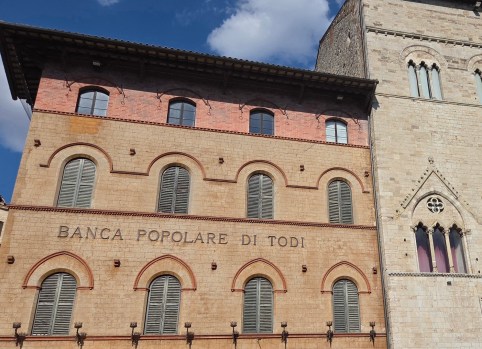
The former headquarters of Banca Popolare di Todi, one of the most recognisable buildings on Piazza del Popolo, is set to become an upscale hospitality property.
At first glance, the story looks familiar: a bank disposes of a historic asset, an investor acquires it, and the building is converted into a hotel.
But the profile of the family behind the acquisition, the timing of the transaction and the relatively small scale of the proposed hotel suggest a more interesting question:
what if the real return on this investment is not generated by room revenue alone?
The company that acquired the property is linked to the Balestra family, the entrepreneurial family behind Sabatino Tartufi, the Umbrian truffle business with a significant international presence and a particularly strong footprint in the United States.
Shortly before the Todi acquisition, international financial investors had entered Sabatino’s capital.
That does not establish that the Todi property sits within Sabatino Tartufi’s corporate perimeter, nor does it demonstrate that those investors are involved in the hotel project.
But it does raise a compelling strategic possibility.
The building may ultimately be more than a hotel.
It could become a flagship asset, an experiential platform and potentially a brand home in the heart of Umbria.
And that is where the Todi transaction becomes far more interesting than a straightforward property conversion.
What we know
On 13 August 2026, the Municipality of Todi released details of the redevelopment project for the former Banca Popolare di Todi building on Piazza del Popolo.
The property comprises almost 2,000 square metres across four floors and sits next to Palazzo del Capitano, in one of the most prominent positions in the historic centre.
Intesa Sanpaolo sold the building roughly two years ago following an auction process to a company linked to the Balestra family.
The new owner has now submitted a refurbishment and change-of-use project.
The municipal building commission approved the proposal without conditions. The design is by architect Diego Cacciamani of Studio A25.
The façade is expected to retain its overall appearance, while undergoing targeted restoration intended, among other things, to recover elements of the building’s original nineteenth-century character.
Todi’s mayor, Antonino Ruggiano, has described the future property as a high-quality hospitality project featuring upper-end suites.
Preliminary works are expected to begin after the Todi Festival, scheduled from 27 August to 6 September 2026.
Opening has been indicated for between late 2027 and spring 2028.
Those are the facts currently in the public domain.
The more interesting part of the deal begins where the official announcement ends.
Who are the Balestras?
In February 2024, before the hotel redevelopment had been formally announced, local reports said that the Intesa Sanpaolo auction had been won by an Umbrian company operating in the truffle sector.
That description points towards the Balestra family behind Sabatino Tartufi, a business founded in Montecastrilli, around 25 kilometres from Todi, in 1911.
Today, the group operates from both Umbria and West Haven, Connecticut, sells internationally and has developed an especially strong position in the US premium food market.
There is, however, another part of the story that matters.
In 2023, New York-based private equity firm Traub Capital Partners, which focuses on consumer brands, announced a strategic investment in Sabatino alongside Three Hills Capital Partners, through Three Hills Capital Solutions IV.
When discussing the transaction, Federico Balestra referred among other things to the investor’s expertise in hospitality and lifestyle.
That detail is relevant, but it needs to be handled carefully.
There is currently no public evidence establishing that Traub Capital Partners or Three Hills Capital Partners are participating in the Todi property investment.
Nor, until the acquiring vehicle is identified conclusively, would it be accurate to say that the building is directly owned by Sabatino Tartufi itself.
The distinction matters.
What can be observed, however, is the sequence:
-
late 2023 — financial investors enter the industrial business associated with the Balestra family;
-
early 2024 — a company linked to the family acquires the former Banca Popolare property in Todi;
-
summer 2026 — the hospitality conversion project is submitted;
-
2027–2028 — the property could enter the market.
This is not proof of an integrated corporate strategy.
But it is a sequence consistent with the broader experiential expansion of a premium consumer brand.
And that is where the investment thesis becomes particularly interesting.
Beyond a hotel: the brand-home hypothesis
The boundaries between luxury products and hospitality are becoming increasingly blurred.
Fashion, automotive, wine, food and design businesses are using hospitality to turn customers into guests and brands into physical experiences.
The hotel, in other words, can become part of the brand architecture.
For an international business rooted in truffles and in Umbria, a historic building on Piazza del Popolo could potentially perform functions that extend well beyond selling overnight stays.
It could provide:
-
hospitality for international clients and distributors;
-
trade events;
-
media and public-relations opportunities;
-
product presentations;
-
high-end food experiences;
-
meetings with partners;
-
branded content production;
-
institutional representation;
-
a physical setting in which to communicate the company’s Umbrian origins.
In that scenario, the property becomes a brand home.
There is no evidence at this stage that this is the owner’s stated strategy.
But it is a useful industrial hypothesis because it helps explain something that is otherwise difficult to reconcile:
the economics of a very small luxury hotel.
The numbers: why hotel operations alone may not be enough
No public information has yet been disclosed on the acquisition price, final room count, development cost, operator or hotel brand.
The figures below should therefore be read as an editorial scenario based on market assumptions, not as a forecast of the project’s actual financial performance.
Indicative operating scenario
| Item | Editorial assumption |
|---|---|
| Gross floor area | approx. 2,000 sqm across 4 floors |
| Assumed efficiency in a historic building | 60–65% |
| Indicative suite size | 45–60 sqm |
| Potential room count | 12–18 keys |
| High-end full refurbishment cost | €4,000–€6,000 per sqm |
| Indicative capex | €8m–€12m |
| Stabilised ADR | €350–€450 |
| Annual occupancy | 55–60% |
| Indicative RevPAR | approx. €200–€270 |
| Total rooms + F&B revenue | approx. €1.6m–€1.9m |
| Assumed GOP margin | 30–35% |
| Indicative GOP | approx. €500k–€650k |
The purpose of the exercise is not to predict what the hotel will earn.
It is to understand the scale of the economics.
Assume, purely for modelling purposes, a total investment of between €12 million and €15 million including acquisition and development costs.
A stabilised GOP of €500,000 to €650,000 would imply an indicative GOP yield on cost of approximately 3.3% to 5.4%.
That measure needs to be described precisely.
It is not a cap rate.
It is not an IRR.
It is not a net property yield.
It does not account for depreciation, financing costs, taxation, FF&E reserves, management fees or terminal value.
It is simply the relationship between hypothetical hotel operating profit and the amount of capital invested.
And that is precisely why it is useful.
It illustrates how difficult it may be to justify an investment of this scale solely through the operating profitability of a 12-to-18-key hotel.
The actual room count may of course be different.
More space may be allocated to restaurants, events or communal areas.
The property may ultimately operate as a historic residence, a boutique hospitality concept or some form of hybrid product.
But the underlying issue remains the same.
At this scale, the project needs to create value beyond the room.
At Investimenti Alberghieri, we regularly examine this distinction: the value of a hotel does not always coincide with the value of the underlying property, nor can it always be understood simply by capitalising GOP.
When the P&L does not tell the whole story
The investment becomes far easier to understand once factors are introduced that a conventional hotel operating statement does not directly capture:
-
corporate representation;
-
brand building;
-
client and partner hospitality;
-
international communications;
-
experiential marketing;
-
the reinforcement of Umbrian provenance;
-
long-term family wealth preservation;
-
ownership of a trophy asset that would be difficult to replicate.
A hotel entrepreneur and an industrial group can therefore assign very different values to exactly the same property.
The hotel investor will primarily focus on ADR, occupancy, RevPAR, GOP and return on invested capital.
An industrial owner may also view the hotel as commercial infrastructure.
That changes the investment logic entirely.
Further analysis of hotel assets, transactions and investment structures is available through InvestHotel.
Four questions still need answers
1. Which entity actually acquired the property?
This is the single most important corporate question.
Saying that the acquiring company is linked to the Balestra family is not the same as saying that the property belongs to Sabatino Tartufi or to a company within the perimeter backed by its financial investors.
The buyer could be a completely separate family-owned property vehicle.
That distinction would materially change the interpretation of the deal.
If the acquisition sits within a corporate structure connected to the operating group, the brand-home thesis becomes considerably stronger.
If it is held through an independent family property company, the transaction may instead be primarily a family-office or wealth-preservation investment.
Identifying the ownership vehicle is therefore the document most capable of changing the entire reading of the project.
2. What is the full planning and heritage approval process?
Approval by the municipal building commission is important, but it does not by itself establish the complete regulatory pathway.
For a nineteenth-century property in such a sensitive historic setting, the key issue is whether heritage protection applies and what additional approvals are required.
If the building is protected, dealings with the relevant heritage authorities could become one of the main variables affecting both programme and design.
With historic hotel conversions, regulatory complexity can prove more decisive than the construction work itself.
3. Is spring 2028 realistic?
There are roughly 18 months between late 2026 and spring 2028.
For the full conversion of almost 2,000 square metres of historic space across four floors, in the middle of a medieval town square, that is an ambitious programme.
Not necessarily impossible.
But until the detailed design, permissions and scope of works are known, spring 2028 is better regarded as a favourable scenario rather than a conservative base case.
4. Who will operate it?
No hotel operator or international brand has yet been announced.
That absence may prove highly significant.
If the eventual property does have only a small number of keys, a conventional international management contract could be difficult to justify economically.
Alternative models may include:
-
direct operation by the owner;
-
an independent specialist operator;
-
soft-brand affiliation;
-
membership of a luxury collection;
-
a historic-residence model;
-
a hybrid hospitality and brand-experience concept.
The management structure will tell us a great deal about the owner’s real objectives.
If the priority is purely to maximise hotel GOP and EBITDA, one set of decisions follows.
If the hotel is also intended as a communications, hospitality and representation platform, the design, F&B offer, service model, target audience and even the definition of investment return all change.
Hotel Management Group explores precisely this relationship between ownership objectives, hotel positioning, governance and operating model.
The physical limitations could become the competitive advantage
A 2,000-square-metre building over four floors cannot compete with an Umbrian country resort on the resort’s own terms.
It does not have the same relationship with the landscape.
Large-scale wellness facilities, extensive gardens, a major pool and private parking are inherently difficult to reproduce in a historic urban building.
But that does not make the product weaker.
It means it has to compete along a different axis.
Heritage, location, architecture, service, culture, gastronomy and direct access to the town itself.
The appropriate benchmark may therefore not be the countryside resort.
It may be the highly experiential urban boutique hotel.
That distinction will directly affect ADR, distribution strategy, source markets, average length of stay and seasonality.
And these are precisely the decisions that should inform the design of the product rather than be addressed after the building has already been completed.
Further analysis of hotel management, positioning and hotel economics can also be found at RobertoNecci.it.
Todi is growing — but so is supply
The Municipality has linked the project partly to growth in tourism demand.
The demand numbers are meaningful.
In 2025, Todi recorded 37,934 international arrivals, up 30.1%, and 101,104 international overnight stays, an increase of 23.3%.
But that is only one side of the market.
In the same year, the town’s accommodation supply reached 295 properties, an increase of 22%.
Demand and supply are therefore expanding at the same time.
Where growth in supply is largely concentrated in non-hotel accommodation, the result does not necessarily indicate a shortage of beds.
It may instead point towards increasing competition in the middle of the market.
The more compelling strategy is therefore not to enter that competition at all.
A properly designed luxury property should not simply sell a room in Todi.
It should sell Todi as an experience.
That is a very different proposition.
From bank branches to hotels: a wider Italian investment theme
The Todi project also points to a broader trend.
Banks continue to rationalise their physical networks.
As branches and historic offices are closed or consolidated, the process is releasing a particular type of real estate onto the market:
-
highly central properties;
-
buildings of substantial scale;
-
recognisable architecture;
-
whole-building ownership;
-
strong links to local urban history;
-
locations that are almost impossible to replicate.
In smaller Italian towns, the local residential or conventional commercial market may struggle to absorb the full economic potential of such properties.
For some of these assets, upper-upscale hospitality can become one of the few uses capable of combining preservation, economic activity and long-term asset enhancement.
But there is another important shift.
The capital redeveloping these buildings does not necessarily come from traditional hotel owners.
Family offices, industrial groups, food companies, luxury brands, financial investors and entrepreneurs from outside the hotel sector are increasingly looking at hospitality through a different lens.
For them, a hotel can simultaneously be:
real estate + operating business + experience + communications platform + long-term wealth asset.
That may prove to be one of the most significant structural changes taking place in Italian hospitality.
The real question behind the Todi deal
The key question, then, is not simply:
how much could the future hotel on Piazza del Popolo earn?
The more interesting question is:
how much total value can this property create for its owner beyond the hotel P&L?
If the answer includes reputation, distribution, international relationships, client hospitality, brand positioning and long-term asset appreciation, the framework used to assess the investment has to change.
That is the difference between valuing a hotel and understanding a hotel investment.
And Todi could become a particularly revealing case study of that distinction.
Evaluating a hotel investment?
Investimenti Alberghieri will continue to follow the Todi project, including the ownership structure, planning process, final room count, operator selection and market positioning.
If you are an owner, investor, family office, fund, hotel operator or advisor considering the acquisition, disposal, conversion, repositioning or management of a hospitality asset, the most valuable time to analyse the project is before the key decisions become irreversible.
For mandates, confidential transactions, hotel valuations or information relating to the Todi project, contact info@investimentialberghieri.it.
Investimenti Alberghieri · InvestHotel · RobertoNecci.it · Hotel Management Group