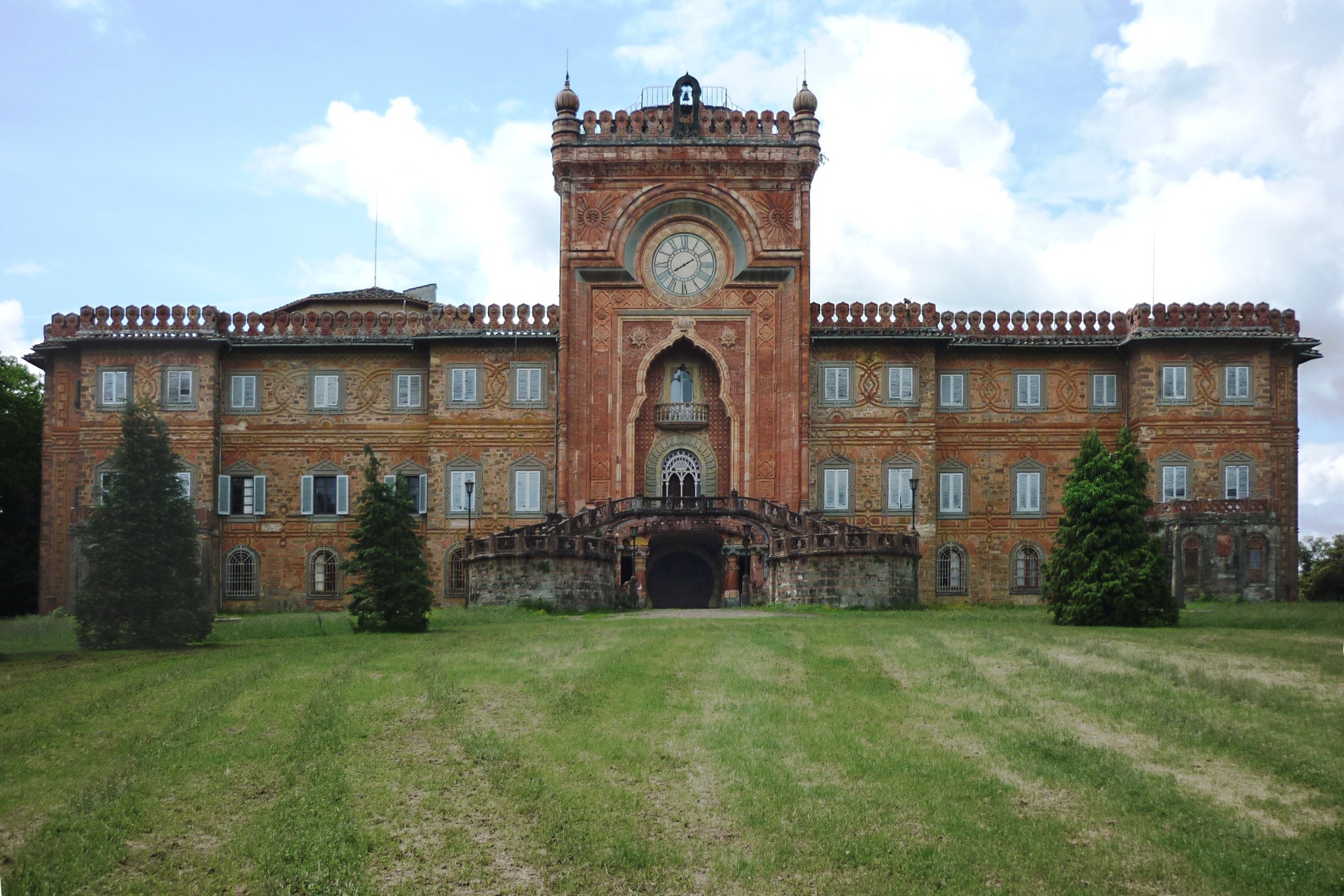
The heritage authority has authorised the first works at Sammezzano Castle and the project is now moving into the construction phase. The Moretti family is indicating a total investment of around €80 million. On paper, the cost per key sits far outside conventional hotel benchmarks. But that is precisely the point: Sammezzano is not, and should not be, assessed as a conventional hotel investment.
From preservation to construction
On 17 August 2026, the update the Sammezzano dossier had been waiting for finally arrived.
The heritage authority authorised restoration and safety works on the building, with construction due to begin in the second half of August.
The first interventions will focus on the façade, roof, skylights and windows: the elements most exposed to weather and therefore the areas that need to be secured before the subsequent phases of the restoration can proceed.
Specialist contractors have already been identified, and the immediate priority is to protect the building envelope from water infiltration ahead of the autumn and winter seasons.
To understand the economics of the project, however, it is necessary to go back to the acquisition.
The property was acquired through a composition with creditors procedure, with the initial investment reported at approximately €18 million.
Following the expiry, on 16 July 2025, of the deadline for the Italian State to exercise its pre-emption rights, the estate formally entered the Moretti family’s ownership.
SMZ S.r.l., wholly controlled by the family holding company HKC S.r.l., is led by Ginevra Moretti, daughter of Florentine entrepreneur Giorgio Moretti.
The transaction brought to an end a very long period marked by abandonment, difficulties involving the previous ownership and proceedings that had failed for years to produce a definitive solution.
Today, the outlook is different.
The owners are now indicating an overall investment of approximately €80 million for the recovery of the entire estate.
And the word “entire” is fundamental.
The investment is not limited to the Castle.
It also covers the historic park, the estate’s other buildings, infrastructure and the restoration of an extraordinary environmental heritage.
Since the acquisition, preliminary works have already been carried out across the external areas, paths and drainage systems.
More than 440 trees of particular botanical interest have also been mapped, with their condition now being progressively assessed.
Museum and luxury hospitality
The announced project does not envisage turning the entire Castle into a hotel.
That is the first point that must be understood if the figures are to be interpreted correctly.
According to industry press reports, the historic building is expected to be used partly as a museum and partly as a luxury hospitality property with approximately twenty rooms.
Ginevra Moretti herself has described the project as a meticulous intervention intended to respect the historical, artistic and natural importance of the estate, identifying structural safety as the first priority before the subsequent administrative phases.
The Castle is currently closed to visitors, and the start of construction will result in further restrictions on access for safety reasons.
From an investor’s perspective, however, the central question is different.
How can an investment of around €80 million be justified by only twenty hotel rooms?
The number that appears not to work
Let us put the publicly available figures together:
-
approximately €18 million of initial investment;
-
a total recovery programme currently indicated at around €80 million;
-
approximately 20 rooms within the hospitality component.
If the investment were simply divided by the number of rooms, the implied cost per key would run into several million euros.
That figure would be entirely outside the range of normal hospitality benchmarks.
Even allowing for extremely high development costs for a five-star luxury hotel within a protected historic property, the figure would remain anomalous.
But the anomaly is not necessarily in the investment.
It is in the denominator being used to assess it.
The twenty rooms are not the principal object of the investment.
They are one economic component of a much broader cultural, patrimonial, real estate and experiential project.
And that distinction changes the way Sammezzano should be analysed.
What could the hotel component generate?
We can nevertheless isolate the hospitality engine, not in order to value the entire project, but to understand its relative contribution.
Let us build a purely theoretical scenario:
-
20 rooms
-
average ADR: €1,200
-
annualised occupancy: 55%
-
approximately 4,000 occupied room nights
Room revenue alone would be approximately €4.8 million.
Additional revenues could potentially come from:
-
high-end food and beverage;
-
private events;
-
weddings;
-
ceremonies;
-
curated experiences;
-
potential wellness services;
-
ancillary spend connected with the stay.
Under a particularly strong operating scenario, the wider hospitality and events business could therefore potentially generate total revenues in the region of €9-11 million.
With a GOP margin of 30-35%, theoretical GOP could fall within an approximate range of €2.7-3.8 million.
This is not a forecast for the Moretti family’s project.
It is an analytical exercise by InvestimentiAlberghieri.it designed solely to understand the potential economic scale of the operation.
And it is sufficient to demonstrate one point.
If the total capital ultimately committed to the project were to fall within a €70-100 million range, the hospitality component alone could not reasonably be assessed as though it were required to remunerate the entire investment.
Because Sammezzano is not primarily a pure hotel investment.
It is a patrimonial investment with multiple revenue engines.
That is the central point.
Anyone acquiring Sammezzano is not simply acquiring a profit and loss account. They are acquiring an irreplaceable patrimonial asset and building an economic ecosystem around it capable of contributing to its preservation and long-term enhancement.
The correct question, therefore, is not simply:
“What return does Sammezzano generate?”
It is:
“What does it cost to keep Sammezzano alive, accessible and properly maintained, and how much of that cost can be funded by the economic activities developed around the asset?”
The project’s three real economic engines
1. The museum: when the Castle itself becomes the product
Sammezzano does not appear to have a visibility problem.
If anything, it has an access problem.
Over the years, the Castle has attracted enormous national interest, also through the FAI “Luoghi del Cuore” campaigns and the civic mobilisation that kept public attention focused on the property throughout its long closure.
This means that there is already latent demand.
A properly structured museum operation within the monumental areas, supported by:
-
controlled visitor numbers;
-
mandatory advance booking;
-
guided tours;
-
digital ticketing;
-
premium tours;
-
cultural events;
-
merchandising;
-
private visits;
could become an independent economic engine.
Again, consider a purely analytical scenario.
With 150,000 visitors per year and an average ticket price of €15-18, gross ticketing revenues would amount to approximately:
€2.25-2.70 million per year.
Those revenues would, of course, not be cost-free.
A museum complex of this scale would require staff, security, insurance, maintenance, utilities, ticketing systems and visitor-flow management.
But its marginal cost structure would remain materially different from that of a hotel.
There would be no room servicing costs.
No housekeeping associated with each visitor.
No OTA commissions.
No perishable inventory to sell every night.
In terms of contribution to operating performance, the museum could therefore become one of the core pillars of the business model rather than merely an ancillary cultural function.
2. The Mall: the economic factor that may be underestimated
There is another variable that deserves considerably more attention in any economic reading of Sammezzano.
The Mall Firenze.
The estate is located around 30 kilometres from Florence and just over one kilometre from the luxury outlet.
That means the immediate area already attracts a structural flow of international, high-spending visitors.
American travellers.
Middle Eastern travellers.
Asian travellers.
European luxury consumers.
This demand reaches the area independently of Sammezzano.
And this is where geography becomes economics.
Twenty ultra-luxury rooms located one kilometre from The Mall are not the same as twenty rooms isolated in the Tuscan countryside.
They are a hospitality product positioned next to an existing international demand generator.
Some of those visitors currently arrive, shop and leave.
Sammezzano could potentially capture part of that flow and convert a few hours of retail activity into an overnight stay or a wider destination experience.
That would not eliminate seasonality.
But it could reduce it.
More importantly, it would introduce a source of demand not entirely dependent on the traditional Tuscan leisure market.
From the perspective of hotel and real estate due diligence, this type of external demand generator can be more important than many purely real estate metrics.
Because a hotel does not survive simply where it is built.
It survives where demand exists and where the property can capture it.
3. Events and weddings: when space becomes inventory
The third component is perhaps the most obvious.
Sammezzano is one of the most visually recognisable historic properties in Italy.
Its Moorish interiors, monumental spaces and architectural uniqueness constitute an independent product for:
-
international weddings;
-
luxury events;
-
corporate events;
-
fashion shoots;
-
film and television productions;
-
private dinners;
-
product launches.
In a conventional hotel, inventory is primarily made up of rooms.
At Sammezzano, the economic inventory is much broader.
Every usable space can become a product.
If anything, the operating risk may run in the opposite direction.
Maximising events could conflict with museum access and heritage preservation.
The events calendar would therefore need to be managed with the same degree of precision as the restoration itself.
This is exactly where operational quality becomes part of asset preservation.
The concrete structure: demolition makes sense, but an industrial question remains
Among the planned interventions is the demolition of the so-called “ecomostro”, an approximately 9,000-square-metre reinforced concrete structure built in the 1970s for hospitality purposes but never brought into use.
From a cultural and landscape perspective, demolition appears entirely consistent with the restoration of the historic estate.
From an industrial perspective, however, it raises an important question.
Those 9,000 square metres represent a significant amount of potential hospitality floor area.
If demolition were to result in the permanent loss of that development capacity, the number of rooms available within the project could remain structurally limited.
The technical question therefore becomes:
does the plan allow for any form of development-right recovery compatible with the heritage constraints?
This could theoretically be:
-
relocated;
-
partially underground;
-
distributed across other buildings within the estate;
-
integrated into the landscape.
Or the decision may be to abandon hospitality scale altogether.
These are two very different scenarios.
In the first, subject to the necessary approvals, greater room capacity could materially change the economics of the project.
In the second, Sammezzano would remain primarily a cultural and patrimonial destination with an ultra-luxury residence attached.
That would not necessarily be a weakness.
It may, in fact, be exactly the right positioning.
But it would require patient capital and an exceptionally long-term patrimonial approach.
This is not criticism.
It is simply one of the variables on which the future balance of the project will depend.
The timeline, without rhetoric
In June 2025, an ambition had been communicated to open the property to the public within approximately eighteen months.
By August 2026, the project is entering the operational phase of the works relating to the building envelope:
façade, roof, skylights and windows.
At first sight, that might be interpreted as a delay.
That would be an overly simplistic conclusion.
The restoration of a protected monumental property does not follow the timetable of a conventional real estate refurbishment.
Months can pass between closing, design work, discussions with public authorities, approvals, technical verification and the start of visible construction.
Anyone underwriting historic properties must incorporate this factor into the business plan from the outset.
At Investhotel.it, this is one of the points we repeatedly emphasise: in hotel redevelopment projects, approval time is financial CAPEX, even when it does not appear directly in the construction budget.
In Sammezzano’s case, however, there is also a positive element.
The sequence appears rational:
secure the building envelope first.
Then consolidate the administrative process.
Then move into interiors and the final product.
Investing in finishes while a building is still exposed to water infiltration would destroy capital rather than accelerate the project.
The quality of a development programme should therefore not be judged solely by speed.
It should also be judged by the correct sequencing of decisions.
Governance matters as much as capital
There is another element that is more difficult to quantify but remains highly relevant from an industrial perspective.
The ownership appears to be directly engaged in the project.
For an asset of this complexity, that matters.
Long, regulated and multidisciplinary redevelopment programmes constantly generate decisions involving:
-
architecture;
-
heritage protection;
-
design;
-
finance;
-
operations;
-
marketing;
-
institutional relationships;
-
territorial management.
Distance between ownership and project execution can itself become a cost.
Directly involved governance reduces the risk of individual disciplines moving forward without a common direction.
It is not possible to convert this automatically into additional points of IRR.
But it is reasonable to treat it as a positive execution factor.
Sammezzano and Italy’s stock of dormant hospitality assets
The case also offers an interesting comparison with other Italian trophy assets.
At InvestimentiAlberghieri.it we recently analysed the case of a major historic property in Liguria acquired by a real estate developer, with an announced hotel redevelopment strategy and an asset still not operational twenty months after closing.
Sammezzano begins from a position that is comparable in certain respects:
an iconic property, closed for many years, extremely strong recognition and the need for substantial capital before it can become economically productive again.
But the transaction structure and industrial path are very different.
At Sammezzano, at least three elements are emerging:
a clear technical sequence;
directly involved governance;
a revenue model that does not attempt to force a monumental property into the economics of a conventional hotel.
This is probably the most important lesson.
The challenge facing Italy’s historic real estate stock is not always a lack of capital.
Very often, it is a lack of an economic model consistent with the nature of the asset.
A castle does not necessarily need to become a 100-room hotel.
A monastery does not necessarily need to become a resort.
A historic villa does not necessarily need to maximise its number of keys.
The right question comes first:
what are the different ways in which this asset can generate revenue without destroying the characteristics that make it valuable in the first place?
This is also the approach behind the analyses published on RobertoNecci.it: start with the industrial model and only then determine the economically sustainable value of the real estate.
Not the other way around.
The point: Sammezzano is not an €80 million hotel
This is where the headline economics change completely.
Saying:
“€80 million for twenty rooms”
makes Sammezzano appear economically irrational.
But Sammezzano is not a twenty-room hotel that costs €80 million.
It is an approximately €80 million cultural, monumental, tourism, real estate and experiential asset, within which twenty rooms may represent one of the highest-monetising components.
Alongside the rooms there can be:
museum + events + weddings + F&B + private visits + experiences + venue hire + hospitality.
The correct unit of measurement, therefore, is not simply cost per key.
It is the ability of the entire ecosystem to:
-
preserve the heritage asset;
-
fund at least part of its operating and conservation costs;
-
generate recurring economic flows;
-
increase the long-term patrimonial value of the estate.
Cost per key remains useful.
But only when analysing the hotel component.
Using it to judge the entire project would mean applying the right metric to the wrong object.
When the business plan comes before the building
Sammezzano therefore provides a lesson that extends well beyond this particular case.
When assessing a historic property, a closed hotel or a building being considered for conversion, the analysis should not begin with the desired use.
It should begin with the sustainable economic model.
At Investhotel.it, projects of this nature are typically assessed through:
-
demand;
-
positioning;
-
revenue mix;
-
cost per key;
-
CAPEX;
-
approval timelines;
-
operating scenarios;
-
PropCo/OpCo structure;
-
cash-generation capacity;
-
terminal asset value.
Only after those variables have been understood should the operating structure be defined.
For implementation — organisational design, USALI-based management control, revenue management, pre-opening, management selection and ancillary revenue development — the operating reference is HotelManagementGroup.it.
Because there is a fundamental difference between restoring a building and creating a sustainable economic activity.
The first produces a restored property.
The second produces an asset capable of remaining alive.
Sammezzano: for the first time, a viable model appears to be emerging
After decades of abandonment, auctions, disputes and unsuccessful attempts, Sammezzano Castle is finally entering a different phase.
It is still too early to judge the final outcome.
Much remains to be assessed:
-
the development of the project;
-
subsequent authorisations;
-
timing;
-
final CAPEX;
-
the definitive mix of uses;
-
hospitality capacity;
-
the operating model;
-
commercial strategy;
-
economic sustainability.
But one difference compared with the past already appears clear.
There is identifiable ownership.
There is governance.
There is an investment programme.
There is a construction site.
Most importantly, a model is beginning to emerge in which Sammezzano’s sustainability does not depend on forcing the Castle into the role of a conventional hotel.
That may ultimately prove to be the smartest decision in the entire project.
Because the best economic use of a great historic property is not necessarily the one that creates the greatest number of rooms.
It is the one that creates enough value to allow the property itself to continue to exist.
At Sammezzano, for the first time in thirty years, that model appears to be taking shape.
We will continue to follow the project.
The analysis does not end here
At InvestimentiAlberghieri.it we continuously analyse closed hotels, hospitality assets, historic properties with tourism potential, insolvency proceedings, judicial auctions, restructuring projects and M&A transactions.
If you are considering the acquisition or redevelopment of a historic property, closed hotel or underperforming hospitality asset, Investhotel.it outlines our advisory services, including:
-
valuations;
-
economic and operational due diligence;
-
cost-per-key analysis;
-
business planning;
-
revenue-mix assessment;
-
PropCo/OpCo structuring;
-
selection of the most appropriate operating model;
-
negotiation of management agreements and hotel leases.
For implementation — pre-opening, operating model design, management control, revenue management, ancillary revenues and executive selection — visit HotelManagementGroup.it.
Further professional analysis, publications and insights are available at RobertoNecci.it.
Are you assessing a historic property, a closed hotel or a real estate asset for hospitality conversion and want to understand which model can genuinely create value?
Contact info@investimentialberghieri.it for an initial assessment of the opportunity and to discuss a potential advisory mandate.
Methodology and sources
This article has been prepared using publicly available sources available as of the publication date, including Save Sammezzano (15 June 2025, 17 July 2025 and 17 August 2026), gonews.it (18 July 2025), FirenzeToday (May 2025), Pambianco Hotellerie (21 October 2025), Finestre sull’Arte and other publicly available sources relating to the project.
Information concerning the project, proposed uses and planned works is based on the sources cited and may evolve as the planning, approval and development process progresses.
All figures relating to ADR, occupancy, revenue, visitor numbers, average ticket price, GOP and the economic contribution of individual components are independent estimates by InvestimentiAlberghieri.it prepared solely for analytical purposes. They do not represent company data, forecasts by the ownership or information contained in SMZ S.r.l.’s business plan.
SMZ S.r.l., the Moretti family and any parties mentioned in this article may request corrections, clarifications or documentary updates at any time by contacting the editorial team.