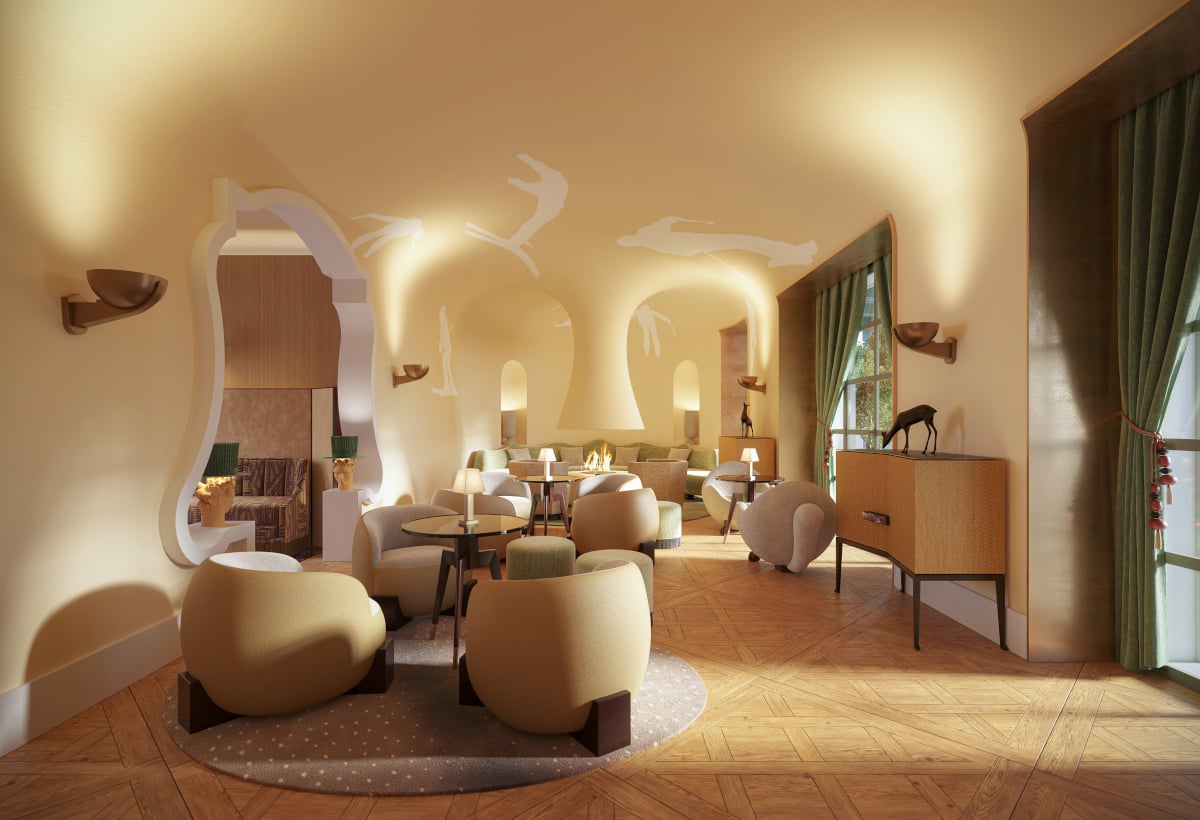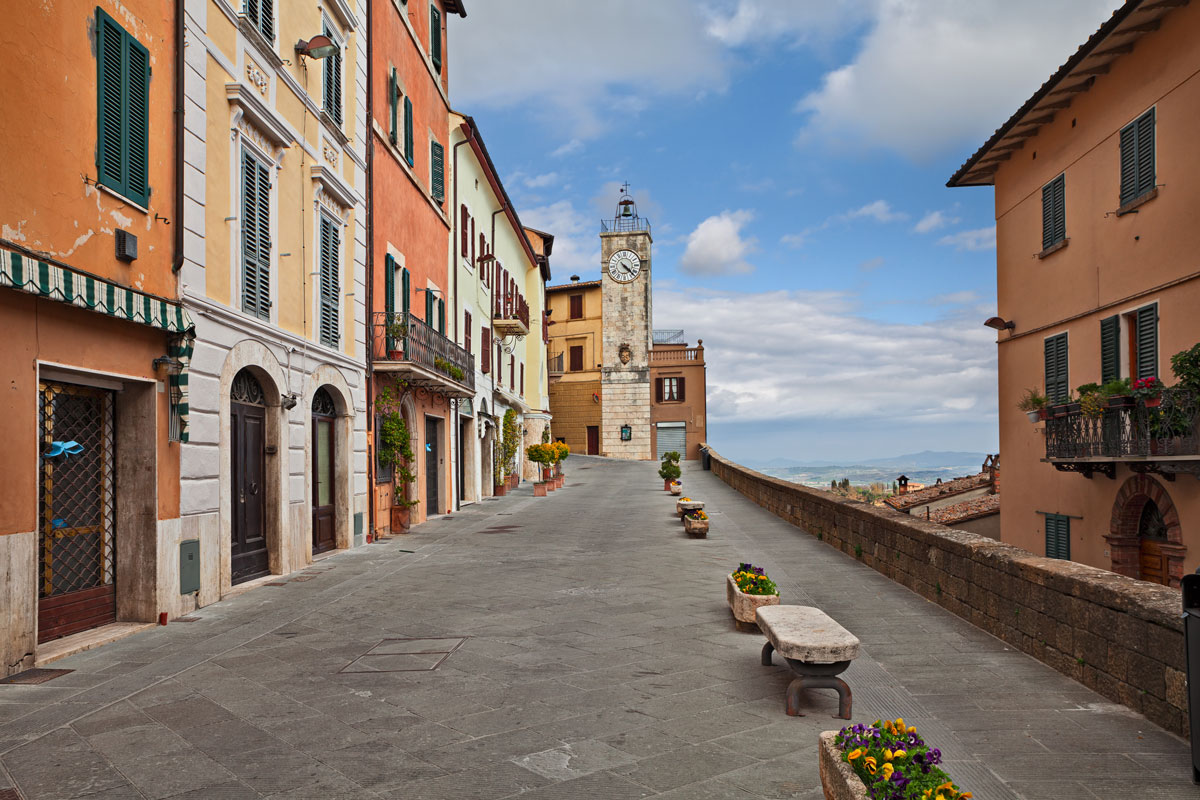
Genoa — One of the Palazzi dei Rolli, part of a UNESCO World Heritage Site, has come to market with an indicative valuation of €11 million. Yet the owners have explicitly ruled out a hotel conversion. That restriction changes the entire investment case: not only what the asset may be worth, but who can realistically buy it, what return they can expect and which economic model can support it.
The facts
According to Il Secolo XIX in its 20 August 2026 edition, in an article by Licia Casali, the Viziano family has granted an exploratory mandate to an agency specialising in prestigious Italian historic residences in relation to Palazzo della Meridiana in Genoa, formerly Palazzo Gerolamo Grimaldi.
The indicative valuation is €11 million.
But the figure itself is not the most important part of the story.
The owners, through Davide Viziano, have made it clear that the permitted use of the property represents a fundamental constraint on any transaction: the building cannot be converted into a hotel, bed & breakfast or tourist apartments.
According to the source, it is expected to continue operating primarily as a cultural, exhibition and events venue, although it could potentially be used as a private residence or prestigious corporate headquarters.
The mandate, moreover, should not be confused with a formal sales process. The owners have stated that no final decision to sell has yet been made, while the events calendar is continuing as normal.
It is precisely this combination — price, restrictions, lack of urgency and permitted uses — that makes the case far more interesting than a conventional Genoa property transaction.
The Asset in Numbers
Based on information contained in the listing and reported by the local press:
| Item | Size / Details |
|---|---|
| Total gross floor area | 3,200 sqm across six levels |
| Monumental reception rooms | 15 |
| Bathrooms | 17 |
| Salone Cambiaso | 144 sqm |
| Sala del Colonnato | 272 sqm |
| Exhibition rooms | 464 sqm in total |
| Consecrated private chapel | 19 sqm |
| Private outdoor areas | 536 sqm |
| Garden | 320 sqm |
| Terrace | 216 sqm |
| Restaurant | approx. 400 sqm |
| Retail units facing Piazza della Meridiana | 2 |
| Duplex apartment | 166 sqm |
| Mechanised parking spaces | 6 |
The palace was built for banker and merchant Gerolamo Grimaldi Oliva between 1536 and 1545.
The Viziano family acquired the property in 2004 and began a major restoration programme in 2007, which lasted five years.
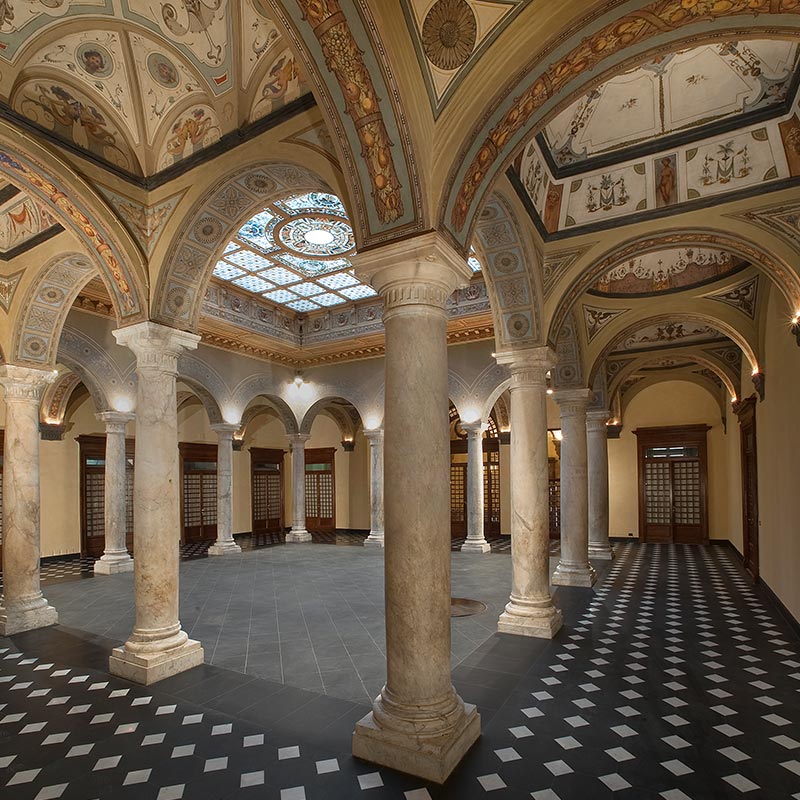
Among its most significant architectural and artistic features are stuccoes by Antonio da Lugano based on designs by Bergamasco, a monumental marble fireplace by Della Porta, a Liberty-style skylight with Neo-Pompeian motifs by Gino Coppedè, a marble staircase and the decorative schemes of the principal reception rooms.
According to the source, the portions that can effectively be subdivided are essentially the commercial areas, namely the two retail units and the restaurant.
And this is where the real analysis begins.
€3,437 per Square Metre: Why This Price Cannot Be Read Like an Ordinary Prime Property
The first calculation is striking:
€11,000,000 / 3,200 sqm = approximately €3,437 per sqm.
Compared superficially with prime residential values in Italy's leading cities, that figure may appear remarkably low.
But that is precisely the point: price per square metre, taken in isolation, is almost misleading in a property of this nature.
One hundred and fifty square metres of frescoed, protected space with a monumental function do not have the same economic utility as 150 square metres that can freely be converted into apartments, hotel rooms or commercial space.
The value of an asset such as Palazzo della Meridiana therefore arises from the interaction of at least four distinct components:
-
real estate value;
-
income-producing or economic value;
-
strategic and use value;
-
historic, cultural and trophy value.
Failing to distinguish between these four dimensions means risking a valuation based on fascination with the building rather than on its ability to create economic value.
Why the Apparent Discount Exists
The relatively low headline valuation per square metre is not accidental.
It reflects at least three economic factors.
1. Heritage restrictions
A historic asset of this calibre does not offer the same degree of design flexibility as an ordinary building.
Alterations, layouts, building systems, circulation, compartmentation and changes in use must all be reconciled with much more demanding conservation and approval requirements.
The result is lower asset flexibility.
And flexibility has value in real estate.
2. Permanent conservation costs
A sixteenth-century, 3,200-sqm building containing monumental interiors, frescoed areas, complex systems, spaces open to the public and substantial safety requirements inevitably carries a far higher cost base than an ordinary property.
Maintenance, insurance, security, staffing, climate control, technical systems, conservation and general management are not secondary expenses.
They are part of the asset's underlying economic model.
3. The exclusion of hotel use
The ability to develop a hotel would dramatically broaden the range of potential investors and value-creation strategies.
Removing that possibility narrows the buyer universe.
That does not necessarily mean that the restriction “destroys” value.
Rather, it shifts value away from a conventional financial-return framework and towards a patrimonial, strategic, cultural and reputational one.
Anyone buying Palazzo della Meridiana is not simply acquiring 3,200 square metres.
They are acquiring an asset whose symbolic value may significantly exceed its capacity to generate a conventional financial return.
The Hotel Conversion That Cannot Happen — and Might Not Have Been Economically Sustainable Anyway
This is the most interesting part of the case for anyone operating in hospitality investment.
Presented with a 3,200-sqm historic palace within a UNESCO context and featuring a series of monumental rooms, the market's immediate instinct would be:
ultra-luxury boutique hotel.
It is a model that has successfully repositioned numerous historic buildings across Italy.
But a hotel conversion does not become financially viable simply because the building is exceptional.
So let us run a purely theoretical exercise.
The figures below are editorial estimates and indicative orders of magnitude, not information provided by the owners.
Theoretical hotel scenario
-
gross floor area: 3,200 sqm;
-
potential proportion allocated to guestrooms, assuming that substantial monumental areas must be preserved: 50-55%;
-
potential guestroom area: 1,600-1,760 sqm;
-
average gross area per key for an ultra-luxury product: 55-65 sqm;
-
theoretical room count: approximately 25-32 keys.
The real issue then becomes the amount of capital required.
For a protected historic building, a top-end conversion could — purely as an indicative assumption — require €8,000-12,000 per sqm once restoration, systems, specialist works, interior design and regulatory upgrades are taken into account.
Capex alone could therefore fall in the region of €25-38 million.
Add the acquisition price and the theoretical total investment becomes:
approximately €36-49 million.
That equates to:
€1.2-1.6 million per key.
The Problem Would Not Be the Palace. It Would Be the Return
Assuming a 6% operating return on total invested capital, the property would need to generate approximately:
€2.2-2.9 million in annual GOP.
With only 25-32 rooms, that would translate into roughly:
€75,000-95,000 of GOP per key.
Even with very strong operating margins, the hotel would need to achieve an exceptionally ambitious combination of ADR and occupancy.
An indicative ADR in the region of €700-900 at around 65% occupancy gives a sense of the performance required.
This is where the analysis must return to the reality of the destination.
Genoa is undergoing genuine growth and attracting increasing international attention, supported by the extraordinary quality of its historic and cultural heritage.
But the city's current luxury hotel market generates rates materially below those required to support an investment of this scale at a return consistent with the capital deployed.
The real problem would therefore not necessarily be the quality of the property.
It would be the relationship between:
purchase price + capex + room count + sustainable ADR + required return.
The Hotel Restriction May Therefore Be Less Value-Destructive Than It Appears
This is the counterintuitive conclusion.
At first sight, removing the possibility of hotel use appears to reduce the property's value.
But if a theoretical hotel scheme would require levels of investment and revenue that the destination could not realistically support, then hotel use might primarily have increased the range of possible development concepts, rather than the economic value that could actually be realised.
In other words:
the restriction is not necessarily eliminating an economically viable hotel project.
It may simply formalise a use that is more consistent with the physical and economic characteristics of the asset today.
That is a fundamental lesson when analysing historic real estate.
Before falling in love with the idea of a hotel conversion, an investor needs to determine whether the hotel being imagined can generate sufficient cash flow to remunerate the full amount of capital required to create it.
This type of assessment — determining whether a hospitality conversion works economically before committing to the asset — falls squarely within the scope of the advisory services we provide for the valuation and structuring of hotel investments.
What Can Actually Be Monetised
Once the hotel scenario is removed, Palazzo della Meridiana still retains several potential sources of income.
1. Events and MICE
The monumental rooms, exhibition spaces, Sala del Colonnato, Salone Cambiaso and outdoor areas create a highly distinctive venue for:
-
corporate events;
-
receptions;
-
product launches;
-
fashion;
-
luxury brands;
-
cultural events;
-
institutional meetings;
-
private events.
This is not an activity that needs to be created from scratch.
The palace already operates as an events venue.
The industrial question is how much further utilisation can be increased, at what pricing level and with what margin.
2. The restaurant
Approximately 400 sqm, according to the source.
As one of the portions that can be legally separated, it can potentially operate as a relatively autonomous income-producing component.
In a setting of this quality, however, the choice of operator should primarily support the positioning of the palace as a whole.
Rent is only one part of the value equation.
3. The retail units
The two commercial units facing Piazza della Meridiana are probably the component most easily analysed using conventional property-investment criteria.
They can generate independent income and, because they are divisible, may also form part of a separate asset-management strategy.
4. The duplex apartment
The 166-sqm apartment adds a high-end residential component that can operate independently or complement the broader use of the building.
The Mistake Would Be to Value Everything in the Same Way
A complex asset such as Palazzo della Meridiana should not be analysed through a single yield.
The correct approach is to break the property down into centres of value and centres of cost:
-
events;
-
food & beverage;
-
retail;
-
residential;
-
monumental areas;
-
shared costs;
-
maintenance;
-
management structure.
Only after that segmentation can a credible operating model be built.
This is much closer to management control applied to a complex venue than to conventional real estate brokerage.
It follows the same logic of format analysis, pricing, profitability and cost structure that we apply through our operational advisory work for hospitality assets and event venues.
Who Can Realistically Buy Palazzo della Meridiana?
The restriction significantly narrows the buyer universe.
That does not mean there is no market.
It means the relevant market is different.
Family office or UHNW private capital
An Italian or international private investor may accept a low financial yield in exchange for:
-
scarcity;
-
wealth preservation;
-
prestige;
-
representational use;
-
personal enjoyment;
-
historic significance.
For this type of capital, part of the operating cost can effectively be viewed as the price of access, ownership and representation.
Corporate buyer
A major company could use Palazzo della Meridiana as a prestigious representative headquarters.
In this case, the return would not be measured solely through real estate income.
Branding, hospitality, institutional relations and reputation would all enter the equation.
Foundation or cultural institution
This may be one of the uses most naturally aligned with the character of the building.
The economic model could combine cultural activity, sponsorship, events, fundraising and ancillary commercial revenue.
High-end events operator
An operator with an established sales platform could regard ownership of the venue as a form of vertical integration.
Here, the economics would not depend purely on property income but on the profitability of the entire events value chain.
The Real Market Signal: An Exploratory Mandate Is Not the Same as a Sale
This is another crucial point.
Based on the statements reported by the source, this does not appear to be a structured competitive sales process.
The owners have decided to test the market.
There is no stated financial urgency.
The property continues to operate.
And there appears to be no requirement to complete a transaction quickly.
For an investor, this means four things.
The bid-ask spread may remain wide
The seller does not appear to face a significant cost of time.
The buyer, however, has both capital costs and alternative opportunities.
Pricing will not necessarily be driven purely by yield
With a trophy asset, an emotional and patrimonial component inevitably enters the valuation.
There is no distressed leverage
Based on the information currently available, approaching the negotiation on the assumption that the seller is under pressure would make little sense.
Closing depends on finding the right buyer
Not necessarily the investor with the most sophisticated return model.
But the investor for whom Palazzo della Meridiana is worth more than the cash flow it generates.
The Wider Lesson for Hotel Investment
The Genoa case offers at least three broader lessons for the Italian hospitality market.
1. Permitted use comes before valuation
In any due diligence exercise involving a historic property, the first checks should cover:
-
planning and zoning;
-
permitted use;
-
cadastral position;
-
chain of title;
-
contractual restrictions;
-
heritage authority requirements;
-
fire safety;
-
accessibility;
-
technical and plant compatibility;
-
actual feasibility of conversion.
Only after that should the economic valuation begin.
Because a property that can become a hotel and one that cannot are not the same asset, even if the buildings are physically identical.
2. Genoa Deserves to Be Monitored
The city has an extraordinary architectural heritage and entry values that remain significantly below Florence, Rome or Venice.
That does not mean every luxury scheme is automatically viable.
It means the destination's trajectory deserves close attention.
If international demand, infrastructure, connectivity, hotel supply and ADR all grow together, certain assets that do not produce institutional returns today may present a very different investment case in the future.
3. Being a Trophy Asset Is Not a Business Plan
This may be the most important lesson.
Italy is full of extraordinary buildings.
But:
an extraordinary building does not automatically make an extraordinary investment.
The methodology should always be:
demand → sustainable revenue → operating model → GOP → affordable capex → target return → maximum acquisition price.
Not:
property → enthusiasm → purchase price → construction works → hope that revenue will eventually catch up.
That is the difference between buying a building and structuring an investment.
For more on this approach — working backwards from sustainable revenue to the price, rather than forwards from the price to hope — see the analysis framework and valuation criteria for hotel assets.
What Is Palazzo della Meridiana Really Worth?
Perhaps the wrong question is:
“Is €11 million expensive or cheap?”
The right question is:
“€11 million for whom?”
For a fund seeking conventional real estate returns, the pricing may be difficult to justify.
For a hotel operator that cannot convert it into a hotel, the opportunity may not be investable at all.
For a foundation, international corporate, family office or private wealth investor that assigns value to representation and stewardship of a unique asset, the valuation framework changes completely.
That is the defining characteristic of trophy real estate.
Price does not derive solely from cash flow. It emerges from the interaction of income, scarcity, permitted use, symbolic value and buyer profile.
And that is why €3,437 per square metre can simultaneously be cheap, expensive or almost irrelevant.
It depends entirely on the capital looking at it.
Assessing a Historic Property for Hospitality Conversion?
If you are considering the acquisition, conversion or repositioning of a historic residence, a protected palace or a hotel asset in Italy, the preliminary feasibility assessment is often the stage at which most of the value in the transaction is either created or destroyed.
Before buying, the investor needs to understand:
-
what the property can legally and physically become;
-
which product the market can actually support;
-
what level of revenue it can generate;
-
what GOP can realistically be achieved;
-
how much capex the project can absorb;
-
and only then, how much the asset is worth paying for.
For a confidential assessment of an investment opportunity:
info@investimentialberghieri.it
Source for factual information regarding the property and statements by the owners: Il Secolo XIX, 20 August 2026, article by Licia Casali. The economic calculations, assumptions regarding capex, room count, revenue and returns contained in this article are independent editorial estimates and indicative orders of magnitude. They were not provided by the owners or by the appointed agency. The underlying information has not been independently verified directly with the owners. Nothing contained in this article constitutes investment solicitation or financial advice.