The transformation of Molino Stucky is one of Italy’s most significant examples of an industrial building being converted into a hotel. The project preserved an architectural landmark on Venice’s Giudecca island, while also demonstrating the importance of financial discipline, operating cash flow, ownership structures and hotel management agreements.
A hotel can be architecturally exceptional, impossible to replicate in terms of location and operated under one of the world’s best-known hospitality brands.
It can become a symbol of its destination and be assigned a real estate value running into hundreds of millions of euros.
Yet the financial structure used to develop it can still come under severe pressure.
The history of Molino Stucky in Venice demonstrates that the quality of a property, the prestige of its brand and the theoretical value attributed to the asset are not enough to guarantee the sustainability of a hotel investment.
A lasting balance must be maintained between:
-
acquisition and conversion costs;
-
financial leverage;
-
construction and opening timelines;
-
operating profitability;
-
future capital expenditure requirements;
-
management fees;
-
cash flow generation;
-
planning and regulatory obligations.
The Giudecca complex has experienced more than 140 years of economic history: from large-scale flour production to industrial closure, from abandonment to hotel conversion, from the 2003 fire to its reopening under the Hilton brand, followed by the Acqua Marcia Turismo restructuring proceedings and the subsequent transfer of the asset into the Marseglia Group perimeter.
The reference to more than €280 million of debt relates to the financial restructuring reported in 2015 within the former corporate structure controlled by Acqua Marcia.
It does not describe the current financial position of the hotel, its present ownership or Hilton, which operates the property as hotel manager.
This is therefore not simply the story of a building.
It is a case study in how a major hotel investment is developed, financed, restructured and repositioned.
Giovanni Stucky and the creation of a Venetian industrial landmark
Molino Stucky was developed by Giovanni Stucky, a Swiss-Venetian entrepreneur and financier who introduced modern grain-processing technologies to Venice.
The complex was constructed in several phases between 1884 and 1895.
The architectural design was entrusted to Ernst Wullekopf, who adopted an industrial neo-Gothic style that differed dramatically from Venice’s traditional architectural language.
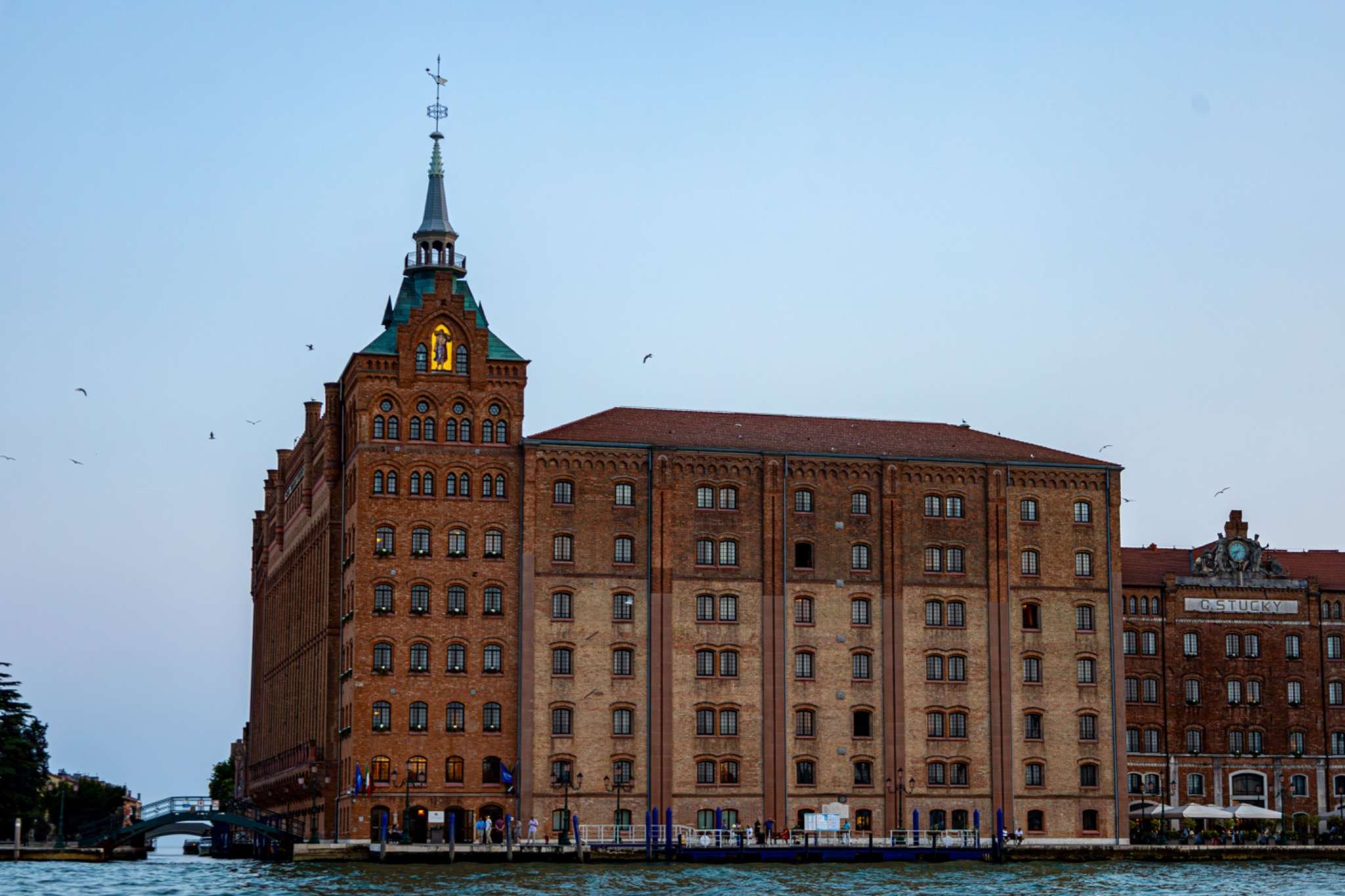
Its vast brick façade, vertical silos, towers and imposing mass transformed the factory into a monumental presence on the Giudecca Canal.
The industrial facility was not concealed within the cityscape.
It was deliberately presented as a symbol of modernity, productivity and economic power.
The complex eventually included thirteen buildings, together with silos, warehouses, offices and facilities dedicated to grain processing. Historical accounts attribute an initial production capacity of approximately 150,000 quintals per year to the mill.
Its location also reflected a precise industrial rationale.
Direct access to the canal allowed raw materials to be delivered and finished products to be transported by water, integrating production, logistics and architecture within a single platform.
Giovanni Stucky did not merely build a flour mill.
He created an industrial infrastructure that combined technology, transport and architectural identity.
From industrial expansion to closure in 1955
The violent death of Giovanni Stucky in 1910 symbolically marked the beginning of a more difficult period for the business.
The factory continued to operate under family control, but it faced economic conditions that were profoundly different from those that had supported its initial expansion.
International competition, the challenges of the interwar period, the revaluation of the Italian lira, Fascist autarkic policies and the consequences of the Second World War gradually weakened the competitiveness of the operation.
Industrial production finally ceased in 1955.
Molino Stucky then remained without a viable economic function for almost forty years.
This is the first major lesson offered by the project: the historical and architectural importance of a building does not guarantee its financial sustainability.
Once its original function disappears, a new use must be identified that can support:
-
restoration costs;
-
ordinary and extraordinary maintenance;
-
heritage protection obligations;
-
plant and technology upgrades;
-
day-to-day operating expenses;
-
the asset’s long-term profitability.
Without an economically sustainable use, even an exceptional property can become illiquid and progressively deteriorate.
The Acqua Marcia acquisition and the hotel conversion project
The turning point came in 1994, when the complex was acquired by Acqua Pia Antica Marcia, subsequently known as the Acqua Marcia Group.
The objective was ambitious: to transform the former industrial plant into a major international hotel while preserving its architectural identity.
The project was incorporated into the “Molino Stucky – Scalera – Trevisan” detailed development plan approved by the City of Venice in 1997.
The regeneration programme was not limited to the main building.
It also included interventions across the surrounding district, including regulated housing, environmental remediation, public spaces and the creation of an urban park.
The conversion was carried out under the supervision of the heritage authorities. Available sources identify architects Giuseppe Boccanegra and Francesco Amendolagine as key figures in the restoration and redevelopment process.
Hilton was selected as the international hotel operator.
The project therefore adopted a structure frequently found in major hospitality developments:
-
a real estate developer;
-
a dedicated asset-owning company;
-
substantial bank financing;
-
an international hotel operator;
-
a management agreement separating ownership from operations;
-
a complex framework of regulatory and planning obligations.
The conversion of Molino Stucky was therefore not simply a construction project.
It was an integrated real estate, financial, hospitality and urban regeneration transaction.
Investors and owners evaluating the sale, conversion or financial restructuring of a hospitality asset can explore these processes through Investhotel.it, which specialises in hotel valuations, asset enhancement and support for complex corporate transactions.
The 2003 fire and the realities of development risk
On 15 April 2003, while construction work was still under way, a major fire damaged the complex.
The former industrial building’s construction characteristics, including load-bearing brickwork, steel reinforcements and timber roofs, made firefighting and safety operations particularly challenging.
The fire represented one of the most critical moments in the entire development process.
Every conversion project exposes investors to risks that extend well beyond the initial purchase price:
-
unforeseen structural problems;
-
planning and authorisation delays;
-
design variations;
-
rising construction costs;
-
litigation;
-
accidental damage;
-
delayed openings;
-
lost revenue during development;
-
increasing financing costs.
Despite the fire, the project continued.
The hotel opened on 1 June 2007 as Hilton Molino Stucky Venice and was presented at the time as the largest hotel in Venice.
The complex currently offers approximately 380 rooms, together with conference facilities, restaurants, a spa and a rooftop swimming pool.
The precise room count varies slightly across different sources, most likely because of subsequent reconfigurations of the accommodation inventory.
When architectural success does not guarantee financial sustainability
The hotel’s opening demonstrated that the architectural conversion had succeeded.
It did not, however, prove that the financial structure supporting the project would remain sustainable over the long term.
The hotel business operated through Acqua Marcia Turismo S.p.A. became involved in preventive restructuring proceedings no. 43/2012 before the Court of Rome.
In 2015, the debt associated with the transaction was reported to exceed €280 million.
At the same time, an appraisal prepared in connection with proceedings before the Court of Venice reportedly valued the hotel at approximately €350 million.
The restructuring involved seven banks, with Royal Bank of Scotland and UniCredit among the principal institutions, and envisaged the establishment of GHMS Venezia S.p.A., the company intended to receive the hotel business.
The case highlights a fundamental distinction.
The value of the real estate does not necessarily correspond to the hotel business’s capacity to service its debt.
A hotel may have a theoretical value of €350 million and still face difficulty supporting an exposure of more than €280 million.
Debt is not repaid through a valuation report.
It is repaid through cash generated by the business or, alternatively, through a sale, refinancing or financial restructuring.
Assessing the sustainability of a hotel investment therefore requires an examination of:
-
stabilised revenue;
-
occupancy;
-
average daily rate;
-
RevPAR;
-
GOP;
-
EBITDA;
-
operating cash flow;
-
capital expenditure requirements;
-
financing costs;
-
debt amortisation;
-
hotel management fees;
-
taxation;
-
maintenance reserves;
-
demand volatility.
When leverage is structured primarily around a property’s theoretical value rather than its ability to generate cash, any delay or market downturn can place the entire transaction under pressure.
Real estate value and cash flow are not the same thing
The distinction between asset value and debt sustainability is one of the most important issues in hotel investment.
A property valuation may reflect:
-
location;
-
architectural significance;
-
gross floor area;
-
scarcity;
-
redevelopment potential;
-
expected future sale value;
-
land value;
-
planning potential.
Financial sustainability, however, depends on the business’s actual ability to generate operating margins and liquidity.
A hotel may produce a positive operating result and still fail to generate sufficient cash to cover:
-
debt repayments;
-
interest costs;
-
taxes;
-
extraordinary maintenance;
-
room renovations;
-
management fees;
-
technology investment;
-
regulatory upgrades.
For this reason, a hotel valuation cannot be based exclusively on floor area or comparable real estate transactions.
It must combine the value of the property with the profitability of the operating business, management risk and the investment required to preserve the hotel’s positioning.
The Marseglia Group transaction and the new ownership structure
Between 2016 and 2017, the Molino Stucky transaction became associated with the entry of the Marseglia Group.
Market sources placed the overall value of the operation at approximately €280 million.
This figure should not automatically be interpreted as the cash purchase price paid for the asset. The value of a restructuring transaction may include debt, real estate, creditor agreements and different corporate components.
Since 2018, GHMS Venezia S.p.A. has been included within the Marseglia Group’s consolidation perimeter as the owner of the hotel complex.
Hilton has continued to operate the property under a hotel management agreement.
The separation between ownership and management is essential to understanding the economics of the asset.
The owner will normally bear responsibility for:
-
the capital invested;
-
the debt;
-
real estate risk;
-
extraordinary maintenance;
-
renovation expenditure;
-
obligations associated with the building;
-
the risk of a decline in asset value.
The hotel operator is instead responsible, within the terms of the agreement, for:
-
day-to-day operations;
-
service standards;
-
organisation;
-
distribution;
-
technology platforms;
-
marketing;
-
use of the brand;
-
commercial performance;
-
staff management.
The distinction is also important from a reputational perspective.
The financial restructuring during the Acqua Marcia era concerned the corporate and debt structure of the investment. It was not a restructuring procedure involving Hilton, which acted as the hotel operator.
A hotel management agreement can create or destroy value
An international brand should not be assessed solely as a reputational advantage.
The hotel management agreement has a direct impact on operating profitability and the future value of the asset.
The most sensitive provisions typically include:
-
contract duration;
-
base management fees;
-
incentive fees;
-
performance tests;
-
termination rights;
-
capital expenditure obligations;
-
territorial protection;
-
budget approval procedures;
-
cost controls;
-
access to operating data;
-
replacement reserves;
-
conditions applying upon a sale.
A hotel may benefit from the distribution strength of a major brand while remaining bound by an agreement that is unfavourable to the owner.
The quality of the hotel management agreement also affects the future liquidity of the asset.
A potential buyer will assess not only the building and its financial performance, but also:
-
the remaining term of the agreement;
-
the ability to replace the operator;
-
obligations towards the brand;
-
termination provisions;
-
potential rebranding costs;
-
capital expenditure required by brand standards.
The management agreement should therefore be reviewed before the acquisition is completed, rather than only when performance or financial problems emerge.
For owners seeking to outsource, reorganise or relaunch hotel operations, NecciHotels.it provides hotel management and operational development services focused on profitability, financial control and market positioning.
The planning obligations attached to the investment
The conversion of Molino Stucky was not limited to the restoration of the principal building.
The planning agreements also included works within the neighbouring Scalera-Trevisan district, including:
-
regulated residential units;
-
environmental remediation;
-
public spaces;
-
the development of a park;
-
urban infrastructure.
Some of these measures were not completed in accordance with the original plans.
The insolvency of the parties involved led to the interruption of certain works and the abandonment of part of the construction site. In 2016, a settlement agreement was reached between the City of Venice and Acqua Marcia Immobiliare.
This element makes the case particularly relevant for hotel investors.
An investor acquiring a hotel does not acquire only a building or an operating business.
The investor may also inherit:
-
the asset’s planning history;
-
contractual obligations towards public authorities;
-
outstanding guarantees;
-
environmental requirements;
-
public infrastructure commitments;
-
remediation liabilities;
-
pending administrative proceedings;
-
relationships with local authorities.
Planning due diligence cannot therefore be limited to confirming hotel use or the compliance of the guestrooms.
It must reconstruct the full perimeter of obligations connected with the transaction.
Seven lessons for hotel investors
Molino Stucky is ultimately a successful heritage regeneration project.
It preserved one of Italy’s most significant examples of industrial archaeology and transformed it into an international hotel that remains operational today.
Its history nevertheless offers at least seven fundamental lessons.
1. An iconic asset can still experience financial distress
Location, reputation and architectural value do not eliminate financial risk.
A hotel remains sustainable only when it generates enough cash to support debt, operating costs and future investment.
2. Real estate value is not the same as financial value
An appraisal may indicate a high value, but debt repayment depends on actual business performance.
A theoretical property value cannot replace liquidity.
3. Debt must be calibrated against cash flow
Leverage must reflect opening timelines, the ramp-up period, demand cycles and future capital requirements.
Financing based on the most optimistic scenario transfers every delay directly onto the debt structure.
4. Development risk must be properly funded
Fires, design changes, delays and cost increases cannot be treated as impossible events.
A realistic plan must include contingencies, reserves and sufficient financial headroom.
5. Capital expenditure continues after opening
A historic hotel requires continuous investment.
Guestrooms, building systems, safety, technology, energy efficiency and public areas must be regularly upgraded.
Insufficient reserves can rapidly weaken the hotel’s market positioning.
6. The management agreement affects asset value
A brand may increase visibility and distribution strength, but the contract must preserve a reasonable balance between owner and operator.
Fees, duration, performance tests and termination rights directly affect profitability and future saleability.
7. Due diligence must be integrated
A hotel investment must be assessed simultaneously from several perspectives:
-
real estate;
-
corporate;
-
financial;
-
operational;
-
contractual;
-
planning;
-
environmental;
-
tax;
-
commercial.
Assessing each component in isolation creates the risk of missing the problems that arise from the interaction between them.
InvestimentiAlberghieri.it analyses the transactions, capital structures, developments and strategies reshaping the Italian hospitality market, with a particular focus on the relationship between real estate value, profitability and financial sustainability.
True value creation begins after the renovation
Converting a historic property into a hotel does not mean that the value creation process has been completed.
Value is genuinely created only when the asset can:
-
provide an adequate return on capital;
-
service its debt;
-
fund future investment;
-
preserve its real estate value;
-
maintain its market positioning;
-
withstand negative economic cycles;
-
remain competitive over time.
Molino Stucky survived the end of its industrial activity, almost forty years of abandonment, a major fire, financial distress and restructuring proceedings.
Its ability to withstand such different phases confirms the resilience of genuinely irreplaceable hotel assets.
It also demonstrates that no property, however exceptional, can substitute for a balanced financial structure, a properly negotiated hotel management agreement and an operation capable of generating sustainable income.
Do you own a hotel, a conversion opportunity or a hospitality exposure requiring assessment?
Problems within hotel investments rarely appear without warning.
They normally develop progressively through:
-
declining margins;
-
increasing leverage;
-
deferred capital expenditure;
-
weaker market positioning;
-
unbalanced management agreements;
-
tensions between owner and operator;
-
refinancing difficulties;
-
property values unsupported by operating performance.
Waiting until the problem becomes obvious often means reducing the number of available solutions.
Hotel Management Group advises owners, investors, banks, funds and operators on the analysis and value enhancement of hospitality assets through integrated expertise in:
-
hotel valuation;
-
due diligence;
-
financial and operating analysis;
-
business planning;
-
debt analysis;
-
turnaround strategies;
-
corporate restructuring;
-
hotel management agreements;
-
management control;
-
real estate value enhancement;
-
operator selection;
-
sale, lease and relaunch strategies.
When evaluating an acquisition, hotel conversion, refinancing or turnaround, the right time to intervene is before the debt, the lenders or the market determine the future of the asset.
To submit a transaction for an initial confidential assessment, contact:
info@investimentialberghieri.it
Roberto Necci - r.necci@robertonecci.it