Investimenti Alberghieri observatory | analysis of the Marciano–Reybier transaction and market implications
Michel Reybier Hospitality is bringing La Réserve to Italy, choosing Florence for its debut. But it is not entering the market through a traditional hotel. The brand’s first Italian address will be a sixteenth-century palazzo in the Oltrarno district, converted into six ultra-luxury serviced apartments: a product closer to a private residence with hotel-level services than to a conventional full-service hotel.
The interesting point is not simply the arrival of another international luxury brand in Italy. The real point is the model. The luxury serviced-residence format is becoming one of the most effective ways to monetise historic trophy assets, particularly where architectural constraints, internal layouts, limited room count and capex make a conventional hotel conversion difficult, or economically fragile.
For those originating, evaluating or structuring hotel investment transactions in Italy, La Réserve Florence is therefore a market case study. It says far less about a single rooftop bar and far more about the future of listed historic real estate in Italy’s art cities.
Transaction snapshot
| Element | Key information |
|---|---|
| Asset | Historic palazzo at 6 via Santo Spirito, Florence |
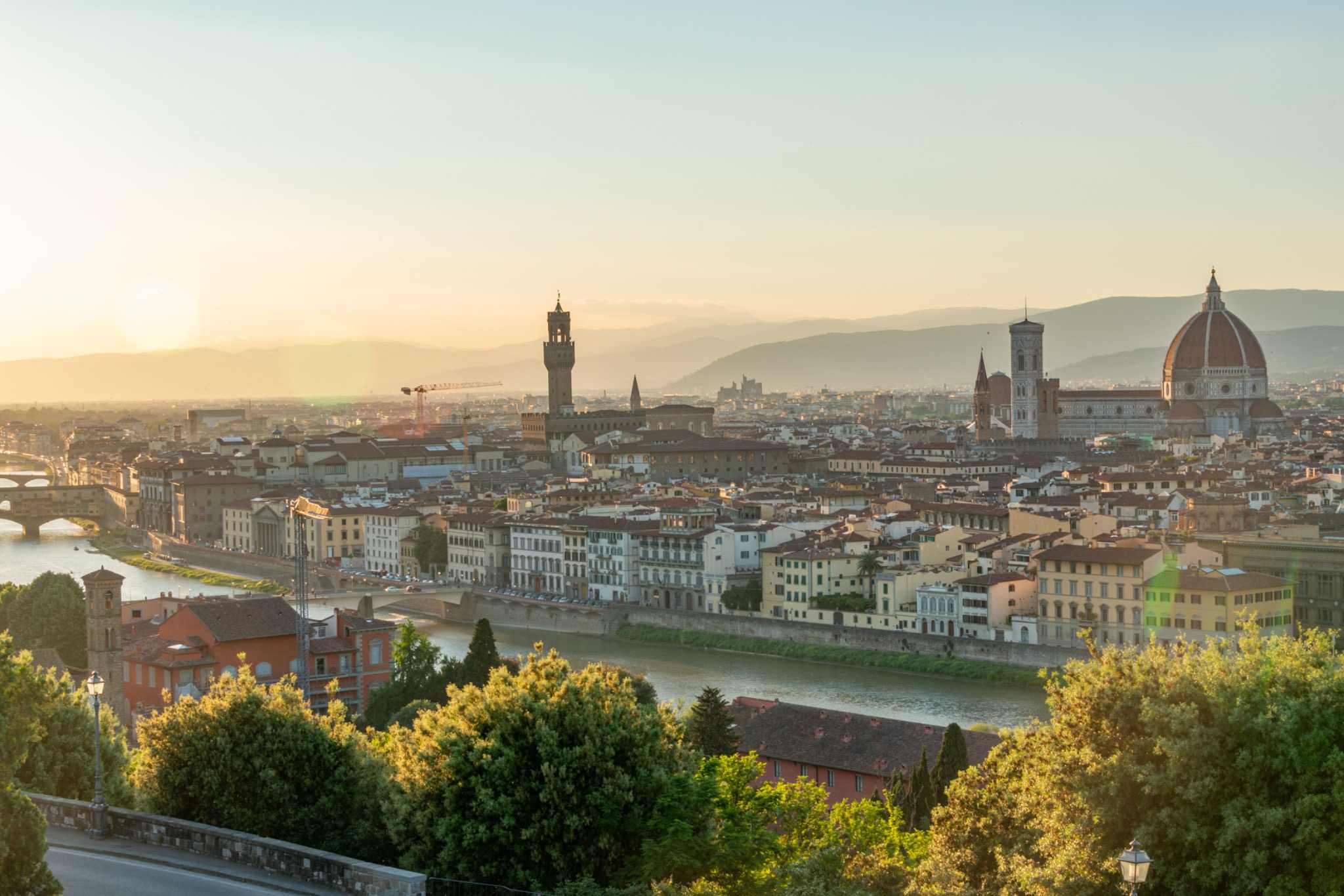
| Area | Oltrarno, close to Palazzo Pitti and Ponte Vecchio |
| Ownership | Olivia and Grégory Marciano |
| Brand | La Réserve, Michel Reybier Hospitality group |
| Format | Private Homes / ultra-luxury serviced residence |
| Number of units | Six apartments |
| Unit size | Approximately 170–210 sqm |
| Expected opening | Autumn 2026 |
| Positioning | Private serviced residence, not a traditional hotel |
| Market reading | A model for unlocking value in historic listed assets where a classic hotel format is inefficient |
This table captures the essential point: this is not a hotel in the traditional sense. It is a hybrid product sitting between private residence, hotel service and branded hospitality.
That hybrid nature is precisely what makes the transaction interesting.
The transaction: the asset came first, the brand followed
The starting point is not a hotel opening. It is a real estate acquisition.
In 2022, Olivia and Grégory Marciano acquired the historic palazzo on via Santo Spirito, in the heart of Florence’s Oltrarno district. The partnership with Michel Reybier Hospitality was structured afterwards, bringing the La Réserve brand to the asset through its Private Homes concept.
Initial communications referred to a 2026 opening; the project is now expected to open in autumn 2026. This will mark the first Italian presence for La Réserve, a brand already associated with highly positioned addresses in Paris, Geneva, Ramatuelle and Zurich.
The structure of the transaction is the most relevant aspect. This is not the classic case of a hotel operator taking over an existing hotel or converting a property under a standard long-term management agreement. The logic appears different:
a well-capitalised private owner acquires and restores a trophy asset;
an international luxury brand contributes positioning, standards, know-how, distribution and reputation;
the final product is not a hotel with dozens of rooms, but a very limited number of units with exceptionally high perceived value.
It is a formula that reduces scale while increasing value density.
That is the real key to the transaction.
Why a historic palazzo requires a different model from a hotel
Palazzo Segni, formerly Reali-Segni and later Sannini, is a historic building located at 6 via Santo Spirito, in one of Florence’s most recognisable Oltrarno settings. The building has strong historic features, a non-standard internal layout and an architectural identity that was not designed for contemporary hospitality.
An asset of this kind does not easily lend itself to a full-service hotel conversion.
A large reception, back-of-house areas, lifts, separated guest and service flows, standardised plant systems, repeatable rooms, fire-safety layouts, F&B spaces and extensive common areas are all elements that, in a listed historic palazzo, can create regulatory friction, high costs and long timelines.
Converting the building into six large apartments, each with a kitchen, living area, dining space and on-demand hotel services, is therefore a rational response to the physical and regulatory limits of the asset.
The constraint is not merely a cost.
It is a selector of the business model.
Where a traditional hotel cannot generate enough rooms to sustain fixed costs, staffing and capex, an ultra-luxury serviced residence can generate value from a small number of commercially powerful square metres. The building is not forced into a standard hotel grid. It is transformed into a private serviced residence, where scarcity becomes part of the pricing power.
For those structuring transactions involving historic Italian assets, this is the central point: before estimating ADR, occupancy and capex, one must first understand which hospitality model the asset can realistically support.
For further analysis of constraints, lease structures, business leases, operating models and complex hotel transactions, see the hotel guides on www.robertonecci.it, designed for those seeking to understand the economic, operational and real estate logic of Italian hospitality.
The serviced-residence model: what La Réserve Florence is really selling
La Réserve Florence is not simply selling rooms.
It is selling privacy, space, length of stay, personalisation and access.
The announced concept includes six one- to three-bedroom apartments, with generous floor areas, equipped kitchens, living rooms, selected common spaces, a gym, library, games room, internal courtyard and panoramic terrace. Hotel service is delivered when required: concierge, housekeeping, private chef, dining on request, bespoke experiences, activity planning and access to a curated local network.
The promise is different from that of a classic luxury hotel. It is not: “enter a grand monumental hotel”.
It is: “live in Florence as if you had your own private residence, with the service, reassurance and positioning of an international brand”.
For an investor, advisor or owner of a prime asset, the model has four structural advantages.
1. High revenue density across very few units
With six apartments, one is not building a scalable hotel platform. One is building a rare product.
The economic balance does not depend on room volume, but on the ability to generate very high rates for high-value stays. The economic unit is not the standard room. It is the apartment as a complete residential experience.
This changes the way the investment should be read.
In a traditional hotel, the question is: how many rooms can I create and at what RevPAR?
In an ultra-luxury serviced residence, the question becomes: how much value can I extract from a limited number of irreplaceable units?
That is a substantial difference.
2. A more variable service cost structure
In a full-service hotel, many costs are structurally fixed: reception, kitchen, restaurant service, housekeeping, maintenance, F&B, management, shifts and permanent on-site staffing.
In an ultra-luxury serviced residence, part of the service can be activated on demand.
Private chef, bespoke experiences, family activities, massages, grocery service, transfers, private dining and tailor-made activities can become variable service components rather than permanent costs within a standard hotel operating machine.
This does not mean that the model is light.
It means that it is different.
The cost base is no longer that of a standardised hotel structure, but that of a flexible service platform built around a very small number of guests with very high spending capacity.
For a deeper look at the operational, management and contractual aspects of these models, from management agreements to the value creation strategy for complex hospitality assets, see the Investhotel blog, which focuses on hotel management, real estate operations and hospitality asset structuring.
3. Greater compatibility with protected historic assets
A serviced residence requires less standardisation than a classic hotel.
It does not necessarily require identical rooms, serial corridors, repeatable layouts or large common areas. This makes it better suited to historic buildings where the irregularity of space is not a problem, but a source of value.
In a historic palazzo, an irregular room, a frescoed ceiling, a monumental staircase, an interconnecting salon or a terrace are not planning anomalies. They are part of the product.
A classic hotel tends to normalise space.
A luxury serviced residence can monetise its uniqueness.
This is why the format is particularly relevant for Italy, a country with a vast stock of palazzos, villas, historic residences and protected buildings that are difficult to convert into traditional hotels, but potentially ideal for hybrid hospitality products.
4. Alignment with contemporary luxury demand
High-end demand is moving away from visible status and standardised service towards privacy, control, authenticity and personalisation.
Luxury is no longer only the largest suite in the hotel. It can be an entire historic apartment, invisible from the outside, managed by a global brand and tailored around the guest’s stay.
This is a perfect fit for family offices, entrepreneurs, international clients, extended stays, families and travellers who want service without the mandatory social dimension of a hotel.
In this sense, La Réserve Florence captures a broader market trajectory: less standardisation, more residentiality; less exposure, more control; less volume, more unit value.
The other side of the model: high potential margins, limited scalability
The model is compelling, but it should not be romanticised.
Six keys remain six keys. Operational risk is concentrated. Profitability depends on a small number of highly sensitive factors:
the brand’s ability to sustain very high ADRs;
discipline around the cost of personalised service;
the long-term strength of international demand for Florence;
the reputation of the asset;
the quality of operational execution;
the ability to ensure that the product is perceived as a La Réserve experience, not merely as a luxury apartment.
The potential margin may be very high, but the tolerance for error is low.
In a 100-room hotel, a pricing mistake can be absorbed by volume. In a six-unit product, every unsold night matters.
That is why La Réserve Florence should be read more as a product thesis than as an industrially scalable operation. The individual asset is, by definition, non-replicable. The model, however, can be replicated across other historic Italian palazzos with similar characteristics.
That is where the broader market reflection begins.
Competitive positioning: not another luxury hotel in Florence
Florence is already a destination with a very high density of luxury hospitality.
Four Seasons, Belmond Villa San Michele, the historic hotels of the city centre, new international openings and projects in the pipeline all occupy different segments of the ultra-luxury market.
La Réserve Florence plays a different game.
It does not compete on room count, a grand lobby, a starred restaurant or the spectacular effect of a palace hotel. It competes on absolute scarcity: six apartments, a historic palazzo, a highly distinctive neighbourhood, a promise of private residential living and a recognisable brand for a very selective international clientele.
The Oltrarno becomes part of the product.
It is not just a location. It is a narrative.
The controlled distance from the city’s most intense tourist flows, the proximity to Palazzo Pitti and Ponte Vecchio, the artisanal and residential character of the neighbourhood, and the private nature of the experience all help position the asset not as “a hotel in Florence”, but as “a private serviced home in Florence”.
In contemporary luxury, that distinction matters.
What the transaction reveals about the Italian market
The Marciano–Reybier transaction points to at least four important trends for those looking at hotel investment in Italy.
1. The listed historic palazzo has found a more efficient vehicle
For many years, the market looked at historic real estate through a simple binary lens: luxury hotel or private residence.
The serviced residence introduces a third route.
It allows the asset to retain its residential nature while adding brand, distribution, service, hotel standards and professional monetisation.
This is particularly relevant in Italy, where the historic real estate stock is vast, but often poorly suited to standard hotel conversions.
Not every palazzo can become a hotel. Not every palazzo should become one.
In some cases, maximum value is not created by increasing the number of rooms, but by reducing it dramatically and raising the positioning.
2. Luxury hospitality enters through single-asset deals
La Réserve is not entering Italy through a hotel portfolio, but through a single iconic asset.
This is consistent with the strategy of the most selective luxury brands: few addresses, strong identity, high narrative coherence.
For those involved in origination, this means that the best opportunities do not necessarily come from competitive processes around hotel portfolios. They may emerge from single-asset deals, private wealth sponsors, family offices and local owners with unique properties.
In this segment, true deal flow is often relational before it becomes public.
The trophy-asset market does not move only through teasers, data rooms and organised sale processes. Many of the best opportunities arise earlier, when an owner first begins to consider whether to sell, generate income, bring in an operator or reposition the asset.
3. Authorisation expertise becomes a competitive advantage
In Italy, finding the asset is not enough.
One must know whether it can be transformed, how, within what timeframe, under which limits and with what authorisation risk.
The Soprintendenza, the cultural heritage framework, landscape authorisations, plant systems, accessibility, fire safety, use class and municipal constraints are not technical details to be addressed later. They are central variables in the business plan.
Those who master these steps gain a real advantage in asset selection, price negotiation and transaction structuring.
A poorly understood constraint can destroy value.
A well-understood constraint can indicate the correct model.
4. Scarcity becomes pricing power
In a traditional hotel market, scarcity is often a limitation.
At the extreme end of luxury, it can become an advantage.
Six units in a historic palazzo in the Oltrarno are not “few” if the product is designed for a clientele seeking exactly what cannot be replicated: privacy, identity, service, location and access.
Pricing power does not come from the number of rooms. It comes from the non-substitutability of the product.
This is a central theme for many Italian assets: historic villas, noble palazzos, former convents, protected residences, lakefront properties, prime coastal assets, masserie and historic complexes in art cities.
In all these cases, the question should not be: “how many rooms can I create?”.
The question should be: “which configuration maximises the value of the asset without distorting it?”.
Implications for owners, investors and family offices
The question many owners of historic properties should ask is not: “can I turn this into a hotel?”.
The correct question is: which hospitality model maximises the value of the asset without destroying its nature?
In some cases, the answer will be a full-service hotel. In others, a business lease. In others, a branded residence, a serviced residence, a private club, a hybrid management structure or a sale to a specialised operator.
The most common mistake is to start from the desire — “I want to create a luxury hotel” — rather than from the asset.
A historic property is not a neutral box. It has constraints, limits, identity, circulation patterns, ceiling heights, layouts, access points, maintenance costs and authorisation requirements. Every palazzo already contains, at least in part, its own possible economic model.
La Réserve Florence shows that, when the asset is rare and the brand is coherent, even a very small number of units can become a high-value hospitality product.
But it also shows that not every historic asset is suitable for this formula. Location, capital, authorisation patience, architectural quality, storytelling and operational capability are all required.
To compare this case with other transactions, market analyses and hotel deals in Italy, the natural reference point is the Investimenti Alberghieri blog, where deals, assets, operators, investors and hospitality market trends are regularly monitored.
The market lesson: fewer rooms, more value
For years, the hotel market has thought in terms of room count, RevPAR, occupancy and operational scale.
These indicators remain fundamental, but they are not enough to understand ultra-luxury transactions involving trophy real estate.
In this segment, the decisive variable is not always the number of keys. It is the combination of:
asset rarity;
brand strength;
international demand;
urban planning and authorisation compatibility;
service capability;
pricing power;
non-replicability of the product.
La Réserve Florence is an emblematic case because it dramatically reduces scale while radically increasing perceived quality.
It does not seek the industrial efficiency of the standard hotel.
It seeks to maximise unit value.
For the Italian market, rich in historic palazzos, villas, convents, protected residences and prime assets that are difficult to convert, the message is clear: the future will not be made only of new hotels.
It will also be made of hybrid hospitality products: smaller, more private, more patrimonial and more complex to structure.
Why this case matters for hospitality investors
La Réserve Florence should not be read as a simple opening announcement.
It should be read as a signal.
It shows that the international luxury market continues to look at Italy, but through increasingly selective models. Not necessarily large hotels. Not necessarily standard operations. Not necessarily portfolios.
More often: unique assets, private capital, strong brands, hybrid products, a strong residential component and very high personalisation.
This scenario creates interesting opportunities for:
owners of historic real estate;
family offices;
institutional investors;
specialised hotel operators;
advisors and originators;
international brands seeking selective entry into the Italian market.
But it also creates a challenge: the ability to read the asset correctly before reading the market.
Because in transactions of this kind, value does not come only from tourism demand. It comes from the intersection of property, authorisations, brand, management and positioning.
When these elements are aligned, even a small number of units can produce substantial value.
When they are not, even the most beautiful asset can become uneconomic.
Are you evaluating a trophy asset, a prime hotel or a luxury hospitality transaction?
If you own a historic palazzo, a villa, a listed property, a prime hotel or a hospitality asset to be repositioned, the first question is not what it is worth today.
The first question is: which model can maximise its value?
Traditional hotel, serviced residence, branded residence, business lease, management agreement, repositioning, sale, search for an operator or partnership with an investor: every asset requires a specific reading.
I have structured more than 100 hotel transactions in Italy and offer a confidential preliminary analysis for owners, family offices, investors and principal-level counterparties evaluating hospitality opportunities.
To submit an opportunity or request an initial assessment, write to:
info@investimentialberghieri.it
Please include:
city and location of the asset;
type of property;
number of rooms or hospitality potential;
any known urban planning or architectural constraints;
transaction objective: sale, income generation, operator search, repositioning, investor search or partnership evaluation.
The best hotel transactions are originated before they become public.
Yours could be next.
Analysis and market interpretation by Roberto Necci for Investimenti Alberghieri info@investimentialberghieri.it