The best hotel investments rarely start with perfect assets.
They start with dislocation.
A hotel may sit in a prime market, carry a recognizable brand, own valuable real estate and still be deeply mispriced. Not because the asset is weak, but because the structure around it is broken: too much debt, weak governance, deferred capex, poor operating discipline, an outdated positioning strategy or a capital stack that absorbs value before the property can generate it.
That is where sophisticated investors operate.
And few cases are more useful to study than Värde Partners.
Värde is not a hotel chain, a brand or a traditional hotel operator. It is not a core real estate fund buying stabilized assets for predictable yield. It is a global alternative investment platform founded in 1993, with roots in distressed credit and a current focus spanning private credit, real estate, asset-based finance and special situations.
Public disclosures place its assets under management broadly in the $15–17 billion range, depending on timing and reporting perimeter.
But the most important point is not its size.
It is its method.
Värde does not simply buy hotels. It identifies situations where the market has confused the value of the asset with the distress of the structure surrounding it.
For hotel owners, investors and lenders, that distinction is critical. In hospitality real estate, value is not created by owning rooms. It is created by understanding capital, operations, timing, debt, positioning and exit better than the market does.
Värde does not buy hotels. It buys solvable dislocation.
The first lesson from Värde’s hospitality strategy is clear: a hotel is not attractive simply because it is well located or operationally recognizable.
It becomes attractive when there is a solvable problem.
That problem may be excessive leverage. It may be fragmented ownership. It may be a tired operator, an underfunded renovation plan, a misaligned brand, a lender looking to reduce exposure or an asset whose highest and best use is no longer purely hospitality.
The central point is that Värde does not look at a hotel as a static building.
It looks at it as a value platform made of five connected elements:
the property, the operating business, the debt, the market and the exit.
A conventional buyer asks: “What is this hotel worth today?”
A sophisticated investor asks: “What could this hotel be worth once the constraint suppressing its value has been removed?”
That is the question that separates investors who buy hotel assets from investors who build institutional-grade hospitality investment products.
Boscolo: the Italian case every hotel investor should understand
For the Italian market, the most important case is Boscolo Hotels, later repositioned as The Dedica Anthology.
This was not simply a hotel acquisition. It was a textbook example of distressed real estate investing applied to hospitality.
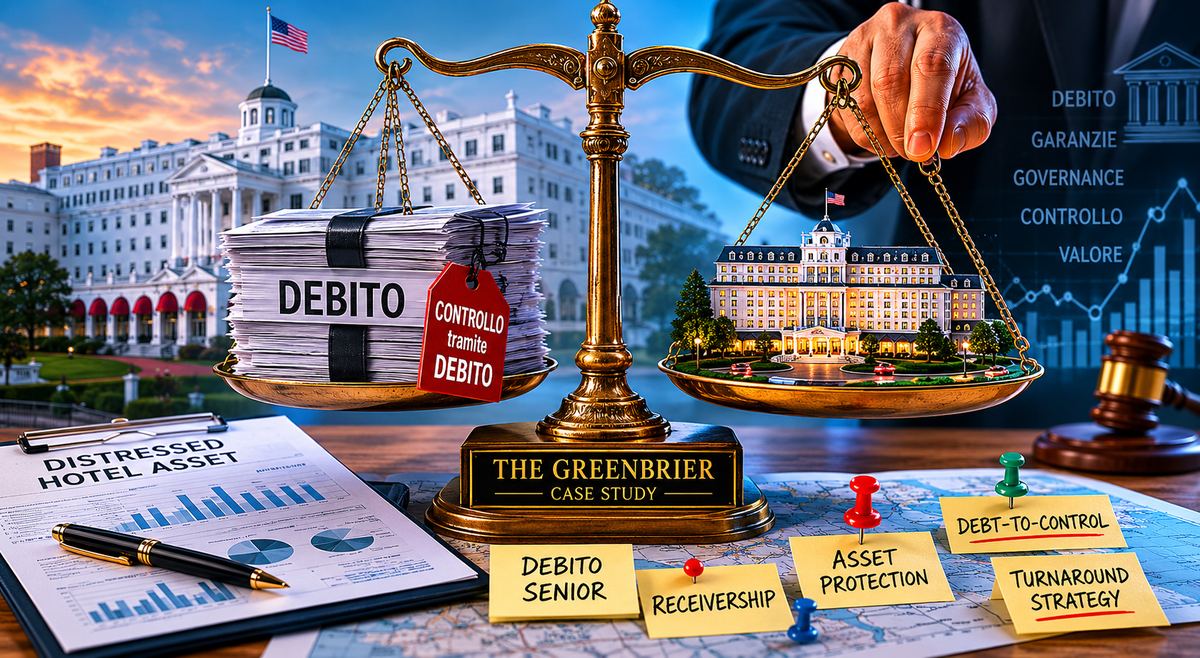
Värde did not enter the transaction by buying the hotels directly. It entered through the debt.
It acquired more than 90% of Boscolo’s debt exposure across multiple transactions, consolidated creditor positions and ultimately gained control of the equity. The original portfolio included nine luxury hotels with more than 1,300 roomsacross Rome, Florence, Venice, Milan, Nice, Budapest and Prague.
That matters because, in distressed hospitality, control does not always begin with ownership.
Sometimes it begins with the capital structure.
When a hotel group owns high-quality assets but is trapped inside a broken financial structure, the opportunity may sit in the debt rather than the real estate itself. Whoever controls the debt can often influence the future of the asset.
In Boscolo, Värde applied the classic special situations playbook: acquire the debt, gain control, reset governance, refinance, invest, reposition, rebrand and exit.
The group was transformed into The Dedica Anthology and later sold to Covivio Hotels.
The lesson for Italy is far broader than one transaction.
Many Italian hotels are not weak assets. They are strong assets inside weak structures.
They have excellent locations but opaque accounts. They have demand potential but non-industrialized management. They own valuable real estate but carry inconsistent debt. They have history but no clear positioning. They generate revenue but lack an investment thesis.
That gap between intrinsic value and institutional readiness is exactly where opportunistic capital looks.
A hotel is not just real estate. It is a capital structure with operations inside it.
Too many hotel assets are still evaluated through incomplete metrics: price per key, revenue, EBITDA, star rating, location and estimated property value.
All of these matter.
None of them is sufficient.
A hotel can look expensive and still contain hidden value. Another can look cheap and be a value trap.
The difference lies in the capital structure, debt sustainability, capex requirement, operator quality, brand relevance, distribution strategy, reputation, cash-flow resilience and exit optionality.
Värde’s approach shows that a sophisticated investor is not merely buying an asset.
It is buying a structure that can be corrected.
This is an uncomfortable but essential point for many hotel owners: a property can be valuable from a real estate perspective and still be uninvestable from an institutional perspective.
A good location is not enough. A long history is not enough. Local reputation is not enough. Valuable walls are not enough.
To attract professional capital, a hotel needs transparent numbers, clear governance, clean contracts, an industrial plan, operational discipline and a credible value-creation strategy.
A hotel does not become attractive because the owner believes it is worth a lot.
It becomes attractive when that value can be demonstrated, financed, transformed and monetized.
Barcelona Apolo: execution beats storytelling
The Hotel Barcelona Apolo case shows a more linear version of the same investment discipline.
The asset was a large four-star hotel with approximately 314 rooms in one of Europe’s most important tourism markets. Värde acquired it in 2015, improved it, refinanced it and sold it in 2021 to Meliá Hotels International for approximately €96 million.
This was not as structurally complex as Boscolo.
There was no large multi-jurisdictional group to restructure. No deeply fragmented debt exposure on the same scale. No broad corporate turnaround.
But the logic was equally disciplined:
enter, improve, stabilize, exit.
That sounds simple. It is not.
In single-asset hotel investing, value is not created by ownership alone. It is created through execution.
The investor is rewarded for buying correctly, reducing risk, improving the asset, strengthening the product and selling to the right buyer at the right time.
Many hotel owners believe value creation means waiting for the right buyer to appear.
The Värde approach suggests the opposite.
The right buyer appears when the asset has been made understandable, financeable, manageable and strategically relevant.
Flynn Properties: hotel value is not confined to luxury
One of Värde’s most revealing moves was its expansion into select-service and extended-stay hotels in the United States through its partnership with Flynn Properties.
In 2021, the joint venture acquired 20 select-service hotels from Apple Hospitality REIT for approximately $211 million. The portfolio included Marriott- and Hilton-branded assets.
In 2022, the platform expanded with the acquisition of an 80% interest in 89 select-service and extended-stay hotels, with an implied enterprise value of approximately $1.1 billion. The portfolio included Marriott, Hilton, Radisson, IHG and Choice-branded properties.
This is an important lesson for markets that often equate hotel investment quality with five-star assets, trophy properties, iconic buildings and luxury positioning.
Institutional capital often sees the market differently.
It looks for demand depth, operating standardization, cost discipline, brand strength, cash-flow predictability, scalability and manageable complexity.
That is why select-service and extended-stay hotels can be highly attractive. They may lack the media appeal of luxury hotels, but they can offer a more disciplined risk-return profile, especially when aggregated into professionally managed portfolios.
The lesson is simple:
hospitality investment is not about prestige. It is about the quality of the thesis.
A luxury hotel bought badly can destroy capital.
A select-service asset bought well, financed correctly and operated professionally can create value with far greater discipline.
Hawkins Way: when the best hotel strategy is no longer a hotel strategy
The partnership between Värde and Hawkins Way Capital introduces an even more advanced theme: adaptive reuse.
In 2022, the two firms announced a joint venture targeting more than $1 billion of investment in value-add and distressed hospitality and housing assets in major U.S. gateway cities.
Here, the question is not simply: “How can this hotel perform better?”
The more important question is:
Should this building remain a hotel at all?
After the pandemic, many urban hotels exposed structural weaknesses: lower business travel, uncertain group demand, obsolete room formats, rising operating costs, heavy capex needs, labor pressure and competition from new living formats.
In some cases, hospitality is no longer the highest and best use of the building.
The better strategy may be student housing, residential, serviced living, temporary living, senior housing, mixed-use or a hybrid model.
This is one of the most important frontiers in hospitality real estate.
The point is not to abandon hotels.
The point is to understand whether hospitality use still represents the highest-value use of the property.
Many owners avoid that question.
Sophisticated investors ask it early.
Private credit is becoming the infrastructure of hotel investment
Värde’s hospitality strategy is also important because it reflects the growing role of private credit in hotel real estate.
For decades, hotel financing was largely viewed through a traditional banking lens: mortgage, collateral, valuation, DSCR, amortization and repayment schedule.
That world has changed.
Banks are more selective. Interest rates matter more. Transitional assets are harder to finance. Capex-heavy repositionings require patient capital. Many value-add hotel strategies do not fit comfortably inside conventional lending criteria.
This is where alternative capital becomes decisive.
Värde has financed hotels, resorts, portfolios and mixed-use assets with hospitality components. In 2021, it originated more than $1 billion of hospitality real estate loans and closed a $527 million hotel-backed CRE CLO, backed by floating-rate loans secured by hotel properties.
That is a major shift.
A hotel is no longer only an equity investment.
It is collateral.
It is cash flow.
It is structured risk.
It is a credit product.
In 2024 and 2025, Värde continued this strategy in Europe through lending transactions involving hospitality components, including a €70 million refinancing for the Moran Group in Ireland, a €112 million loan for The Wings in Brussels and a €225 million refinancing linked to a luxury hotel portfolio involving Santander and Meliá.
For hotel investors, understanding debt is becoming as important as understanding the asset.
A transaction can be excellent from a real estate perspective and still fail because the capital structure is wrong.
A hotel may have strong operating potential but insufficient time to execute the plan.
It may be profitable at EBITDA level and still fragile at debt-service level.
The next phase of hotel investing will increasingly be decided not only by how much a hotel can generate, but by what type of capital is appropriate for that return profile.
The real lesson for hotel investors
The first lesson is that distress is not automatically a problem.
It can be an entry point.
But only when the underlying asset is valid and the problem is solvable.
A distressed hotel is not automatically an opportunity. Often, it is simply risk wearing the appearance of a discount. It becomes an opportunity only when location, demand, repositioning potential, execution control and sustainable capital structure are present at the same time.
The second lesson is that debt is not merely a cost.
It can be a strategic lever.
Many owners experience debt as pressure. Sophisticated investors use debt as an access point, a control mechanism and a restructuring tool.
The third lesson is that capital alone is not enough.
Värde frequently works with specialized operating partners. This means institutional capital does not replace management. It demands better management.
It demands reporting, discipline, revenue management, brand strategy, procurement, technology, distribution and accountability.
The fourth lesson is that the exit must be designed before the acquisition.
Selling to an operator, refinancing, converting, stabilizing and selling to a core buyer, securitizing the loan or holding the asset in portfolio are fundamentally different strategies.
Buying without knowing who the future buyer could be is not investment.
It is hope.
The fifth lesson is that not every hotel should remain a hotel.
This may be the most uncomfortable lesson, but it is also one of the most important. In some cases, maximum value does not come from a hotel turnaround. It comes from changing the use.
Why Värde matters for the Italian hotel market
Italy is one of the strongest tourism markets in the world. Yet it is not always one of the most readable hospitality investment markets for institutional capital.
The issue is rarely demand.
The issue is often supply structure.
Fragmented ownership. Non-industrialized accounts. Assets without capex plans. Hotels managed as family property rather than economic platforms. Confusion between real estate value and business value. Limited culture around debt, equity, governance and exit.
Värde’s playbook shows that sophisticated capital does not merely search for hotels to buy.
It searches for situations where a method can be applied.
That method requires information, numbers, control and transformation capacity.
An Italian hotel can be highly attractive to international capital if it is prepared correctly.
But it must be made investment-ready.
That means building a serious investment dossier, a credible valuation, an industrial plan, a positioning strategy, a debt analysis, a capex view, a management thesis and a plausible exit route.
Without these elements, even a good asset can remain invisible to sophisticated capital.
The point many hotel owners do not want to hear
The market does not pay for the past.
It pays for the future.
It does not pay for family history.
It pays for expected cash flow.
It does not pay for emotional value.
It pays for return potential.
It does not pay for rooms.
It pays for the hotel product.
It does not pay for location alone.
It pays for location converted into demand, revenue and margin.
This is the hardest part of the transition for many hotel owners.
They believe value is embedded in the building. Investors like Värde show that value is created through the interaction of property, capital, management and timing.
A hotel truly has value when someone can buy it, finance it, manage it, improve it and sell it again according to a credible investment logic.
Everything else is expectation.
The Värde checklist applied to a hotel asset
Before discussing price, investors should ask a deeper set of questions.
Is the debt sustainable relative to real cash flow?
Does the income statement clearly separate operations, ownership costs and extraordinary items?
Is required capex quantified or merely assumed?
Is the positioning coherent with the destination and future demand?
Is the current operator the best possible operator for the asset?
Does the brand create value or limit it?
Can the hotel be refinanced?
Is there a credible exit strategy?
Is hospitality still the highest and best use of the building?
Would a future buyer be buying a business, a property, a debt position or a conversion option?
These may sound like financial questions.
They are, in fact, deeply hotel-specific.
Because a hotel is never just a collection of rooms.
It is an economic machine that must convert location, capital, management and demand into sustainable cash flow.
Where to go deeper
For further analysis of hotel transactions, capital flows and investment strategies reshaping hospitality real estate, visit the Investimenti Alberghieri blog.
For broader guidance on hotel valuation, management, restructuring, revenue management, asset repositioning and operating models, explore the hotel guides by Roberto Necci.
Together, these resources connect the Värde case to a wider question: how can hotel assets become stronger, more transparent, more financeable and more attractive to qualified investors?
Conclusion: Värde shows where hotel investment is heading
Värde Partners is worth studying because it reads hotels for what they have become: not just properties, not just businesses, not just brands, but complex platforms of capital, operations, risk and optionality.
Its method shows that returns do not come from complexity itself.
They come from the ability to control it.
Buying debt when others are selling.
Entering assets that are undervalued because they are financially blocked.
Repositioning hotel portfolios.
Working with strong operating partners.
Using private credit as investment infrastructure.
Converting hotels when hospitality is no longer the best use.
Exiting when the market recognizes the value created.
That is the real lesson for hotel investors.
The future of hospitality real estate will not reward those who merely own buildings in attractive destinations.
It will reward those who can turn those buildings into financeable, manageable, scalable and saleable investment products.
Those who look only at the hotel see rooms, walls and stars.
Those who look like Värde see debt, control, optionality, capital, risk, timing and exit.
And in the next phase of the hotel investment cycle, that difference will define the market.
Are you evaluating the acquisition, sale, repositioning or value enhancement of a hotel asset?
Hotel Management Group supports owners, investors and operators in the strategic assessment of hotels, hospitality portfolios, distressed situations, turnaround plans, operating models and investment strategies.
A hotel should not be valued only for what it is today.
It should be valued for what it can become after the right plan.
Learn more at HotelManagementGroup.it.
Roberto Necci - r.necci@robertonecci.it