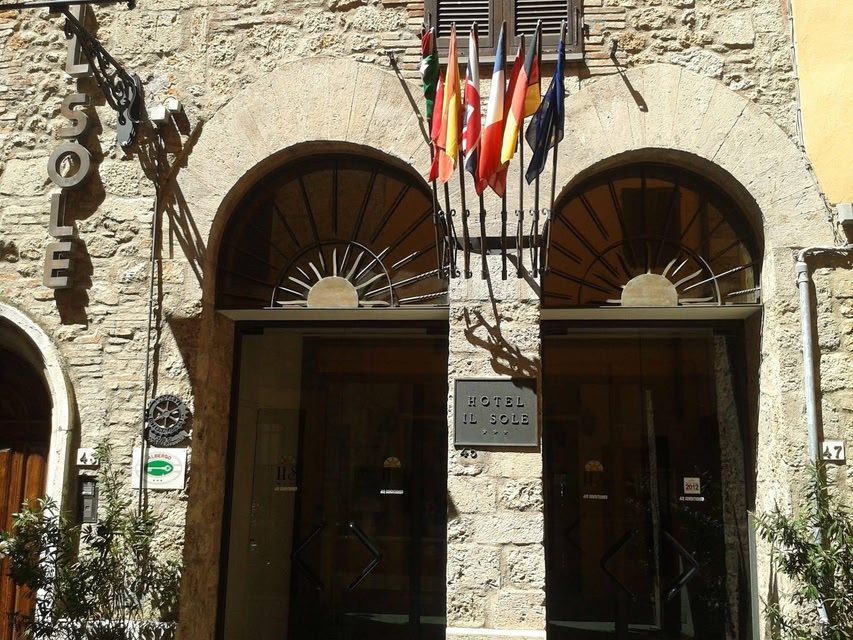
On 29 September 2026, Hotel Il Sole in Massa Marittima will return to market in the heart of this historic Tuscan town. The sale, within Bankruptcy Proceeding No. 1/2020 before the Court of Grosseto concerning Albergo Il Sole S.r.l., relates to a hotel complex at Via della Libertà 43, 45 and 47. Available information describes a three-star property of approximately 2,470 sqm arranged over five levels, with around 50 guestrooms, reception, lobby, lift, hotel infrastructure, an internal garage and furnishings. The property is reported as vacant within the proceeding. Both the asking level and minimum admissible offer are €900,000, equivalent to approximately €18,000 per physical key and €364 per sqm. These are immediately eye-catching numbers. But the real investment question lies elsewhere: acquiring a vacant, furnished hotel already configured for hospitality use does not mean acquiring a going concern. The investor needs to determine how much of the existing platform can genuinely be retained, how much needs to be repositioned and, above all, how much CAPEX can be economically justified by the ADR and GOP that the destination can realistically support. Because the risk is not only under-investing and reopening an obsolete hotel. It is also over-investing and creating a product that Massa Marittima will never be able to remunerate.
In the hotel investment market, the first fundamental distinction is:
Vacant + Furnished
≠
Operationally Ready.
And:
Real Estate + FF&E
≠
Going Concern.
But in the case of Hotel Il Sole, a third equation needs to be added:
More CAPEX
≠
More Value.
Together, these three relationships define the entire investment case.
First Certainty: Bankruptcy Proceeding No. 1/2020 — Albergo Il Sole S.r.l.
The proceeding concerns:
Albergo Il Sole S.r.l.
and is identified as:
Bankruptcy Proceeding No. 1/2020
before the:
Court of Grosseto.
In this case, the entity subject to the proceeding is the:
hotel company itself.
But this does not mean that the successful purchaser automatically acquires:
the operating business;
licences;
employees;
customers;
contracts;
OTA accounts;
brand;
database;
goodwill.
The property is reported as:
VACANT.
Therefore:
Hotel Company Bankruptcy ≠ Going-Concern Hotel Acquisition.
The real estate perimeter and the operating-business perimeter must be analysed separately.
The Sale on 29 September
The sale is scheduled for:
29 September 2026.
The deadline for submitting bids falls in the days preceding the sale.
The indicated price is:
€900,000.
The asset is offered as:
a single lot.
The property is returning to market following previous attempts to sell it.
This should not automatically be interpreted as:
a negative investment verdict.
But it is:
market information.
The correct question is:
What Has Prevented Transaction Execution So Far?
Not simply:
“Why has nobody bought it?”
Approximately 50 Rooms for €900,000
Publicly available information indicates:
approximately 50 rooms
within a building of around:
2,470 sqm.
The first headline metric is therefore:
€900,000 ÷ 50 = €18,000 per Physical Key.
The second:
€900,000 ÷ 2,470 sqm ≈ €364/sqm.
Both are exceptionally low numbers for a hotel property in the historic centre of a Tuscan tourism destination.
But:
€18,000 per Physical Key ≠ All-in Cost per Reopened Key.
And:
€364/sqm Acquisition Cost ≠ €364/sqm Hospitality Investment Cost.
The Real Price Is Calculated After Due Diligence
The true investment is:
Acquisition Price
Technical CAPEX
Compliance CAPEX
FF&E Refresh / Replacement
Technology
Brand & Digital Relaunch
Pre-opening
Working Capital
Holding & Financing Costs
=
Total Invested Capital.
Only then:
Total Invested Capital ÷ Final Saleable Keys
=
All-in Cost per Reopened Key.
That is the number that should be compared with:
Stabilised Value per Key.
Not €18,000.
The Hotel Is Vacant: An Important Advantage, but Not Enough
The property is reported as:
VACANT.
This eliminates a significant risk.
The buyer does not appear to need to wait for:
the expiry of a lease;
the departure of a tenant;
the termination of an operator.
But:
Vacant Possession ≠ Operational Continuity.
Being able to enter the property does not mean being ready to:
sell guestrooms.
The Reopening Gap Could, However, Be Shorter Than in a Pure Brownfield
Hotel Il Sole does not appear to be:
an empty hotel shell.
The property is described as including:
ensuite guestrooms;
building systems;
a lift;
air conditioning;
fire-safety infrastructure;
furnishings;
an internal garage.
This does not establish:
Current Operational Readiness.
But it raises a very important question:
how much of the existing infrastructure can be retained without compromising the future positioning?
That is where a significant part of the upside may lie.
Furniture Included ≠ FF&E Fit for Market
The fact that furnishings are already present is:
a potential advantage.
It is not an automatic saving.
Every item should be reviewed through an:
FF&E Condition Survey.
Retain
Suitable for continued use.
Refurbish
Economically recoverable.
Replace
Obsolete relative to the new positioning.
Remove
No longer valuable or itself a source of cost.
The equation becomes:
Existing FF&E
−
Obsolete FF&E
Required New FF&E
=
Net FF&E Requirement.
The False Economy of Existing Furniture
Retaining furniture that no longer meets market expectations may reduce:
CAPEX.
But it can also reduce:
ADR;
conversion;
guest satisfaction;
review scores;
brand perception.
Therefore:
CAPEX Saved Today
can become:
Revenue Lost Tomorrow.
The correct comparison is:
CAPEX Saved
vs
Lifetime GOP Lost.
That is:
FF&E Capital Allocation.
Good Physical Condition ≠ Contemporary Hotel Product
A hotel can be:
physically functional
while being commercially:
obsolete.
Design.
Bathrooms.
Lighting.
Acoustics.
Beds.
Wi-Fi.
Technology.
Access control.
Guest journey.
All affect:
ADR;
conversion;
reviews;
repeat business.
Therefore:
Good Maintenance ≠ Competitive Product.
Strong Location ≠ Strong Hotel
The commercial history of the former Hotel Il Sole appears to show an interesting divergence:
the location was viewed as one of the property’s strengths;
the product did not always fully capture that advantage.
This is a classic situation:
Strong Location
Weak Product Execution
=
Underperforming Hospitality Proposition.
And that is precisely what makes the turnaround interesting.
The Real Project May Be a Reputation Reset
The location:
already exists.
The historic centre:
already exists.
The garage:
already exists.
The guestrooms:
already exist.
What may need to be rebuilt is:
the hospitality proposition.
The equation becomes:
Legacy Property
New Product
New Brand
New Distribution
New Reputation
=
Commercial Reset.
Value creation here may depend less on:
structural transformation
and more on:
commercial transformation.
The Garage Could Be One of the Most Important Assets
In the centre of a historic Tuscan town:
parking is scarce.
An internal garage can therefore represent:
a competitive moat.
For self-drive guests, it may influence:
booking conversion;
willingness to pay;
length of stay;
guest satisfaction.
Therefore:
Historic Centre
Internal Garage
=
Potential Competitive Advantage.
But Garage ≠ Competitive Advantage Until It Is Measured
Before bidding, the investor needs to verify:
number of spaces;
dimensions;
clear height;
access;
manoeuvrability;
ZTL restrictions;
fire compliance;
EV-charging feasibility;
operational logistics;
security.
Then:
Garage Spaces ÷ Saleable Keys
=
Parking Coverage Ratio.
This could be a highly relevant metric for a hotel in the historic centre.
The Garage Could Also Become a Bike Hub
Massa Marittima has developed a meaningful positioning around:
cycling;
mountain biking;
outdoor tourism.
A portion of the garage could potentially accommodate:
secure bike storage;
e-bike charging;
bike wash;
small workshop;
drying room;
equipment storage.
The sequence would be:
Garage
→
Bike Infrastructure
→
Product Specialisation
→
Longer Stay
→
Ancillary Revenue.
But:
Bike Amenity ≠ Bike Economics.
Every square metre removed from parking should generate:
more value elsewhere.
The Garage Should Be Treated as Scarce Inventory
Capacity can be allocated among:
Hotel Guest Parking;
Premium Parking;
EV Charging;
Bike Storage;
Operational Space.
The question is not:
“How many cars can fit?”
It is:
“Which garage configuration maximises the overall value of the hotel?”
The equation may be:
Incremental ADR / Occupancy Generated by Garage
Direct Parking Revenue
Bike-Related Contribution
−
Garage Operating Cost
=
Garage Contribution to Hospitality Value.
Massa Marittima Has a Destination Thesis Far Broader Than Its Historic Centre
The destination can combine:
heritage;
culture;
events;
cycling;
outdoor;
food;
wine;
Maremma;
proximity to the coast.
This diversity allows the future hotel to build:
multiple demand layers.
Demand Generator 1 — Historic & Cultural Tourism
The central location allows the property to capture demand linked to:
the cathedral;
historic centre;
museums;
mining heritage;
events;
Tuscany touring.
The principal advantage is:
walkability.
For a heritage hotel:
Destination Access
may be more important than:
Internal Amenity Density.
Demand Generator 2 — Bike & Outdoor
Cycling demand can generate:
shoulder-season business;
international guests;
multi-night stays;
groups;
ancillary spend.
For a hotel with a garage:
Bike Tourism
can become:
a Product Vertical.
Not merely:
a page on the website.
Demand Generator 3 — Maremma + Coast
Relative proximity to the coast may add:
summer spillover;
touring demand;
mixed itineraries;
longer stays.
But:
20 km from the Sea ≠ Beach Hotel.
The coast should be:
a demand extension.
Not:
the product identity.
The Demand Formula Could Become
Culture
Bike / Outdoor
Events
Maremma Touring
Coastal Spillover
=
Diversified Demand Stack.
The strength of the model lies in its potential to reduce:
seasonality concentration.
Demand Diversification ≠ Occupancy
Having five possible demand segments does not mean capturing them.
The hotel will still need:
distribution;
content;
pricing;
partnerships;
international sales;
revenue management;
reputation.
The equation is:
Destination Demand
×
Product Fit
×
Distribution Effectiveness
×
Conversion
=
Captured Demand.
Fifty Rooms Can Be an Attractive Scale
With approximately:
50 keys,
the hotel is large enough to support:
groups;
tour operators;
revenue management;
international distribution;
cycling groups;
small events.
But small enough to operate with:
lean staffing;
outsourcing;
centralised sales;
digitalisation.
The risk is:
Full-Service Cost Structure
50-Key Revenue Base
=
Margin Compression.
Historic 3-Star ≠ Future Product Strategy
The fact that the historic hotel was positioned as:
three-star
does not mean the future property should replicate:
the same three-star product.
The process should begin with:
room sizes;
bathrooms;
building constraints;
guest expectations;
competitive set;
ADR ceiling.
Only then should the investor determine:
classification;
brand;
service level.
Classification should be:
an output.
Not:
the strategy.
Four Potential Investment Theses
Scenario 1 — Contemporary Heritage Hotel
Design consistent with Massa Marittima.
Guestroom upgrade.
Strong breakfast.
Lean service.
Garage.
International leisure.
Driver:
Location Premium + Product Upgrade.
Scenario 2 — Bike & Maremma Hotel
Bike room.
Workshop.
Garage.
E-bike charging.
Early breakfast.
Laundry / drying facilities.
Outdoor partnerships.
Driver:
Product Specialisation + Shoulder-Season Demand.
Scenario 3 — Maremma Lifestyle Hotel
Contemporary design.
Food & wine.
Culture.
Outdoor.
Coast.
Driver:
ADR Repositioning.
Scenario 4 — Heritage + Outdoor Hybrid
Culture.
Cycling.
Maremma touring.
Events.
Coastal spillover.
Driver:
Demand Diversification + Seasonality Reduction.
This may offer the best balance between:
breadth of demand
and:
operating simplicity.
Product Upgrade ≠ Service Inflation
A major mistake would be to equate:
higher positioning
with:
more services.
Spa.
Gym.
Full-service restaurant.
Meeting facilities.
Complex bar concept.
Not necessarily.
Every amenity brings:
CAPEX;
staff;
energy;
maintenance.
The question should be:
Does This Amenity Increase Sustainable GOP?
Not:
Does This Amenity Make the Hotel Look More Upscale?
Better Product + Lean Service Model
The upgrade could focus on:
beds;
bathrooms;
lighting;
acoustics;
design;
Wi-Fi;
breakfast;
digital guest journey;
parking;
bike services.
The ideal equation may be:
Better Product
Lean Service Model
=
Higher ADR + Controlled OPEX.
This Creates the Opposite Risk: Over-CAPEX
So far, the risk appears to be:
investing too little.
But the opposite risk is equally important:
investing too much.
A hotel can be:
beautifully renovated
while being:
economically overbuilt.
If the market can support a stabilised ADR of X,
it makes little sense to create a product whose CAPEX requires:
an ADR of X + 50%.
Therefore:
Great Design ≠ Good Investment.
Under-Investment vs Over-Investment
The project needs to avoid two extremes.
Under-Investment
CAPEX too low.
Dated product.
Weak ADR.
Mediocre reviews.
Fragile occupancy.
Result:
Cheap Reopening + Weak GOP.
Over-Investment
CAPEX too high.
A product superior to what the destination can remunerate.
Insufficient ADR ceiling.
Low return on incremental capital.
Result:
Beautiful Hotel + Weak Yield on Cost.
The optimum lies between the two.
Minimum Efficient CAPEX
The real objective should be:
Minimum CAPEX Required to Maximise Sustainable GOP and Stabilised Value.
Not:
Minimum CAPEX Possible.
And not:
Maximum Product Quality Possible.
This is true:
capital allocation discipline.
Repositioning ROI: What Does Each Additional Euro of Investment Earn?
This is the decisive metric.
Assume that beyond Mandatory CAPEX the buyer can invest:
additional capital into repositioning.
The question becomes:
how much additional GOP does that investment generate?
The formula is:
Incremental Stabilised GOP from Repositioning
÷
Incremental Repositioning CAPEX
=
Repositioning ROI.
Conceptual example:
if €500,000 of additional CAPEX generates:
€75,000 of incremental stabilised GOP,
the Repositioning ROI is:
15%.
This is not a forecast for Hotel Il Sole.
It is the methodology for deciding:
whether those €500,000 should be invested.
Every CAPEX Package Should Have Its Own ROI
The buyer should build a:
CAPEX ROI Matrix.
Rooms Refresh
CAPEX.
ADR uplift.
Occupancy uplift.
Incremental GOP.
ROI.
Bathroom Upgrade
CAPEX.
Product uplift.
ADR impact.
Review impact.
Incremental GOP.
ROI.
Garage / EV
CAPEX.
Parking revenue.
Conversion uplift.
ROI.
Bike Hub
CAPEX.
Bike room nights.
Ancillary spend.
Shoulder-season contribution.
ROI.
Full Rebrand
CAPEX.
Distribution improvement.
ADR uplift.
Customer acquisition cost.
ROI.
This allows investments to be ranked by:
capital efficiency.
Not All CAPEX Euros Are Equal
One euro spent on:
fire compliance
is:
Mandatory Capital.
One euro spent on:
a better mattress
may be:
Product Capital.
One euro spent on:
a designer feature with no ADR impact
may be:
Non-Economic Capital.
The investor should distinguish between:
Mandatory CAPEX
Revenue-Generating CAPEX
Value-Accretive CAPEX
Non-Economic CAPEX.
The last category should be eliminated.
Incremental Value Creation
The second test is:
Incremental Stabilised Value
−
Incremental Repositioning CAPEX
=
Net Value Created by Repositioning.
If positive:
the CAPEX creates value.
If close to zero:
the investor is taking execution risk without sufficient reward.
If negative:
the asset is being:
over-capitalised.
CAPEX Should Stop When Marginal Returns Fall Too Far
This is the professional logic.
For every additional euro:
Incremental GOP
÷
Incremental CAPEX
=
Marginal Repositioning Return.
As long as the marginal return exceeds the required return:
the CAPEX may be justified.
Once it falls below it:
stop investing.
The rule is:
Marginal Repositioning Return > Required Return
→
Invest.
Marginal Repositioning Return < Required Return
→
Stop.
That is the real:
CAPEX Ceiling.
Destination ADR Ceiling: The Market Places a Limit on Investment
A hotel cannot be underwritten solely from the perspective of:
construction cost.
There is also:
Revenue Capacity.
The destination and competitive set place an upper limit on:
ADR;
occupancy;
RevPAR.
Therefore:
Maximum Sustainable CAPEX
should be derived from:
Maximum Sustainable GOP.
Not the other way around.
The correct sequence is:
Market ADR
→
Occupancy
→
RevPAR
→
GOP
→
Required Yield on Cost
→
Maximum Total Invested Capital
→
Maximum CAPEX
→
Maximum Bid.
This is the opposite of the classic mistake:
Buy → Renovate → Hope for the ADR.
The Real Risk at Hotel Il Sole Is Over-CAPEX in a Secondary Destination
Massa Marittima offers:
quality;
beauty;
differentiation;
tourism appeal.
But it should not be underwritten like:
Florence;
Rome;
Venice.
Every euro of CAPEX must be consistent with:
destination pricing power.
The correct question is:
“How much can the guest realistically pay to stay here?”
Not:
“How much can we spend to make the hotel beautiful?”
The Digital Legacy Must Be Resolved Before Rebranding
The former Hotel Il Sole still carries:
name recognition;
search history;
reviews;
digital footprint.
But potentially also:
legacy reputation.
The buyer needs to verify:
domain;
Google Business Profile;
Tripadvisor;
Booking.com;
Expedia;
social channels;
database;
brand rights.
Because:
Digital Footprint ≠ Transferable Digital Asset.
Rebrand or Retain?
Relaunch Hotel Il Sole
Advantages:
local awareness;
historic search presence;
brand familiarity.
Disadvantages:
legacy reputation.
New Brand
Advantages:
clean slate;
new review base;
new design narrative;
new positioning.
Disadvantages:
customer acquisition cost;
no initial reputation;
SEO restart.
The equation is:
Brand Equity Retained
−
Reputation Liability Retained
=
Net Legacy Brand Value.
CAPEX Should Be Divided into Four Levels
1. Mandatory CAPEX
Fire safety.
MEP.
Lift.
Electrical.
Plumbing.
Accessibility.
Compliance.
2. Product CAPEX
Rooms.
Bathrooms.
Beds.
Lighting.
Acoustics.
Corridors.
Reception.
Breakfast.
3. Value-Accretive CAPEX
Garage enhancement.
EV charging.
Bike facilities.
Digital access.
High-speed connectivity.
Selective premium guestrooms.
4. Optional / Lifestyle CAPEX
Additional amenities.
Design features.
Non-core services.
This fourth category must pass:
the Repositioning ROI test.
Otherwise:
do not spend.
The Reopening Gap Could Be the Real Competitive Advantage
The sequence may be relatively short:
Auction Award
→
Possession
→
Technical DD Confirmation
→
Selective CAPEX
→
FF&E Refresh
→
Compliance
→
Brand & Distribution Setup
→
Pre-opening
→
Reopening.
If genuinely achievable:
the project could benefit from:
Speed to Cash Flow.
Speed to Cash Flow Is Part of the Return
The relationship is:
Shorter Reopening Gap
→
Lower Holding Cost
→
Earlier Revenue
→
Lower Capital at Risk
→
Higher Effective Return.
Two hotels with the same:
Total Project Cost
and the same:
Stabilised GOP
can produce very different returns if one opens:
much earlier.
But “Vacant, Furnished and in Good Condition” Is Not Enough
These are positive headlines.
They are not:
Investment Due Diligence.
The buyer still needs to verify:
rooms;
bathrooms;
HVAC;
electrical systems;
plumbing;
fire safety;
lift;
roof;
windows;
acoustics;
furniture;
garage;
technology;
licences.
Therefore:
Public Listing ≠ Investment Data Room.
The Business Plan Starts with Final Saleable Keys
The approximately:
50 rooms
are only the starting point.
The investor needs to verify:
Physical Keys;
Authorised Keys;
Compliant Keys;
Saleable Keys.
Then:
Final Saleable Keys × 365
=
Available Room Nights.
Only then should the model build:
ADR;
Occupancy;
RevPAR;
Rooms Revenue;
Distribution Cost;
Payroll;
Energy;
GOP.
Break-even Occupancy Before Maximum Bid
With 50 saleable keys:
50 × 365 = 18,250 Available Room Nights.
The formula is:
Fixed Operating Costs
−
Ancillary Contribution
=
Fixed Costs to Be Covered by Rooms.
Then:
Fixed Costs to Be Covered by Rooms
÷
Contribution per Occupied Room
=
Break-even Occupied Room Nights.
Finally:
Break-even Occupied Room Nights
÷
18,250
=
Break-even Occupancy.
That is the true operating stress test.
Repositioning Uplift
One of the central questions is:
how much can the new product improve:
ADR;
Occupancy;
RevPAR;
reviews;
direct bookings.
The difference between:
Legacy Performance
and:
Stabilised Repositioned Performance
is:
Repositioning Uplift.
But that uplift must be compared with:
Incremental CAPEX.
Repositioning Efficiency
A useful metric may be:
Incremental Stabilised GOP
÷
Repositioning CAPEX
=
Repositioning Efficiency.
The higher the ratio:
the more efficient the use of capital.
This allows the investor to compare:
deep refurbishment;
light refurbishment;
selective refurbishment.
Three CAPEX Strategies
Light Repositioning
Minimum works.
FF&E refresh.
Technology.
Branding.
Fast reopening.
Advantage:
low capital;
fast cash flow.
Risk:
insufficient ADR uplift.
Selective Repositioning
Rooms and bathrooms prioritised.
Public areas upgraded selectively.
Garage and bike services.
Digital reset.
Advantage:
balanced CAPEX / revenue uplift.
This is probably the strategy that deserves the greatest scrutiny.
Deep Repositioning
Full design transformation.
Major FF&E programme.
Heavy public-area works.
Potential service expansion.
Advantage:
higher positioning.
Risk:
Over-CAPEX.
The Choice Must Not Be Aesthetic
The decision between:
light;
selective;
deep
should not be based on:
how beautiful the hotel becomes.
It should be based on:
which option creates the highest risk-adjusted value.
The equation is:
Stabilised Value after Repositioning
−
Total Project Cost
=
Net Value Creation.
Three Economic Scenarios
Downside Case
Low acquisition basis.
But:
hidden technical CAPEX;
obsolete FF&E;
weak brand reset;
garage constraints;
slow reopening;
low ADR;
deep refurbishment not supported by destination pricing.
Result:
Low Purchase Price + Hidden CAPEX + Over-Investment + Weak ADR = Value Trap.
Base Case
Disciplined acquisition.
Technically recoverable asset.
Selective CAPEX.
Most rooms retained.
Rooms and bathrooms upgraded where economically justified.
Garage fully leveraged.
Rebrand.
Professional revenue management.
Culture + outdoor demand.
Fast reopening.
Result:
Efficient CAPEX + Fast Reopening + Sustainable 50-Key Hotel.
Upside Case
Low entry basis.
Highly selective capital allocation.
Strong design repositioning.
Digital reputation reset.
Garage as a competitive moat.
Bike segment developed professionally.
International distribution.
Culture + outdoor + Maremma demand stack.
Strong ADR uplift.
Short reopening gap.
High Repositioning ROI.
Result:
Low Entry Basis + High Capital Efficiency + Fast Cash Flow + Strong Repositioning Uplift + Asset Re-rating.
Yield on Cost Remains the Final Arbiter
The formula is:
Stabilised Operating Return
÷
Total Invested Capital
=
Yield on Cost.
The denominator is not:
€900,000.
It is:
all the capital required to create the future hotel.
Development / Repositioning Spread
Then:
Yield on Cost
−
Stabilised Market Yield
=
Development / Repositioning Spread.
If the return on cost is materially higher than the yield required by the market:
Value Is Created.
If CAPEX absorbs the entire advantage of the low acquisition basis:
the discount disappears.
Maximum Bid Must Be Derived Backwards
The professional sequence is:
Destination Demand
→
Product Strategy
→
Final Saleable Keys
→
ADR
→
Occupancy
→
RevPAR
→
GOP
→
Break-even Occupancy
→
Repositioning Uplift
→
Repositioning ROI
→
CAPEX Ceiling
→
Time to Reopen
→
Total Invested Capital
→
Yield on Cost
→
Stabilised Value
→
Maximum Bid.
Not:
€18k per Key Looks Cheap
→
Buy.
The Real Value Creation Flywheel
Value creation may follow this sequence:
Low Acquisition Basis
→
Selective CAPEX
→
Better Product
→
Higher Conversion
→
Higher ADR
→
Better Reviews
→
Higher Occupancy
→
Higher RevPAR
→
Higher GOP
→
Higher Yield on Cost
→
Asset Re-rating.
But only if:
Incremental GOP
grows faster than:
Incremental CAPEX.
Otherwise, the flywheel breaks.
The Fourteen Questions to Answer Before Bidding
Are all approximately 50 rooms authorised and genuinely saleable?
What is the actual condition of HVAC, electrical systems, plumbing and the lift?
What is the current status of fire-safety compliance?
Which furnishings are actually included in the sale?
How much of the existing FF&E should genuinely be retained?
What is the effective capacity of the garage?
How much value does the garage actually generate?
Does a bike hub generate enough contribution to justify the space it occupies?
Should Hotel Il Sole be retained as a brand or fully rebranded?
What is the realistic ADR ceiling in Massa Marittima?
What level of CAPEX maximises Repositioning ROI?
Where is the point beyond which Over-CAPEX begins?
What is the realistic Time to Reopen?
What Maximum Bid is compatible with an adequate Yield on Cost and Development Spread?
These are the questions that determine:
whether €900,000 is cheap or expensive.
Conclusion: The Real Asset Is Not 50 Rooms at €18,000 Each. It Is the Opportunity to Turn a Good Location into a Good Hotel Without Spending More Than the Market Can Remunerate
On 29 September 2026, an asset with difficult-to-ignore characteristics comes to market:
approximately 50 rooms.
Approximately 2,470 sqm.
Historic centre of Massa Marittima.
Historic three-star positioning.
Internal garage.
Lift.
Existing building systems.
Furnishings.
Vacant possession.
Price: €900,000.
The destination adds:
heritage;
culture;
events;
cycling;
outdoor;
Maremma;
coastal spillover.
But the real investment question is not:
50 rooms × €18,000.
It is the distance between:
Legacy Hotel
and:
Economically Optimal Future Hotel.
The correct sequence is:
Vacant Hotel
→
Technical Verification
→
FF&E Audit
→
Product Strategy
→
Selective CAPEX
→
Garage / Mobility Strategy
→
Brand Reset
→
Culture + Bike + Maremma Demand Stack
→
Fast Reopening
→
Reputation Rebuilding
→
Stabilised GOP
→
Repositioning ROI
→
Yield on Cost
→
Asset Re-rating.
Because:
Vacant ≠ Operating.
Furnished ≠ Market-Ready.
Existing FF&E ≠ Valuable FF&E.
Historic 3-Star ≠ Future Product Strategy.
Garage ≠ Monetised Competitive Advantage.
Strong Location ≠ Strong Hotel.
Digital Legacy ≠ Brand Equity.
More CAPEX ≠ More Value.
Beautiful Hotel ≠ Good Investment.
And, above all:
Incremental Stabilised GOP
÷
Incremental Repositioning CAPEX
=
Repositioning ROI.
While:
Incremental Stabilised Value
−
Incremental Repositioning CAPEX
=
Net Value Created by Repositioning.
The buyer should not ask:
“How much can we spend to make the hotel more beautiful?”
The correct question is:
“What is the minimum amount of capital required to maximise sustainable GOP and stabilised value?”
That is the real issue.
Because the investment can fail in two ways.
By spending:
too little
and reopening an obsolete hotel.
Or by spending:
too much
and creating a hotel the destination cannot economically support.
The optimum is:
Minimum Efficient CAPEX
capable of generating:
Maximum Sustainable GOP.
If the buyer can combine:
Low Entry Basis
Selective CAPEX
Garage Scarcity
Product Repositioning
Short Reopening Gap
ADR Uplift
High Repositioning ROI
then Hotel Il Sole can become:
a genuine value-creation investment.
If, instead, the investor confuses:
renovation
with:
value creation,
even a hotel acquired at:
€18,000 per room
can become:
too expensive.
InvestimentiAlberghieri.it Advisory
InvestimentiAlberghieri.it analyses hotel auctions, insolvency proceedings, inactive hotels, repositioning opportunities, hospitality brownfields and special situations, from origination through to the design of a new economic and operating model.
For pre-auction underwriting, hotel valuation, due diligence, CAPEX analysis, FF&E audits, repositioning strategy, Repositioning ROI, feasibility studies, business planning, operator search, Revenue Management, Yield on Cost and reopening planning:
info@investimentialberghieri.it
Complementary expertise and insights:
Robertonecci.it — hospitality advisory, valuations and specialist guides covering hotel investment, distressed hotels, contracts and asset management
Investhotel.it — hotel acquisitions, disposals, conversions, repositionings and turnaround transactions
HotelManagementGroup.it — hotel management, temporary management, revenue management, asset management and repositioning