Demolition has been completed. Reconstruction is expected to be finished by 2029. Yet for anyone looking at the project through an investor’s lens, the real question is not what has been torn down, but how much value the new Hotel Gioli will be able to generate once it becomes operational.
In Ascoli Piceno, one of the city’s long-established hotels has physically disappeared, making way for an entirely different project: not a conventional refurbishment, but a full demolition and redevelopment designed to reposition the asset within the upscale hospitality market.
According to Corriere Adriatico, following the completion of demolition works at the historic property on Viale De Gasperi, the current timeline points to 2029 for completion of the redevelopment.
This is precisely where the Hotel Gioli story becomes particularly relevant from an InvestimentiAlberghieri.it perspective.
This is no longer simply about restoring an old hotel.
It is a genuine hotel development project, where cost of capital, development timeline, room count, positioning and the ability to generate EBITDA will ultimately matter far more than the historical value of the building that has now been demolished.
From a historic hotel to a new hospitality product
For decades, Hotel Gioli represented an established part of Ascoli’s hospitality landscape.
Over the years, the property became part of the city’s history and hosted prominent figures from the worlds of film and entertainment. Operations eventually ceased in 2020.
In June 2026, Ascoli Piceno City Council unanimously approved the redevelopment plan for the property.
Demolition subsequently began.
That decision is significant.
When a hotel building is completely redesigned rather than simply refurbished, the economics of the transaction change substantially: the objective is no longer merely to recover a real estate asset, but to create an entirely new competitive positioning.
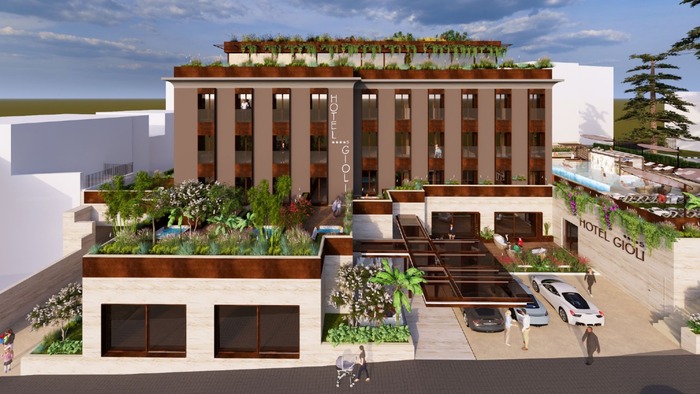
The project is expected to incorporate sustainable construction principles, energy efficiency, seismic safety, accessibility, wellness facilities, a swimming pool, solarium, landscaped areas and services designed around the guest experience and the surrounding destination.
Local media have also described the new Gioli as a future five-star hotel, which would represent a significant repositioning compared with the previous property.
The first question an investor should ask: how many rooms will the hotel actually have?
One particularly interesting issue already emerges from the publicly available information.
In June 2026, ANSA, reporting on the approved redevelopment project, referred to a reduction from 56 to 44 rooms, while increasing total bed capacity from 77 to 88.
A later media report published in September instead referred to 64 rooms and 88 beds.
That discrepancy is anything but marginal.
For an investor, moving from 44 to 64 keys would materially affect:
-
investment per key;
-
average room size;
-
potential rooms revenue;
-
fixed-cost absorption;
-
staffing requirements;
-
total accommodation capacity;
-
potential GOP;
-
stabilised enterprise value.
Before attempting any meaningful valuation of the project, it would therefore be essential to verify the currently approved execution plan and the final number of keys.
It is a small but telling example of what hotel due diligence should always involve: media reports can describe a transaction, but value must be assessed on the basis of verified documentation.
A five-star hotel is not created simply by putting five stars on the door
The move towards the luxury segment is arguably the most interesting element of the entire project.
It is also the most challenging.
An outstanding building does not automatically translate into a high-performing hotel.
The key question will be:
What ADR can Ascoli Piceno realistically support for a property positioned at this level?
Much of the business plan depends on the answer.
A five-star hotel requires:
-
higher service standards;
-
greater staffing intensity;
-
more sophisticated housekeeping operations;
-
food & beverage consistent with the positioning;
-
professional wellness management;
-
international distribution;
-
appropriate marketing expenditure;
-
the ability to generate demand beyond peak periods.
The property will therefore need to do more than simply increase room rates.
It will have to create a sufficiently compelling reason for the market to be willing to pay them.
That distinction is fundamental.
As we have repeatedly highlighted on Robertonecci.it, a hotel’s official category and its actual economic positioning are not necessarily the same thing.
The real risk is building the property correctly but getting the hotel product wrong
A development of this nature should be analysed starting with the market, not with the architecture.
The sequence should be:
demand, target segment, sustainable ADR, occupancy, RevPAR and GOP.
Only then should the physical product be sized and designed accordingly.
Reversing that sequence creates one of the most common risks in hotel development: delivering a high-quality property that the local market is subsequently unable to remunerate adequately.
This is precisely where feasibility studies, positioning analysis and hospitality advisory — such as the work carried out by HotelManagementGroup.it — become essential in hotel redevelopment projects.
The key question is not whether the new Gioli will be more attractive than the old hotel.
The question is how much revenue it will need to generate to deliver an adequate return on the capital invested.
2029: time becomes part of the economics
The current completion horizon is 2029.
This means the investment must also be assessed through a variable that is too often underestimated: time.
Between demolition, detailed design, construction, building services, fit-out, FF&E, pre-opening activities and commercial ramp-up, several years may pass during which a substantial amount of capital remains deployed without yet producing hotel EBITDA.
A robust financial model should therefore incorporate at least:
acquisition cost + demolition + construction + building systems + FF&E + professional fees + development charges + financing costs + pre-opening expenditure + working capital + contingency.
Only then can the total capital invested be compared with the potential value of the hotel once stabilised.
The cost of time is not a footnote.
It is financial CAPEX.
And the longer the development phase lasts, the greater the level of operating performance the asset will ultimately need to deliver in order to justify the investment.
At Investhotel.it, hotel investments are analysed precisely through the relationship between financial structure, cash-generating capacity and the long-term industrial sustainability of the project.
Wellness, swimming pool and guest experience are not merely amenities
Wellness facilities, a swimming pool, solarium, landscaped areas and food-and-wine experiences could become important components of the new hotel offering.
But there is an essential distinction between an amenity and a profit centre.
Every square metre of a hotel carries a cost.
A wellness area that supports higher room rates or generates its own revenue can create value.
A costly, underutilised wellness facility with high operating requirements can destroy it.
The same principle applies to restaurants, bars, public areas and ancillary services.
In contemporary hotel development, the question should no longer simply be:
“How much does it cost to build?”
It should be:
“How much value does each component of the investment generate?”
The final value will not be determined by the cost of reconstruction
One of the most common mistakes in hotel real estate is to assume that:
property value + refurbishment or construction cost = final hotel value.
It does not work that way.
Once operational, a hotel is primarily assessed on its ability to generate sustainable income.
The value of the new Hotel Gioli will therefore depend on variables including:
-
ADR;
-
occupancy;
-
RevPAR;
-
total revenue;
-
GOP;
-
EBITDA;
-
labour costs;
-
food & beverage performance;
-
profitability of ancillary services;
-
financial structure;
-
total CAPEX;
-
potential brand affiliation;
-
quality of management.
Two hotels developed with exactly the same capital investment can ultimately have completely different values if one generates twice the EBITDA of the other.
This is why hotel real estate and the hotel operating business cannot be analysed in isolation.
Ascoli itself will also need to support the new positioning
The Hotel Gioli project ultimately raises a question that extends beyond the boundaries of the property itself.
Can Ascoli Piceno support a growing supply of upscale and luxury hotel accommodation?
The city is seeing new hospitality developments and redevelopment projects emerge. Palazzo Saladini Pilastri, for example, is also expected to accommodate a four-star hotel with 26 rooms.
A broader supply of higher-quality accommodation could create a positive effect:
increasing destination visibility, attracting new demand and allowing Ascoli to compete for higher-spending traveller segments.
But supply does not create demand by itself.
Performance will also depend on accessibility, events, cultural tourism, leisure demand, business travel, average length of stay and the destination’s ability to market itself effectively across both domestic and international markets.
The investment thesis therefore extends beyond Hotel Gioli itself.
It also concerns Ascoli’s ability to evolve as a hotel destination.
The real investment starts now
The excavators have finished their work.
From an investor’s perspective, however, the most complex phase is only just beginning.
Over the coming years, deployed capital, architectural design and commercial ambition will have to be transformed into a hotel business capable of generating sustainable returns.
The success of the new Hotel Gioli will therefore not be measured solely by the quality of the building scheduled to open in 2029.
It will be measured by its ability to achieve an ADR consistent with the capital invested, maintain healthy occupancy levels, control operating costs, generate an appropriate GOP and convert its new positioning into economic value.
Demolishing the old hotel was the visible part of the transaction.
Building an economically sustainable hotel will be the decisive one.
And this is exactly where the real estate story ends and the hotel investment analysis begins.
Hotel Investment Analysis
InvestimentiAlberghieri.it analyses hotel acquisitions, redevelopments, conversions, distressed opportunities and new developments by integrating real estate, operational and financial analysis.
To submit an investment opportunity or request an independent analysis:
info@investimentialberghieri.it