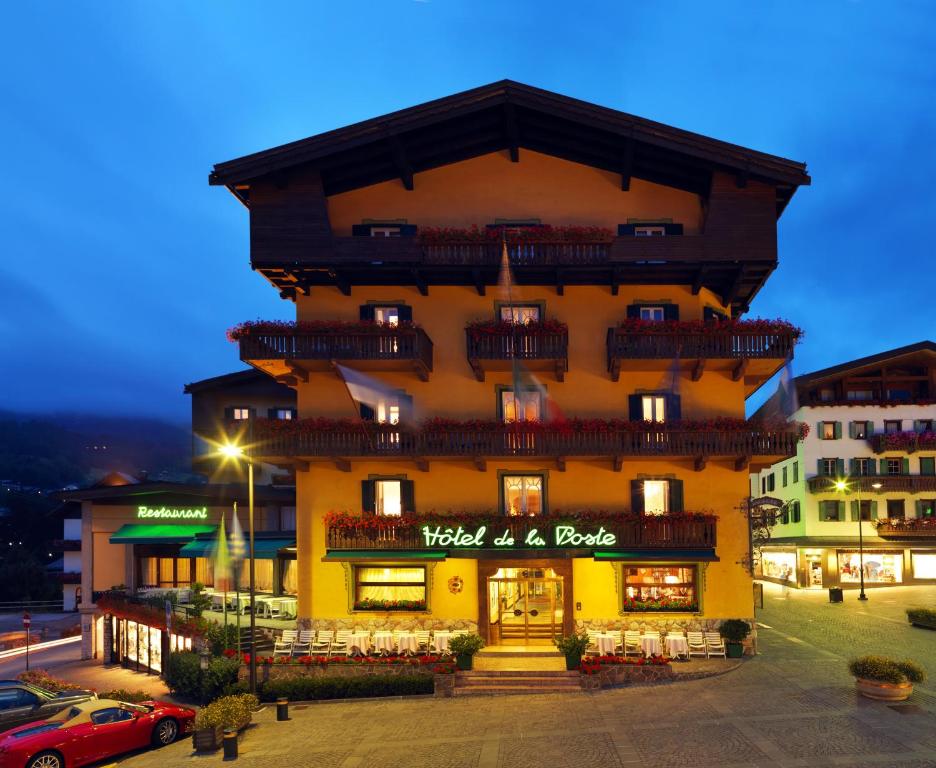
The former three-star hotel on Viale Manzoni was acquired at auction by a Cyprus-based company. According to reporting by Il Tirreno, the transaction is backed by Russian entrepreneurs and capital. The proposed redevelopment would involve lifting the hotel-use restriction and converting the property into residential apartments. Yet the purchase price is only the first component of the overall investment.
A hotel comprising 54 rooms across six floors, acquired at auction for €460,000.
The figures surrounding the former Hotel Augustus in Montecatini Terme are immediately striking: the entry price equates to approximately €8,500 per room.
That appears exceptionally low, particularly when compared with the cost of developing a hotel of similar size today.
It would be a mistake, however, to conclude that the property was necessarily acquired at an extraordinarily attractive price.
A hotel that has been closed for years, has fallen into disrepair, generates no revenue, requires a full technical assessment and may need a change of use is not simply an undervalued building. It is a complex redevelopment project in which the purchase price may represent only a small fraction of the total capital required.
That is the real investment story behind the Hotel Augustus transaction.
Hotel Augustus in Montecatini: the key transaction details
According to Il Tirreno, the former Hotel Augustus on Viale Manzoni operated as a three-star hotel before closing and gradually falling into a state of abandonment.
An initial auction, reportedly based on a starting price of approximately €340,000, failed to produce a successful sale.
A subsequent procedure was completed at an acquisition price of approximately €460,000.
Property snapshot
-
Location: Montecatini Terme
-
Address: Viale Manzoni
-
Original use: three-star hotel
-
Number of rooms: 54
-
Building configuration: six floors
-
Purchase price: approximately €460,000
-
Indicative price per room: approximately €8,500
-
Current condition: closed and requiring comprehensive redevelopment
-
Proposed project: conversion into residential apartments
-
Acquiring entity: Cyprus-based company
-
Source of capital: linked, according to the newspaper’s reporting, to Russian entrepreneurs and capital
The price per room is eye-catching, but it is not sufficient to determine whether the transaction represents an attractive investment.
A proper assessment of the Hotel Augustus would require detailed information on:
-
total gross and net floor area;
-
planning and cadastral compliance;
-
structural and building-services conditions;
-
any legal, heritage or planning restrictions;
-
remediation and safety costs;
-
development contributions and change-of-use charges;
-
total refurbishment expenditure;
-
administrative approval timelines;
-
achievable apartment sale values;
-
the local market’s capacity to absorb the completed units.
These are precisely the matters that should be examined during due diligence before an acquisition is completed—not after it.
Transactions involving disused hotels require an integrated property, financial, planning and operational assessment, as consistently highlighted in the research and analysis published by InvestimentiAlberghieri.it.
Why €460,000 is not the true cost of the investment
The auction price secures ownership of the building. It does not automatically make the property usable, marketable or profitable.
The purchaser will presumably need to account for additional costs including:
-
legal and notarial fees;
-
technical surveys and design work;
-
structural interventions;
-
seismic upgrading, where required;
-
complete replacement or refurbishment of building systems;
-
energy-efficiency improvements;
-
remediation works;
-
planning and development charges;
-
financing costs;
-
marketing and sales expenses;
-
taxes;
-
delays and unforeseen expenditure.
Any preliminary cost estimate for a building that has remained closed for years must be treated with caution.
A system that initially appears recoverable may require complete replacement. A change of use believed to be achievable may take significantly longer than expected. An estimated residential sale value may prove too optimistic when tested against actual demand.
For this reason, the real investment is not the €460,000 paid at auction.
The full investment equation is:
acquisition price + refurbishment costs + approvals + financing costs + holding period + commercial risk.
This distinction is also central to the transactions assessed by Investhotel.it, where the value of a hotel property is determined not simply by its room count, but by its capacity to generate sustainable income or support a viable alternative redevelopment strategy.
Can a 54-room hotel really be worth so little?
Yes—when valued in its current condition.
A closed hotel produces no revenue, generates no operating profit, has no recent trading record and cannot easily be assessed using conventional income-based valuation methods.
The number of rooms, moreover, does not automatically translate into economic value.
A hotel may contain a significant number of rooms and still have limited value where it is affected by:
-
insufficient demand;
-
an obsolete or uncompetitive product;
-
excessive operating costs;
-
inefficient floor plans;
-
heavy dependence on intermediaries;
-
inadequate average daily rates;
-
accumulated maintenance requirements;
-
an outdated operating model;
-
substantial capital expenditure needs;
-
planning or regulatory difficulties.
The Hotel Augustus transaction illustrates a fundamental principle: a hotel property only retains its full value as a hotel when there is a market, an operating model and a business plan capable of generating income.
Without those elements, its value may be driven primarily by the land, the physical structure or the potential for an alternative use.
The proposed conversion into apartments
According to the available reporting, the new owner intends to convert the former Hotel Augustus into residential apartments by securing the removal of the existing hotel-use restriction.
Residential conversion may appear more straightforward than reopening the property as a hotel. Profitability, however, is far from automatic.
A credible development appraisal should consider:
-
net saleable area;
-
the number and size of the proposed apartments;
-
subdivision and conversion costs;
-
required quality and specification standards;
-
common areas that cannot be sold;
-
parking availability;
-
planning and approval timelines;
-
actual achievable sale prices;
-
the local absorption rate;
-
the investor’s required return.
Apartment values cannot be estimated solely by reference to asking prices published in property listings.
The analysis must be based on completed transactions, the quality of the finished product, location, competing supply, unit sizes and the purchasing power of the target market.
A residential conversion may show an attractive theoretical margin and still become financially fragile if approvals are delayed or sales take longer than expected.
Removing the hotel-use restriction: a solution or a permanent loss of accommodation capacity?
The removal of a hotel-use restriction can be a rational response when a property is no longer economically viable and there is no realistic prospect of recovery.
It should not, however, become an automatic shortcut.
Before permitting the permanent conversion of a hotel, the relevant parties should assess:
-
whether the property could be repositioned;
-
whether a hotel operator might be interested in managing it;
-
whether it could be combined with adjacent properties;
-
whether a different hotel category or concept could be viable;
-
whether there is genuine demand for additional housing;
-
whether the proposed conversion would deliver a high-quality urban regeneration project;
-
whether the property’s hospitality use still has strategic importance for the destination.
The loss of a hotel is effectively irreversible.
Once hotel rooms have been converted into apartments, the building is unlikely ever to return to the destination’s accommodation supply.
The objective should not be to preserve every hotel regardless of its condition or economic prospects. It should be to distinguish between properties that are genuinely obsolete and those that could regain competitiveness through new capital, professional management and a different market positioning.
Montecatini Terme and the deterioration of its hotel stock
Montecatini Terme has one of Italy’s most significant hotel traditions.
Its development was built around thermal tourism, extended stays, organised groups and an international customer base whose travel behaviour and booking channels have changed substantially over time.
Part of the local hotel supply failed to adapt quickly enough.
Many properties have faced:
-
declining margins;
-
seasonality;
-
dependence on tour operators;
-
inadequate average rates;
-
fragmented ownership;
-
succession challenges;
-
insufficient investment;
-
deferred maintenance;
-
weak management control;
-
unclear commercial positioning.
The process through which hotel value is destroyed tends to follow a familiar pattern.
As operating profit declines, ownership reduces investment. Product quality deteriorates. Rates are cut. Demand becomes increasingly price-sensitive. Margins then contract even further.
The hotel enters a downward spiral from which recovery becomes progressively more difficult.
As frequently examined by RobertoNecci.it, hotel distress rarely results from one isolated event. It is generally the consequence of years of delayed decisions, undercapitalisation and failure to update the operating model.
The precedent of the Grand Hotel La Pace
Local reporting has drawn a comparison between the Hotel Augustus and the Grand Hotel La Pace, another historic Montecatini property acquired by an ownership structure connected to Russian investors.
The acquisition of the Grand Hotel La Pace initially generated expectations of refurbishment and reopening.
According to Il Tirreno, the necessary municipal procedures for the renovation of the property have been initiated, but physical redevelopment works have yet to begin.
The comparison between the Hotel Augustus and the Grand Hotel La Pace points to a broader issue.
Montecatini contains prestigious and substantial hotel properties that can, in some cases, be acquired at values well below their replacement cost. A low purchase price, however, does not eliminate complexity.
Successfully reviving these buildings requires:
-
capital that is genuinely available;
-
an executable redevelopment plan;
-
regulatory approvals;
-
qualified management;
-
a coherent commercial strategy;
-
a sustainable operating model;
-
timelines compatible with the investor’s required return.
International investment becomes an opportunity only when acquisition is followed by execution.
Is it more valuable as a hotel or as residential property?
There is no universal answer.
Continued hotel use may produce greater value where the property:
-
operates in an attractive destination;
-
can achieve an appropriate ADR;
-
offers an operationally efficient room count;
-
includes ancillary spaces capable of generating revenue;
-
can be entrusted to a professional operator;
-
can join a recognised brand or distribution platform;
-
generates a sufficient GOP;
-
can service its debt and provide an adequate return on equity.
Residential conversion may be more attractive where the net value of the individual apartments, after all costs, exceeds the value achievable through hotel operations.
The correct comparison is not therefore between “hotel” and “apartments” in abstract terms.
It is between two complete business cases.
Hotel scenario
-
refurbishment investment;
-
projected revenue;
-
ADR;
-
occupancy;
-
GOP;
-
capitalisation rate;
-
stabilised value;
-
operating costs;
-
rent or management fees.
Residential scenario
-
net saleable area;
-
conversion cost;
-
average sale price;
-
sales period;
-
financing costs;
-
planning and development charges;
-
developer margin;
-
unsold inventory risk.
Only this comparison can identify which use offers the best risk-adjusted return.
Value is not determined by the auction price
The Hotel Augustus may ultimately prove to be a successful investment. It may also become a project constrained by costs, approvals and delays.
The difference will depend primarily on four factors.
1. Planning approvals
The entire transaction depends on the owner’s ability to secure the removal of the hotel-use restriction and obtain the necessary change-of-use approvals.
2. Construction costs
A closed and deteriorated building may conceal substantial structural and technical problems.
3. Timing
Every month of delay generates additional financing, tax, professional and property-holding costs.
4. Exit value
The proceeds generated by apartment sales must cover the invested capital, all associated expenditure and the return required for the risk assumed.
Buying at a low price does not in itself create value.
Value is created through the ability to transform a problematic building into a viable, authorised, financeable product for which there is genuine market demand.
The lesson for hotel owners
The Hotel Augustus case should also serve as a warning to owners of hotels that remain operational.
A hotel does not begin losing value when it is placed into an auction process. The decline starts much earlier.
Value erosion begins when ownership:
-
fails to measure profitability;
-
postpones maintenance;
-
does not monitor debt;
-
retains an obsolete product;
-
fails to update the property’s positioning;
-
underinvests in management;
-
confuses revenue with profit;
-
neglects succession planning;
-
waits until the crisis becomes irreversible.
Professional management and financial control are therefore tools for protecting the underlying asset.
The Necci Hotels network operates in the management and value enhancement of hotel properties, with the objective of improving performance, organisation, market positioning and operating profitability.
The first line of defence for a hotel’s value is not its sale.
It is the ability to make the business perform before the market, the lenders or a judicial procedure determine its price.
Conclusions
The acquisition of the former Hotel Augustus for approximately €460,000 should not be treated merely as an unusual property transaction.
It brings together several of the forces currently reshaping Italy’s hotel stock:
-
closed and deteriorating hotels;
-
court-supervised sales;
-
international capital entering local markets;
-
exceptionally low acquisition prices;
-
substantial capital expenditure requirements;
-
residential conversions;
-
the permanent loss of hotel rooms;
-
the absence of viable alternative hotel business plans.
The central issue is not the nationality of the capital involved.
The real question is whether the transaction will deliver meaningful regeneration and whether Montecatini can place these conversions within a coherent strategy for the future of its hotel stock.
The €460,000 purchase price attracts attention.
The millions that may ultimately be required to obtain approvals, refurbish, convert and commercialise the building will determine whether the transaction succeeds.
Are you considering the acquisition or conversion of a hotel?
Hotel Management Group advises investors, hotel owners, funds, family offices and operators on:
-
hotel acquisitions;
-
preliminary investment assessments;
-
due diligence;
-
property and business valuations;
-
business-plan reviews;
-
repositioning strategies;
-
hotel operator selection;
-
conversions and change-of-use projects;
-
asset management;
-
the turnaround of underperforming properties.
Never acquire a hotel solely on the basis of its auction price, room count or a preliminary estimate of refurbishment costs.
A mistake in the planning assessment, conversion budget or projected exit value can lock up capital for years and eliminate the expected return entirely.
To submit a transaction for a confidential preliminary assessment:
info@investimentialberghieri.it