A landmark hotel closed for almost half a century, protected as a cultural asset, burdened by an extensive redevelopment requirement and unable to attract investors through several public tender processes has now secured more than €64 million of private US capital.
The deal was not structured as a conventional property sale.
Instead, it was built around a 99-year concession and surface right, a largely symbolic annual rent and a contractual framework designed to allocate capital, risk and long-term returns more effectively.
The Grand Hotel San Pellegrino transaction demonstrates a principle that should be closely examined by hotel owners, investors and public authorities across Italy:
There are not necessarily any such things as impossible hotel assets. More often, there are assets that have been presented to the market through the wrong transaction structure.
The case deserves the attention of owners, investors, lenders, local authorities and hotel operators because it brings together many of the forces currently reshaping the Italian hospitality market:
-
international capital targeting historic Italian properties;
-
the redevelopment of underused hospitality assets;
-
long-term concessions;
-
surface rights;
-
public co-financing;
-
the restoration of protected buildings;
-
the separation of real estate ownership, investment capital and hotel operations.
Grand Hotel San Pellegrino: how the transaction is structured
Based on the information that has become available, in August 2024 the Municipality of San Pellegrino Terme awarded EKN Development Group, a California-based real estate developer, the right to restore and operate the Grand Hotel.
The transaction is understood to include:
-
a 99-year surface right over the building, the surrounding land and the park;
-
the substantial preservation of the existing building volume;
-
an annual rent of €10,000;
-
private investment of more than €64 million;
-
approximately €5 million in public funding;
-
the development of a luxury hotel with thermal, restaurant, retail and events facilities.
The public funding is expected to include approximately €2 million from the municipality and around €3 million from the Lombardy Region.
In October 2025, the feasibility study was entrusted to Lombardini22, a leading Milan-based design practice with a dedicated hospitality division.
The project has also involved the relevant heritage protection authorities, an unavoidable step for a property of this architectural and historical importance.
The reopening is currently expected between 2028 and 2030, subject to detailed design, permitting and construction progress.
Why the municipality did not sell the property
One of the most important strategic features of the transaction is the decision not to sell the Grand Hotel.
The public authority retains ownership, while the private investor assumes the majority of the:
-
development risk;
-
financial risk;
-
construction risk;
-
industrial risk;
-
operating risk;
-
permitting risk;
-
commercial risk.
The municipality does not receive an immediate disposal price, but it retains title to the property, secures the redevelopment of an asset it would have struggled to restore independently and benefits from the economic, tourism and employment effects generated by the project.
The investor, meanwhile, avoids the cost of acquiring the freehold and can allocate more capital to the redevelopment, hotel product and future income-generating capacity of the asset.
When properly structured, this model can create value for both the public owner and the private investor.
Surface rights and the bankability of the investment
A 99-year surface right is not legally equivalent to freehold ownership.
It can, however, provide a sufficiently long economic horizon to support:
-
the amortisation of the development expenditure;
-
the long-term operation of the hotel;
-
an acceptable return on invested capital;
-
the involvement of institutional operators and lenders;
-
the potential transfer of the project, subject to the terms of the concession.
The bankability of the project does not depend on the duration of the concession alone.
Other critical provisions include:
-
termination and forfeiture clauses;
-
transferability of the surface right;
-
lender security rights;
-
lender step-in rights;
-
authorisation to grant security over the concession;
-
compensation in the event of early termination;
-
ownership of improvements;
-
maintenance obligations;
-
conditions governing the return of the asset;
-
treatment of residual value at the end of the concession.
A complex hotel concession must therefore be treated as a genuine industrial and financial structure, not merely as a property-use agreement.
This is the same principle that applies to the most sophisticated hotel investment transactions, where value is created through the correct alignment of ownership, capital, operations and future cash flows.
The project: 118 rooms, a thermal spa and a luxury repositioning
The redeveloped Grand Hotel San Pellegrino is expected to operate as a high-end hotel with approximately 118 roomsacross the upper floors.
The project is understood to include:
-
a thermal spa in the basement;
-
access to municipal thermal water sources;
-
a fine-dining restaurant;
-
luxury retail space;
-
a library bar;
-
a panoramic terrace;
-
meeting and event facilities;
-
an outdoor swimming pool;
-
resort facilities within the surrounding park.
This is not simply a plan to reopen a historic hotel.
The objective is to create an integrated luxury resort in which room revenue will represent only one part of the overall business model.
The financial sustainability of the project will also depend on its ability to generate revenue from:
-
wellness;
-
food and beverage;
-
events;
-
meetings;
-
day-spa access;
-
retail;
-
destination-based experiences;
-
thermal packages;
-
international leisure and corporate demand.
More than €540,000 of capital expenditure per room
Dividing the approximately €64.2 million of private investment by the planned 118 rooms produces an indicative capital expenditure of around:
€544,000 per room
This places the development firmly within the category of major heritage redevelopments and capital-intensive luxury resorts.
The capex-per-room figure must, however, be interpreted carefully.
The investment covers far more than guestrooms. It is also expected to include:
-
restoration of the facades;
-
structural reinforcement;
-
heritage conservation;
-
new mechanical and electrical systems;
-
thermal and spa facilities;
-
food and beverage outlets;
-
public areas;
-
the swimming pool;
-
landscaping and park works;
-
technical infrastructure;
-
regulatory and seismic upgrades.
The cost per room is therefore a useful headline indicator, but it does not fully reflect the scale or complexity of the development.
An investment of this size will nevertheless require a high-rate positioning, an occupancy profile consistent with the luxury segment and a meaningful contribution from non-room revenue.
Before launching a project of this nature, the developer must prepare:
-
a feasibility study;
-
a demand analysis;
-
a competitive benchmark;
-
an ADR forecast;
-
an occupancy forecast;
-
a thermal and food-and-beverage revenue plan;
-
a GOP forecast;
-
an analysis of the cost of capital;
-
downside and sensitivity scenarios;
-
a refinancing or exit strategy.
These are the assessments that should precede any hotel sale, acquisition or repositioning mandate, because the value of a hotel asset is not determined by the building alone, but by the ability of the final operating structure to generate sustainable cash flows.
Why US capital recognised the opportunity
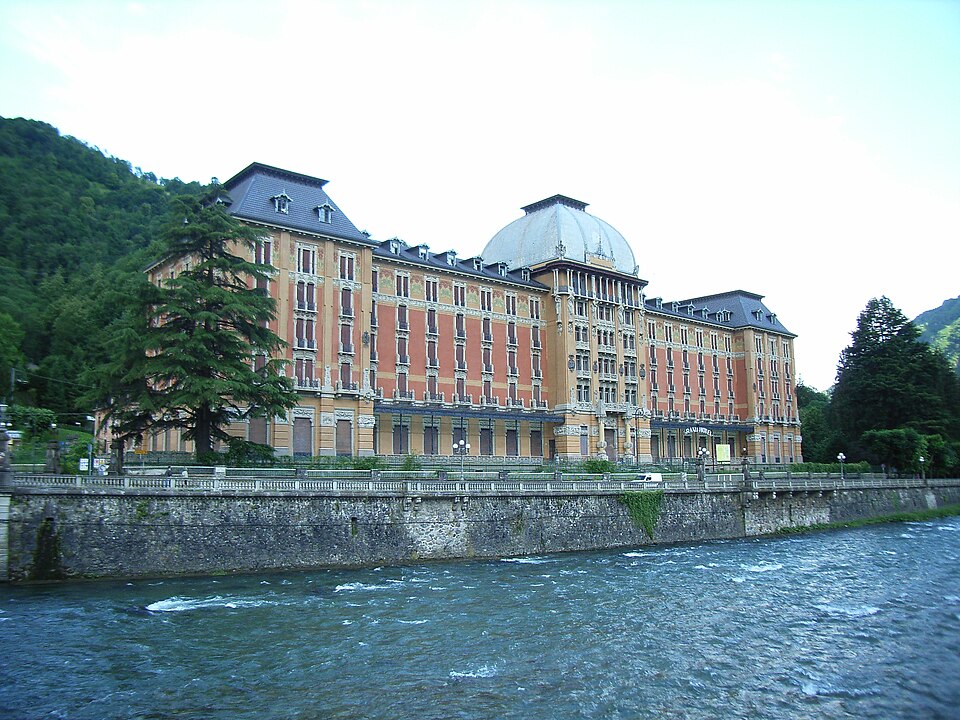
The Grand Hotel San Pellegrino is an Art Nouveau landmark opened in 1904, with a monumental facade extending for approximately 128 metres and an architectural identity that would be almost impossible to reproduce today.
Its value does not derive solely from its scale or location.
It derives from its uniqueness.
Specialist investors tend to evaluate heritage restrictions from two perspectives.
The first is risk:
-
longer development timelines;
-
higher construction costs;
-
design limitations;
-
complex interaction with heritage authorities;
-
limited freedom to alter the building.
The second is competitive protection.
A hotel of this historical and architectural importance cannot be replicated by a competitor. The same heritage restriction that increases the cost of the redevelopment also creates a barrier to entry and a powerful source of differentiation.
For an investor experienced in adaptive reuse, the opportunity lies precisely in the combination of:
-
uniqueness;
-
scarcity;
-
history;
-
design;
-
destination appeal;
-
experiential value;
-
limited replicability.
EKN Development is also understood to operate through an integrated platform combining finance, development, construction, design and in-house legal capabilities.
That integration is particularly important in complex projects, where success depends not on one area of expertise, but on the coordination of multiple technical, legal, financial and operational disciplines.
San Pellegrino Terme as an investment destination
The Grand Hotel project should not be viewed in isolation.
San Pellegrino Terme is undergoing a broader repositioning process involving public investment, urban regeneration, thermal tourism development and private-sector projects.
The destination is also home to the Sanpellegrino flagship factory project, connected to the Nestlé Waters group, with an estimated investment of approximately €100 million.
The combination of:
-
the global recognition of the Sanpellegrino brand;
-
thermal tourism;
-
architectural heritage;
-
proximity to Milan and Bergamo;
-
airport accessibility;
-
mountain tourism;
-
wellness;
-
meetings and events;
-
luxury travel demand;
could allow the destination to move beyond its traditional local and regional tourism base.
The real objective will not simply be to fill a hotel.
It will be to create an internationally relevant reason to travel.
The lesson for the Italian hotel market
The Grand Hotel San Pellegrino is not an isolated case.
Across Italy, there are numerous hotels, former holiday colonies, thermal complexes, historic palaces and hospitality properties that are:
-
closed;
-
underused;
-
without an operator;
-
protected by heritage restrictions;
-
oversized for their current market;
-
burdened by debt;
-
unable to generate sufficient income;
-
owned by parties without the required capital;
-
trapped within public processes that fail to attract investors.
These situations are often treated primarily as real estate problems:
What is the building worth?
The more useful question is:
What industrial, contractual, financial and operating structure could turn this property into a sustainable investment?
Alternatives to a conventional sale may include:
-
a long-term concession;
-
a surface right;
-
a property lease;
-
a business lease;
-
a lease with shared capital expenditure;
-
a joint venture;
-
a hotel management agreement;
-
a franchise agreement;
-
the entry of an equity investor;
-
a PropCo and OpCo structure;
-
project finance;
-
a public-private partnership.
Each asset requires a different configuration.
A property that cannot attract a buyer may still attract an operator through a long-term concession.
A hotel that is not bankable in its existing form may become financeable through a new management agreement, a different market positioning or a more disciplined capital expenditure plan.
These are among the issues that Roberto Necci has addressed for years through his advisory, research, institutional and educational activities within the hotel industry.
A closed hotel is not necessarily a valueless hotel
The Grand Hotel has been closed since 1979.
For decades, the property continued to exist without producing revenue, employment or economic activity proportionate to its potential.
During that period:
-
redevelopment costs increased;
-
regulations became more complex;
-
physical deterioration required more extensive intervention;
-
the capital requirement grew;
-
the destination lost years of potential development.
The arrival of an investor does not eliminate those costs.
It does, however, demonstrate that an apparently stranded asset can become investable when the following elements are properly aligned:
-
transaction duration;
-
cost of accessing the asset;
-
capital availability;
-
destination;
-
product concept;
-
public-sector partner;
-
technical expertise;
-
operating strategy.
The difference is not always the underlying value of the building.
Very often, it is the quality of the transaction structure.
Do you own a closed, protected or underused hotel property?
The Grand Hotel San Pellegrino waited almost half a century before a structure capable of attracting more than €64 million of capital was put in place.
Not every property needs to wait that long.
Every additional year of inactivity increases the capital requirement, reduces the number of available options and shifts negotiating power towards the party that eventually arrives with the financial resources needed to execute the redevelopment.
If you own, represent or finance a hotel property that is:
-
operating but underperforming;
-
closed;
-
heritage-protected;
-
suitable for conversion;
-
available for sale;
-
seeking an operator;
-
in need of redevelopment;
-
without a credible business plan;
Hotel Management Group supports owners and investors in defining the strategy, assessing feasibility, structuring the transaction and identifying the most appropriate solution.
Email info@investimentialberghieri.it and provide:
-
the property location;
-
the current or potential number of rooms;
-
the operating status;
-
the gross floor area;
-
the ownership structure;
-
any heritage or planning restrictions;
-
the owner’s strategic objective.
All information will be reviewed on a strictly confidential basis.
International capital is actively searching for opportunities, but it does not finance properties without a credible structure. The transaction must be designed before the investor is approached. Reversing that order almost always results in wasted time, lost value and weaker negotiating power.
Roberto Necci - r.necci@robertonecci.it
Osservatorio Investimenti Alberghieri — analysis, transactions and strategies across the Italian hotel investment market.