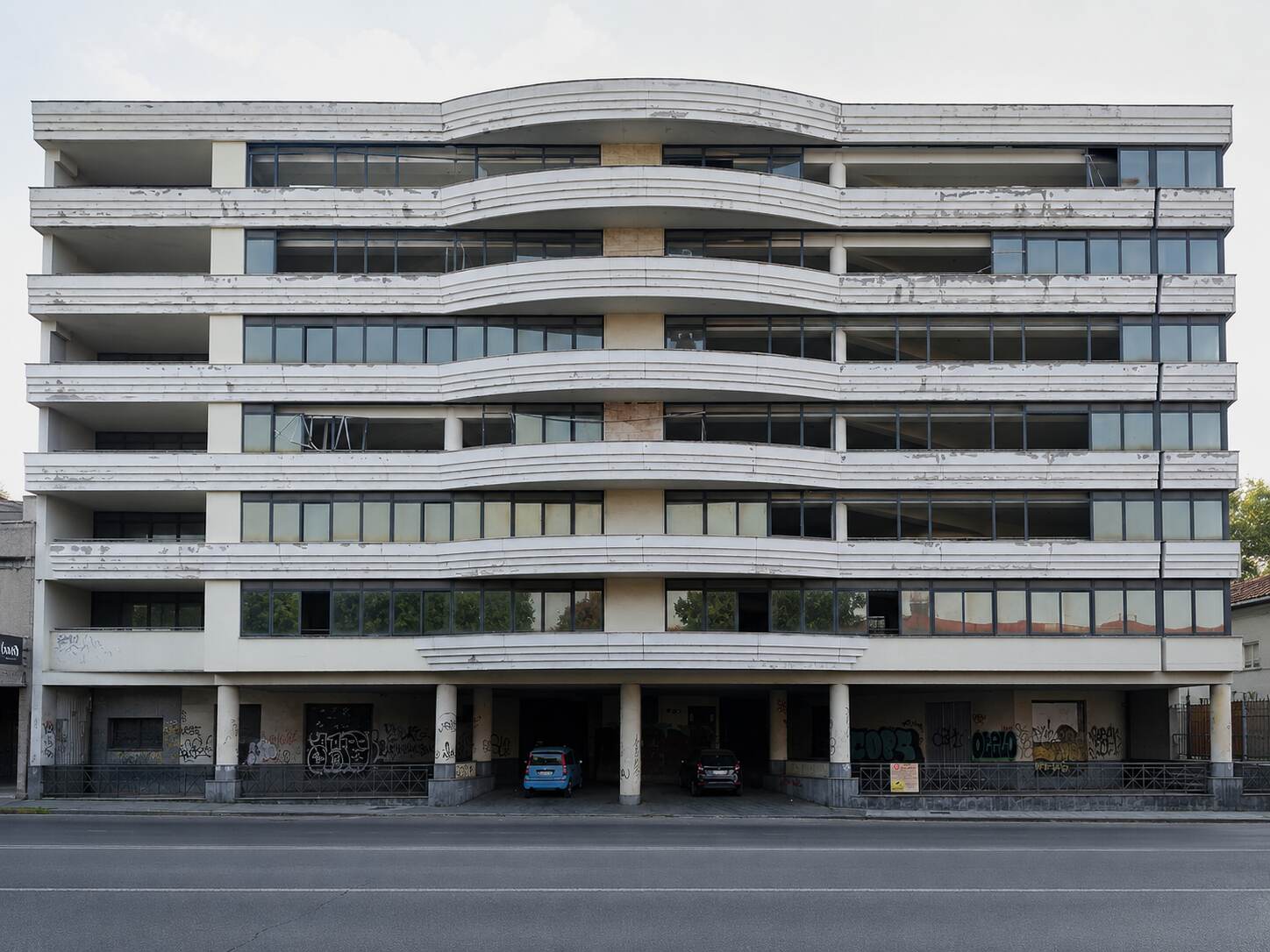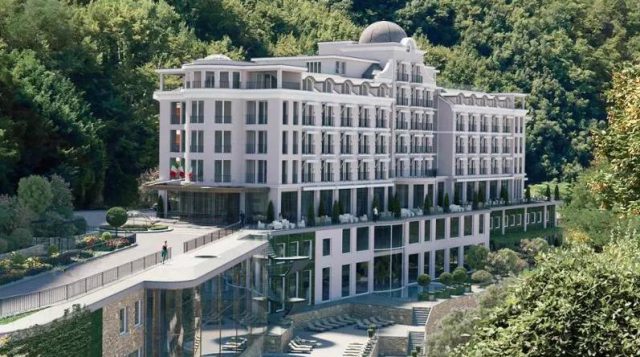
Grand Hotel and Terme di Pigna is one of the most compelling case studies for understanding the difference between acquiring a hospitality asset at a substantial discount and structuring an economically sustainable hotel investment.
A complex of approximately 24,600 square metres.
An eight-storey hotel.
A thermal spa asset.
An acquisition price of approximately €3.7 million, following a series of unsuccessful auctions and against an initially reported valuation of approximately €24.9 million.
On paper, that represents a discount of more than 80%.
Yet the most important figure today is a different one.
Over time, the redevelopment plan has evolved towards a luxury wellness positioning, with reported investment requirements reaching tens of millions of euros and, according to some press reports, approximately €60 million.
Construction commencement has now been deferred until 7 March 2030.
The ownership has stated that the project has not been abandoned. However, the postponement — combined with the stated need to identify additional financial and equity partners — turns Pigna into something considerably more interesting than a conventional real estate redevelopment.
It becomes a genuine hospitality special situation.
More importantly, it demonstrates a fundamental investment principle:
the price paid to acquire a hotel may ultimately be the least important component of the investment.
€3.7 Million Is Not the Cost of the Transaction
The first mistake frequently made in distressed hospitality transactions is to compare the acquisition price with the property's previous appraisal value.
The logic appears straightforward:
Reported former valuation: €24.9 million
Acquisition price: €3.7 million
Implied discount: approximately 85%
But this comparison says very little about the actual financial attractiveness of the transaction.
The value of a hospitality investment is not determined by how much an investor has saved against an historic appraisal.
It is determined by the total amount of capital required to transform the asset into a hotel capable of generating sustainable cash flows.
The correct question is therefore not:
“What was this property previously worth?”
The correct question is:
“How much capital must be invested today to achieve a stabilised EBITDA, and what return will that capital generate?”
This is the framework that should underpin complex hospitality transactions analysed by InvestimentiAlberghieri.it, particularly where competitive sales processes, distressed assets and special situations of the type examined by Investhotel.it are involved.
From Purchase Price to Total Investment Cost
A sophisticated investor should never stop at the Purchase Price.
The relevant metric is the Total Investment Cost.
In simplified terms:
Total Investment Cost =
acquisition price
-
taxes and transaction costs
-
design and professional fees
-
technical due diligence
-
CAPEX
-
planning and infrastructure charges
-
regulatory compliance costs
-
financing costs
-
pre-opening expenditure
-
working capital
-
contingency
-
holding costs during the non-operational period.
In the Pigna case, the €3.7 million acquisition price may therefore represent little more than the first line of a substantially larger capital commitment.
If the overall project were ultimately to require €50–60 million, the purchase price would account for only a relatively small proportion of the total capital deployed.
That fundamentally changes the investment perspective.
The principal risk is no longer overpaying for the real estate.
It is overinvesting in order to make the asset economically productive again.
Why an 85% Discount Can Become Almost Irrelevant
Pigna illustrates a recurring paradox in distressed hotel auctions.
As acquisition prices fall, investors naturally focus more heavily on the discount achieved.
Yet in high-CAPEX transactions, the opposite perspective may be more appropriate:
the greater the capital required for redevelopment, the less relevant the original purchase price becomes.
Consider two hypothetical transactions.
Hotel A
Acquisition: €20 million
CAPEX: €5 million
Total investment: €25 million
Hotel B
Acquisition: €4 million
CAPEX, financing, pre-opening and development costs: €45 million
Total investment: €49 million
Which hotel was acquired more attractively?
Looking only at the real estate purchase price, Hotel B.
Looking at total capital employed, execution risk, development period and expected returns, the answer could be entirely different.
This is why metrics such as acquisition price per key or discount to appraisal can become misleading in complex hospitality special situations.
The Relevant Benchmark Is Stabilised Hotel Value
An investment of this nature should be assessed backwards.
Not:
property price → design → investment → then determine whether the economics work.
But rather:
market → positioning → ADR → occupancy → RevPAR → revenue → GOP → EBITDA → stabilised value → sustainable CAPEX → maximum acquisition price.
This is the reverse engineering of a hospitality investment.
The methodology can be summarised as follows:
Stabilised Hotel Value
minus
Development CAPEX
minus
Financing Costs
minus
Pre-opening Costs
minus
Working Capital
minus
Contingency
minus
Required Developer / Investor Return
equals
Residual Asset Value
This is the economic value against which an acquisition should ultimately be underwritten.
Not the historic appraisal.
Not the auction reserve price.
Not the cadastral value.
Not the historical construction cost.
Pigna Is Not Simply a Refurbishment: It Is the Creation of a New Hospitality Product
The second fundamental consideration is the nature of the development itself.
Grand Hotel and Terme di Pigna does not appear to be a conventional hotel renovation.
Over the years, the concept has evolved towards a luxury thermal and wellness destination, with high-end rooms and suites, a substantial spa component and a positioning materially different from that of the former property.
This means the project does not simply have to reconstruct or refurbish a building.
It must simultaneously create:
-
the product;
-
the brand;
-
the market;
-
the distribution strategy;
-
the reputation;
-
international demand;
-
the operating model;
-
and ultimately the future profitability.
In other words:
the investor is not simply acquiring a hotel. The investor is financing the creation of a new hospitality business.
That distinction is frequently overlooked in analyses that focus primarily on the underlying real estate.
The Six Risks That Actually Determine the Investment Value
A professional assessment of Pigna should distinguish between at least six categories of risk.
1. Asset Risk
The underlying real estate exists, is substantial in scale and possesses characteristics that may be difficult to replicate.
At the same time, its size, structural complexity, technical systems, maintenance condition and prolonged period of inactivity may materially increase the actual CAPEX requirement.
Every additional year before construction begins may also increase:
-
deterioration;
-
extraordinary maintenance requirements;
-
security costs;
-
insurance costs;
-
the likelihood of design amendments;
-
and the need to comply with evolving technical and regulatory standards.
Time therefore affects not only financing costs but also the technical value of the asset itself.
2. Development Risk
An investment requiring tens of millions of euros cannot be approached as a conventional refurbishment.
It requires genuine development underwriting.
The analysis should include:
-
construction costs;
-
programme and timing;
-
design revisions;
-
structural works;
-
mechanical and electrical systems;
-
fire-safety compliance;
-
energy efficiency;
-
planning constraints;
-
authorisations;
-
and contingency.
A bill of quantities is not sufficient.
Investors need to model the probability of cost overruns and schedule slippage.
For this reason, a robust technical due diligence process should be accompanied by a comprehensive CAPEX sensitivity analysis.
3. Financing Risk
This is potentially one of the most important components of the entire transaction.
A hospitality project of this scale is unlikely to be financed solely through conventional senior bank debt.
Its capital structure may require a combination of:
equity + senior debt + potentially mezzanine financing + contingency equity.
The critical issue, however, is the amount of equity required before the development becomes financeable.
This is where the search for additional investors or financial partners may become decisive.
A longer development timeline can create a challenging financial loop:
delay → higher holding costs → greater funding requirement → more equity required → lower IRR.
This is a classic dynamic in capital-intensive real estate and hospitality developments.
4. Market Risk
Luxury wellness positioning represents both a significant opportunity and a meaningful risk.
Pigna cannot be underwritten in the same way as a conventional urban hotel destination.
The property needs to generate its own demand.
A high-end wellness resort must be capable of attracting guests independently of the spontaneous tourist demand already present in the destination.
Demand therefore needs to be developed through:
-
international source markets;
-
medical wellness;
-
luxury leisure;
-
long-stay demand;
-
destination spa positioning;
-
specialist partnerships;
-
premium distribution;
-
direct bookings;
-
international PR;
-
and disciplined brand positioning.
The success of the project consequently depends on more than the quality of the underlying real estate.
It depends on the ability to transform Pigna into a destination within the destination.
5. Operational Risk
A luxury wellness hotel with a large spa has a radically different cost structure from a conventional hotel.
Its operating model should incorporate at least:
-
payroll;
-
utilities;
-
maintenance;
-
treatment rooms;
-
food and beverage;
-
laundry;
-
distribution costs;
-
marketing;
-
management fees;
-
spa operating expenses;
-
revenue management;
-
maintenance of thermal systems;
-
and international sales.
For that reason, a project of this type should undergo a genuine hotel operating feasibility assessment before the final CAPEX programme is approved.
The work carried out by HotelManagementGroup.it sits precisely at the intersection between real estate, operations, positioning and economic sustainability, because an hotel can be technically exceptional and still represent a poor financial investment.
6. Time Risk: The Invisible Cost
Time is probably the most underestimated component of the transaction.
An asset acquired for €3.7 million and opened several years later no longer effectively costs €3.7 million.
During the non-operational period, investors continue to incur:
-
cost of capital;
-
taxation;
-
insurance;
-
design fees;
-
advisory fees;
-
maintenance;
-
security;
-
corporate costs;
-
interest expense;
-
and the opportunity cost of equity.
One euro invested today and locked into a non-income-producing project for several years must generate a higher return than one euro invested in an operating hotel.
Time is CAPEX.
Even when it does not appear in the construction budget.
The Critical Question: How Much EBITDA Must Pigna Generate?
This brings the analysis to the metric that ultimately matters.
If the total capital deployed were to reach several tens of millions of euros, how much EBITDA would the hotel need to produce once stabilised?
The answer depends on:
-
total investment cost;
-
financial leverage;
-
cost of debt;
-
required equity return;
-
exit yield;
-
destination risk;
-
and the stability of future cash flows.
At a minimum, investors should model three scenarios.
Base Case
Development proceeds broadly in line with the business plan, opening occurs within the revised timetable, and ADR and occupancy are consistent with the intended positioning.
Downside Case
CAPEX exceeds expectations, opening is delayed, ADR underperforms and occupancy takes longer to ramp up.
Severe Downside Case
Construction costs increase further, financing becomes more expensive, stabilisation is delayed and additional equity is required.
Only after these scenarios have been modelled can investors determine whether the project genuinely creates value.
The Key Metric Is Not Price per Key
Hotel transactions are frequently compared using price per key.
It is a useful metric, but in a case such as Pigna it can become almost meaningless.
The more relevant metric is:
Total Investment Cost / Stabilised EBITDA.
And subsequently:
Stabilised EBITDA Yield on Cost.
A hotel requiring €50 million or €60 million of total investment must generate an operating result consistent with the capital committed.
Otherwise, investors face one of the most dangerous outcomes in hospitality development:
creating an outstanding hotel that is worth less than the amount spent to build it.
From Real Estate Value to Hotel Investment Value
This is where the Pigna case becomes particularly relevant from a valuation perspective.
There are at least four different concepts of value.
Real Estate Value
The value of the physical property.
Development Value
The value of the completed development.
Operating Business Value
The value generated by the hotel operating company.
Investment Value
The value of the overall opportunity to a specific investor.
Confusing these four concepts can produce major valuation errors.
The analysis published on RobertoNecci.it explores precisely this distinction between real estate value, operating value, profitability and the economic and financial structure of a hotel investment.
The Next Phase May Be More Interesting Than the Previous One
The postponement of construction does not necessarily mean that the project has failed.
On the contrary, it may mark the beginning of a phase that is typical of complex hospitality special situations:
capital restructuring.
Several theoretical alternatives may emerge.
1. New Equity Partner
An additional investor funds part of the development programme.
2. Joint Venture
A partnership separates or reallocates real estate ownership and hospitality investment exposure.
3. Institutional Investor
A fund, family office or specialist hospitality investor enters the capital structure.
4. International Brand
A management agreement or franchise arrangement potentially improves the project's commercial positioning and bankability.
5. CAPEX Review
Value engineering or a redesign reduces the overall funding requirement.
6. Phased Development
The project is delivered in stages to reduce the upfront capital requirement.
7. SPV Recapitalisation
The equity and debt structure is redesigned.
8. Strategic Transaction Involving the Asset
A new investor enters or the broader ownership and financing structure is reorganised.
This does not mean that any of these options are currently being formally pursued.
It means they represent the type of alternatives that typically emerge where there is a significant gap between an asset already owned, an authorised development project and the capital required to complete it.
It is precisely within this gap that many of the opportunities analysed by Investhotel.it arise.
The Real Value Is Not in the Discount but in the Ability to Solve Complexity
Grand Hotel and Terme di Pigna demonstrates a fundamental rule of hospitality investing.
An investor can acquire a property:
-
significantly below appraisal value;
-
significantly below replacement cost;
-
significantly below its theoretical real estate value;
and still generate an inadequate return.
This is because, in complex hotels, value is not created at acquisition.
It is created through:
acquisition + design + capital structure + CAPEX discipline + positioning + operations + timing + exit strategy.
The acquisition price is simply the entry point into the complexity.
The investor's ability to solve that complexity determines the return.
The Grand Hotel Pigna Investment Lesson
Pigna deserves to be studied by investors, lenders and advisers for one specific reason.
It demonstrates that, in distressed hospitality transactions, discount to appraisal is not an investment thesis.
It is merely the starting point.
A credible investment thesis must answer five questions:
How much capital is actually required?
How long will it take?
What stabilised EBITDA can the hotel realistically generate?
What value will the market assign to that EBITDA?
What IRR does the overall investment produce?
If those five answers are not aligned, even a hotel purchased at a fraction of its previous appraisal value can destroy capital.
If they are aligned, however, a complex hospitality special situation can generate returns significantly above those available from a conventional hotel investment.
The real opportunity therefore does not lie in acquiring a hotel for €3.7 million.
It lies in demonstrating that, once all required capital has been invested, the completed and stabilised hotel will be worth more than the total amount of capital required to create it.
That is the difference between buying real estate and structuring a hospitality investment.
InvestimentiAlberghieri.it | Analysis of Complex Hospitality Investments
Transactions involving closed hotels, assets arising from competitive procedures, capital-intensive refurbishments, conversions and hospitality special situations require an integrated assessment of:
real estate, CAPEX, market positioning, operations, financing structure and future value.
InvestimentiAlberghieri.it analyses the Italian hospitality investment market and the sector's most relevant transactions.
For hotel valuation, economics and investment analysis: RobertoNecci.it.
For special situations, hotel transformation, disposal and extraordinary transactions: Investhotel.it.
For hotel operations, positioning and management models: HotelManagementGroup.it.
For hospitality investment analysis, asset opportunities and special situations:
info@investimentialberghieri.it