B&B operators reporting consistently high occupancy, a hotel acquiring adjacent properties to add rooms, new accommodation projects and even plans for student housing. Frosinone is not yet a proven hotel investment market, but it is showing precisely the kind of early signals investors should examine before an opportunity becomes obvious to everyone else.
Frosinone’s historic centre rarely appears in the leading reports on Italian hotel investment.
That is precisely why what is happening there deserves attention.
According to local reporting, residential properties and small apartments are progressively being refurbished and converted into hospitality accommodation. An existing B&B operator reports particularly strong demand. Another property is expected to open by the end of the year. The historic Hotel Garibaldi has gradually expanded its capacity to approximately 40 rooms and has reportedly acquired neighbouring properties to continue growing.
At the same time, there is discussion around converting the former municipal headquarters on Viale Mazzini into student accommodation.
Taken individually, these are small local developments.
Taken together, they tell a much more interesting story:
underutilised real estate capital is searching for a new economic function.
That is where the story becomes relevant to InvestimentiAlberghieri.it.
The first question is not how many tourists visit Frosinone
One of the most common mistakes in hospitality investment analysis is to confuse tourism demand with accommodation demand.
They are not the same thing.
A city can lack a strong leisure tourism profile and still support an attractive accommodation market.
In Frosinone, evidence from local operators points to at least four potential sources of demand:
-
business travellers and professionals working temporarily in the city;
-
visitors connected to universities and education;
-
people associated with the Academy of Fine Arts and the Conservatory;
-
travellers using Frosinone as an overnight stop on their way to other destinations.
This changes the investment perspective completely.
An investor should not simply ask:
“How many tourists visit Frosinone?”
The more relevant questions are:
“How many room nights does the local economy generate each year? Who purchases them? On which days? For how long? And at what rate?”
An investment thesis begins with those answers.
Piuma Suite: when a specific need becomes a market test
The story of Piuma Suite is particularly revealing.
According to its operator, the project was initially created to accommodate the families of foreign football players competing for local teams.
A wider market reportedly emerged afterwards.
Management says demand began coming from business travellers, people connected to education and training, and travellers stopping temporarily in Frosinone.
The operator has even stated that over the past year there has effectively never been an evening with all rooms unoccupied.
That statement needs to be treated carefully.
It is not an official market statistic for Frosinone. It is the experience reported by one individual operator.
But from an investment standpoint, it is nevertheless a signal worth investigating.
It suggests that a property originally conceived to serve a narrow demand segment may have uncovered a broader accommodation market than initially expected.
The relevant question therefore becomes:
Is this simply one particularly successful property, or is it evidence of previously underserved accommodation demand?
The distinction becomes extremely important once the discussion moves from operating a handful of rooms to committing significant real estate capital.
The strongest signal is not a B&B: it is Hotel Garibaldi
There is, however, an even more relevant piece of evidence.
The historic Hotel Garibaldi, located in the upper part of Frosinone, has reportedly increased its inventory over time to approximately 40 rooms.
More importantly, it is reported to have acquired nearby properties in order to expand capacity and meet demand.
From an investor’s perspective, this may be the strongest signal in the entire story.
A new B&B can be launched based largely on entrepreneurial expectations.
An established hotel, by contrast, operates with access to:
-
historical operating data;
-
actual occupancy;
-
achieved ADR;
-
direct demand;
-
guest segmentation;
-
seasonality;
-
cancellations;
-
average length of stay;
-
operating costs.
When an operator with this information chooses to reinvest capital in additional inventory, the market deserves closer scrutiny.
It does not automatically prove that Frosinone has become an institutional hotel investment destination.
But it is significantly more meaningful than generic claims about tourism growth.
From additional rooms to a spa: moving from volume to value
Hotel Garibaldi is also reportedly considering developing a spa.
That detail matters.
It suggests a possible shift in strategy.
The first phase is:
higher demand → more rooms.
The second could become:
better services → stronger positioning → higher ADR → improved margins → greater enterprise value.
This is where hotel investment becomes more sophisticated.
Adding rooms does not automatically create value.
Building a spa does not automatically create value.
Refurbishing a property does not automatically create value.
Value is created when the incremental EBITDA generated by the investment adequately remunerates the capital deployed.
This is the same principle that should underpin operational, positioning and value-enhancement analysis carried out by specialist advisory firms such as Hotel Management Group.
High occupancy does not automatically mean a good investment
This is perhaps the most important issue in the entire analysis.
A property can be almost continuously full and still represent a mediocre investment.
Consider, for example, a property operating with:
-
85% occupancy;
-
an ADR of €65;
-
heavy dependence on OTAs;
-
only four rooms;
-
significant housekeeping and laundry costs;
-
high utility costs;
-
substantial initial CapEx.
The occupancy figure would look excellent.
The return on invested capital might be far less impressive.
Conversely, a property operating at 68% occupancy with an ADR of €100 could potentially deliver a stronger financial result.
That is why:
occupancy without ADR tells us very little.
ADR and occupancy without a cost structure tell us even less.
And revenue without EBITDA cannot tell an investor whether an asset is attractive.
A simple model: how an investor should think
Consider, purely for illustrative purposes, a small property that can be converted into a five-room hospitality operation.
Illustrative operating scenario
Average ADR: €80
Average occupancy: 70%
Annual available room nights:
5 × 365 = 1,825 room nights
Estimated room nights sold:
1,825 × 70% = 1,278 room nights
Theoretical room revenue:
1,278 × €80 = approximately €102,000 per year
At first sight, that revenue may appear attractive.
But it is not the return.
The investor still needs to deduct:
-
OTA commissions;
-
housekeeping;
-
laundry;
-
utilities;
-
maintenance;
-
insurance;
-
technology;
-
marketing;
-
administration;
-
staffing;
-
taxes and operating charges;
-
replacement reserves.
If the resulting operating margin were, for example, 30%, the property could generate approximately €30,000 of operating profit.
Only then does the crucial question arise.
How much capital was invested in total?
If acquisition, refurbishment, furniture, technical works, professional fees and initial working capital amounted to €250,000, the economics would be fundamentally different from an identical business requiring €450,000 of total investment.
The quality of the investment is determined by the relationship between operating profit and total capital deployed.
Not by review scores.
Not by being fully booked.
Not by topline revenue.
Frosinone may have an advantage Rome does not
Large hotel destinations have an obvious advantage:
deeper demand.
But they generally also require much more capital to enter.
Secondary markets may present the opposite profile:
-
less liquidity;
-
shallower demand;
-
higher operational risk;
-
but potentially lower entry costs;
-
less professional competition;
-
greater opportunities to acquire inefficient assets;
-
greater scope for value creation through repositioning and conversion.
This is why Frosinone should not be compared with Rome solely in terms of tourist arrivals.
It should be compared in terms of risk-adjusted returns on capital.
A relatively small investment producing an attractive risk-adjusted yield can be financially superior to a prestigious asset purchased at a price that already reflects most of its future upside.
Is the historic centre becoming an investable asset?
Local reporting also points to an ongoing process of urban regeneration.
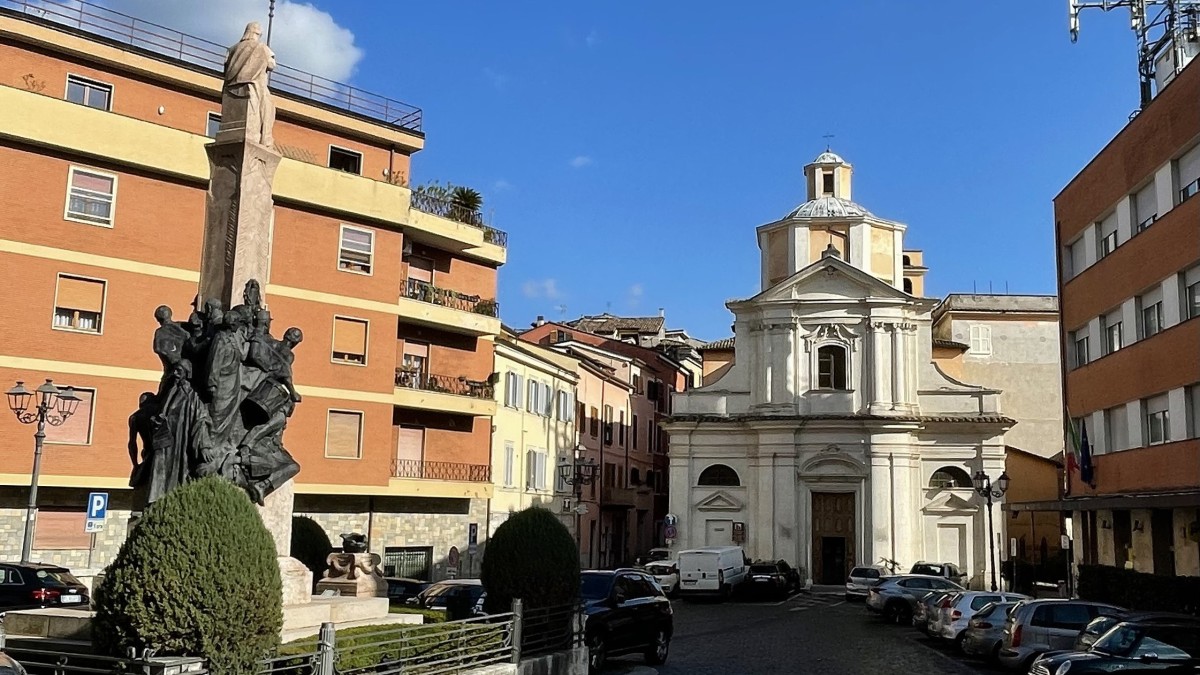
In recent years, improvements have reportedly been made around Piazza Turriziani, the Piloni, San Francesco Park and the bell tower, while new commercial activity — particularly food and beverage — has emerged.
Hospitality is now entering the equation.
The economic sequence could be:
urban regeneration
↓
higher footfall
↓
new commercial activity
↓
greater reasons to stay
↓
hospitality demand
↓
new real estate investment
↓
further urban value creation
This is one of the classic mechanisms through which historic districts regenerate.
But it is not guaranteed.
The cycle can also break if public infrastructure and services fail to support private investment.
Parking and accessibility can determine investment returns
One of the main issues highlighted by local operators is parking.
There are also references to the inclined lift not being operational, the need for a multi-storey car park and improvements in urban maintenance.
From an investment perspective, these are not minor issues.
They are financial variables.
A corporate traveller arriving by car evaluates:
-
accessibility;
-
parking availability;
-
security;
-
distance between parking and accommodation;
-
local services;
-
restaurants;
-
mobility.
A hotel room can be beautifully refurbished yet remain competitively disadvantaged by weaknesses in its surrounding environment.
This means that part of the investment risk lies outside the property owner's direct control.
That risk needs to be reflected in the underwriting.
Then there is student housing
The potential conversion of the former municipal headquarters on Viale Mazzini into student accommodation adds another layer to the story.
The building is reportedly still in a state of abandonment.
This broadens the investment discussion well beyond short-stay hospitality.
Properties within the city centre could theoretically compete between several uses:
Traditional residential
More predictable income and simpler operations.
Medium-term rentals
Greater flexibility and higher turnover.
Hospitality
Potentially higher returns, but greater operating complexity.
Student housing
A different demand profile, longer stays and its own operating model.
Serviced apartments
A potentially attractive hybrid for professionals and medium-to-long-stay guests.
A disciplined investor should not choose the end use first.
The asset should be analysed first, and the numbers should determine the most economically efficient use.
The future may not be dozens of independent B&Bs
There is another, potentially more interesting scenario.
Imagine that the historic centre gradually develops:
-
5 rooms in one building;
-
7 in another;
-
4 in a third;
-
8 in a fourth;
-
6 in a fifth.
Total:
30 rooms.
Managed independently, they remain five micro-businesses.
Managed through a single operating platform, however, they could benefit from:
-
one brand;
-
one PMS;
-
centralised revenue management;
-
shared housekeeping;
-
common marketing;
-
one digital reputation;
-
centralised purchasing;
-
coordinated distribution;
-
a shared physical or digital reception model.
Five small B&Bs could effectively become a 30-room distributed hospitality operator.
Not a traditional hotel.
Not necessarily an “albergo diffuso” in the strict Italian regulatory sense.
But a professionally operated distributed hospitality platform.
This model could become increasingly relevant across many smaller Italian historic centres.
Scale changes the economics
One of the biggest weaknesses of micro-hospitality businesses is the lack of scale.
With four or five rooms, it becomes difficult to support professionally:
-
revenue management;
-
marketing;
-
management accounting;
-
CRM;
-
direct sales;
-
administration;
-
maintenance;
-
internal housekeeping;
-
review management;
-
technology.
Once 20, 30 or 40 rooms are aggregated, the economics start to change.
Central costs are spread across a larger inventory.
Operations become more professional.
Commercial capability improves.
And the business may also become more attractive to future investors or buyers.
That is the difference between owning rooms and building a hospitality business.
International demand: avoid simplistic conclusions
Hotel Garibaldi has also referred to foreign guests and interest from some visitors in acquiring small residential properties, partly due to Frosinone’s relative proximity to Rome.
This is an interesting signal.
But it needs to be interpreted cautiously.
Geographical proximity to Rome does not create value by itself.
For a secondary market to benefit materially from proximity to a major city, several variables need to align:
-
efficient transport links;
-
acceptable journey times;
-
local services;
-
urban quality;
-
security;
-
a meaningful price differential;
-
residential demand;
-
temporary accommodation demand.
Only when these conditions converge can a pricing gap become genuinely investable.
What a real Frosinone investment due diligence should include
Before acquiring a property for conversion into hospitality use, investors would therefore need to undertake a much broader due diligence than a conventional real estate appraisal.
1. Demand analysis
How many room nights does the market actually generate?
2. Segmentation
Corporate, education, leisure, transient, groups and events.
3. Competitive set
Comparable hotels, B&Bs, serviced apartments and short-term rentals.
4. ADR
What rate does the market actually pay?
5. Occupancy
How does occupancy vary across months and weekdays?
6. RevPAR
How much revenue is generated per available room?
7. CapEx
What is the real cost of converting the asset?
8. EBITDA
What operating profit remains after all costs?
9. ROI
What return does the total invested capital generate?
10. Exit value
What could the asset be worth following repositioning?
This is the same discipline required in transactions analysed by Investhotel: the objective is not simply to determine whether a property can technically become a hotel, but whether that conversion creates value.
RobertoNecci.it also regularly examines the distinction between real estate value, enterprise value and income-generating capacity in hotel investments.
The real opportunity may be entering before everyone else
The most obvious hotel investment markets are also the most closely monitored.
By the time an opportunity is obvious to everyone, much of its future value may already be reflected in the acquisition price.
Secondary markets behave differently.
Information is less structured.
Benchmarks are harder to obtain.
Execution risk is higher.
But precisely because of that, inefficiencies can exist.
Based on the evidence currently available, Frosinone cannot yet be described as an established emerging hotel investment destination.
That would be premature.
But several early signals deserve attention:
one operator reports particularly strong demand;
new accommodation businesses are entering the market;
an existing hotel is increasing its inventory;
neighbouring properties have been acquired to support expansion;
additional guest services are being considered;
underutilised real estate is available for conversion;
student housing is being discussed;
the historic centre is undergoing regeneration.
These are signals.
Not conclusions.
And this is precisely the stage at which serious investors should begin their analysis.
The million-euro question is not how many rooms will open
The real question is:
Is Frosinone’s accommodation demand sufficiently deep, stable and profitable to remunerate new real estate investment?
If the answer proves to be yes, the opportunity could extend far beyond a handful of new B&Bs.
It could support:
-
new hospitality operators;
-
serviced apartments;
-
student housing;
-
aggregation of micro-properties;
-
value-add transactions;
-
acquisitions of underutilised buildings;
-
new commercial activity;
-
further real estate appreciation.
A small hospitality market can become the catalyst for something much larger:
the economic regeneration of part of a city.
But between an empty building and an investment capable of creating value, the same variables always matter:
Numbers.
Demand.
CapEx.
Operations.
EBITDA.
Returns.
Exit.
Only then comes the real estate.
Want to know whether a property can become a profitable hospitality investment?
InvestimentiAlberghieri.it analyses hotels, conversion opportunities and hospitality investments through:
-
market analysis;
-
financial and investment assessment;
-
CapEx estimates;
-
operating scenarios;
-
ADR, occupancy and RevPAR analysis;
-
profit and loss modelling;
-
ROI and return-on-capital analysis;
-
real estate valuation;
-
alternative-use analysis;
-
value creation and exit strategies.
The question is not:
“Can this property become a hotel or B&B?”
The right question is:
“Which use creates the greatest value on the capital invested?”
For the analysis of a hotel, real estate asset or hospitality conversion project: