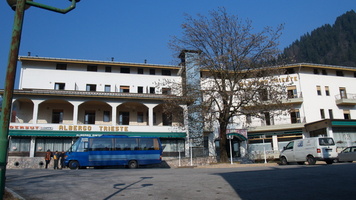
On 30 September 2026, the former Albergo Trieste in Arta Terme, at Via Giosuè Carducci 54, will be offered for sale through Real Estate Enforcement Proceeding No. 20/2025 before the Court of Udine. The property is a D/2 hospitality building with approximately 2,859.25 sqm of commercial area arranged over five levels, 54 physically existing guestrooms, two large restaurant halls, a bar, professional kitchen, laundry, storage areas and external spaces also used for parking. The reserve price is €571,000 and the minimum admissible offer is €428,250 — approximately €7,930 per physical room and €150 per commercial sqm. But the appraisal describes an asset far more complex than the headline price suggests: the hotel has been closed since 2019, does not have a valid fire prevention certificate, the previous district-heating infrastructure will not be delivered as a fully operational system, two underground tanks must be decommissioned, there is no air-conditioning system, and nine of the 54 rooms currently rely on shared bathrooms. The investor should therefore not ask whether €428,250 is cheap for 54 rooms. The real questions are how many rooms can become genuinely saleable after repositioning, how much capital will be required to reactivate the entire platform and, above all, whether reducing the number of rooms could generate more GOP and more value than preserving the historic inventory.
In the hotel investment market, there is a fundamental distinction between:
Physical Keys
≠
Authorised Keys
≠
Saleable Keys.
That is probably the correct way to read the former Albergo Trieste.
Because:
€428,250 ÷ 54 = approximately €7,930 per Physical Key.
But:
€7,930 per Physical Key ≠ All-in Cost per Reopened Key.
And, above all:
Maximum Key Count ≠ Maximum Asset Value.
First Certainty: Real Estate Enforcement Proceeding No. 20/2025
The proceeding is:
Real Estate Enforcement No. 20/2025
before the:
Court of Udine.
The asset is:
Lot 1.
The sale is conducted:
without auction
through a:
mixed synchronous bidding process.
The sale is scheduled for:
30 September 2026 at 3:00 p.m.
The deadline for submitting offers is:
29 September 2026 at 12:30 p.m.
Reserve Price: €571,000
Minimum Offer: €428,250
Minimum Bid Increment: €2,000
Deposit: 10% of the offer.
This is therefore a genuine:
Pre-Auction Hospitality Special Situation.
The Property Is the Historic Locanda Trieste
The documentation traces the origins of the building back to the historic:
Locanda Trieste.
The complex was expanded during the 1970s; further works followed the 1976 earthquake, while subsequent interventions included the installation of a lift, an accessibility ramp and improvements to the external areas.
This is therefore not:
a generic hotel shell.
It is:
a legacy hospitality asset
that nevertheless needs to be completely reinterpreted against contemporary hotel standards.
Fifty-Four Rooms. But the Number Needs to Be Deconstructed
The appraisal identifies:
18 rooms on the first floor
18 rooms on the second floor
18 rooms on the third floor.
Total:
54 physical rooms.
On each floor, the configuration includes:
14 double rooms with private bathrooms
1 single room with a private bathroom
3 single rooms using shared bathrooms.
This means that:
45 rooms have private bathrooms
while:
9 rooms rely on shared bathroom facilities.
This is where the headline price per key begins to lose meaning.
54 Physical Keys ≠ 54 Market-Ready Keys
For a contemporary hotel product, nine rooms with shared bathrooms raise issues around:
product design;
classification;
guest expectations;
ADR;
distribution;
positioning.
This does not automatically mean those rooms need to be removed.
It means the investor must decide whether to:
retain them;
add private bathrooms;
combine rooms;
convert them;
redistribute some of the space.
The outcome may alter:
the final number of genuinely saleable guestrooms.
Therefore:
Historic Key Count ≠ Reopened Key Count.
This Is Where Key Count Dilution Begins
The first relevant metric is:
Total Invested Capital
÷
Final Saleable Keys
=
Effective All-in Cost per Key.
Not:
Purchase Price ÷ Historic Physical Keys.
If the final saleable inventory falls after redesign:
the true cost per key automatically increases.
The relationship is:
Historic Keys
÷
Final Saleable Keys
=
Key Count Dilution Multiplier.
This variable needs to be resolved:
before final underwriting.
But Key Count Dilution Is Not Necessarily Negative
This is the critical point.
Reducing the number of rooms does not automatically mean:
destroying value.
It may mean:
creating private bathrooms;
increasing room sizes;
improving soundproofing;
creating family rooms;
creating junior suites;
adding storage;
improving corridors and guest-service areas;
raising overall positioning.
Therefore:
Key Reduction
can become:
Product Upgrade.
The question is not:
“How many rooms can we save?”
It is:
“Which configuration generates the highest GOP and the highest asset value?”
Key Rationalisation Economics: Fewer Rooms Can Be Worth More
This is the real underwriting layer that needs to be applied to the asset.
Assume the new project reduces the inventory from:
54 rooms
to:
48 rooms.
At first glance, this appears to eliminate:
6 revenue-generating units.
But the investor needs to compare:
Scenario A — Maximum Historic Key Count
More rooms.
Smaller rooms.
Less competitive product.
Lower ADR.
Higher maintenance.
More housekeeping.
Greater pressure on common areas.
Scenario B — Rationalised Key Count
Fewer rooms.
All with private bathrooms.
Better room sizes.
Better comfort.
Better guest experience.
Higher ADR.
Better reputation.
More upselling potential.
The correct comparison is not:
54 vs 48 rooms.
It is:
GOP of 54 Obsolete Keys
vs
GOP of 48 Better Keys.
The Key Rationalisation Formula
The equation is:
Lost Room Revenue from Fewer Keys
vs
Higher ADR
Higher Occupancy
Lower Maintenance
Lower Housekeeping Complexity
Better Guest Experience
Higher Review Scores
Lower Obsolescence Risk.
If:
Incremental GOP after Key Rationalisation
GOP with Maximum Historic Key Count
then the reduction in inventory is:
Value-Creative Key Reduction.
That is the point.
Key Quantity ≠ Key Value
A hotel is not worth more simply because:
it has more doors.
It is worth more because those doors generate:
sustainable cash flow.
The equation becomes:
Final Saleable Keys
×
ADR
×
Occupancy
×
Contribution Margin
=
Economic Room Inventory.
The historic room count is therefore only:
a starting point.
Not an objective to be preserved at any cost.
The Appraisal Also Identifies a Gap Between Physical and Authorised Inventory
The documentation indicates that there is not complete consistency among:
approved plans;
authorisations;
physical configuration;
rooms;
bed count.
This requires a precise sequence:
Physical Room Survey
→
Authorised Room / Bed Count
→
Planning Regularisation
→
Product Redesign
→
Key Rationalisation
→
Final Saleable Keys.
Only after that:
Price per Key.
The Lift Also Changed the Historic Layout
The cadastral documentation is not fully aligned with the later installation of the external lift.
That intervention also altered part of the historic room layout.
Once again:
Plan Keys ≠ Physical Keys ≠ Legal Keys.
For a hotel investor, this matters far more than the simple:
stated room count.
2,859 sqm of Commercial Area for €428,250
The indicated commercial area is:
2,859.25 sqm.
The minimum offer therefore equates to approximately:
€150 per commercial sqm.
That is exceptionally low.
But:
Low €/sqm ≠ Low Reopening Cost.
The relevant metric will be:
All-in Repositioning Cost per sqm.
Not:
Auction Price per sqm.
The Valuation Waterfall Already Shows Where the Risk Sits
The appraisal develops a valuation path that begins from a higher underlying property value and applies deductions for:
building irregularities;
fire safety;
building systems;
forced-sale conditions.
Conceptually, the sequence is:
Gross Market Benchmark
→
Technical / Compliance Haircuts
→
Current-State Market Value
→
Forced-Sale Value
→
Minimum Bid.
But the critical point is:
Valuation Haircut ≠ CAPEX Budget.
Appraisal Haircut ≠ Remediation CAPEX
A valuation deduction applied by the appraiser does not automatically correspond to the real cost of the works.
A:
fire-safety haircut
is not necessarily:
fire-safety CAPEX.
A deduction for building systems is not necessarily:
MEP CAPEX.
Actual CAPEX must be built:
bottom-up.
Using:
quantity survey;
technical design;
cost planning;
contingency;
inflation;
professional fees.
Fire-Safety Compliance Must Essentially Be Redesigned
The property does not currently have a:
valid fire prevention certificate
that can automatically support reopening.
A future operator will need:
a new design;
regulatory review;
potential works;
a new approval process.
Therefore:
Hotel Building
≠
Hotel Ready for Fire-Safety Approval.
Fire safety may become one of the primary:
Critical Path Items.
The Second Critical Path Is Heating
The hotel was connected to a:
district-heating system.
But some of the relevant components are not part of the property and cannot automatically be assumed to be available for future operations.
The purchaser will therefore need to evaluate:
a new contract;
reconnection;
new equipment;
an alternative system;
energy economics.
This creates another important formula:
Vacant Hotel
≠
Heated Hotel.
Heating Infrastructure Gap
For a:
54-room
hotel in:
Carnia,
heating is not a secondary utility.
It is:
core operating infrastructure.
The sequence becomes:
Acquire
→
Choose Energy Strategy
→
Reconnect / Replace Heating Infrastructure
→
Fire-Safety Compliance
→
Room Repositioning
→
Reopening.
Energy strategy must therefore be included:
in the business plan.
Not treated as a post-closing surprise.
Two Underground Tanks Must Be Decommissioned
The presence of unused underground tanks adds another element of:
Hidden Reopening CAPEX.
Individually, this may appear relatively minor.
But combined with:
fire safety;
heating;
room redesign;
building systems;
energy;
regularisation,
it becomes part of a broader:
Reopening Capital Stack.
There Is No Air-Conditioning System
The property does not have a modern air-conditioning system.
This creates a real:
Energy Strategy Decision.
The future investor must choose among:
minimum recommissioning;
deep energy repositioning;
hybrid solutions;
renewables;
new HVAC.
The choice affects:
CAPEX;
OPEX;
guest comfort;
ADR;
ESG profile;
future value.
Therefore:
Legacy Energy Deficit
can represent:
CAPEX Risk
but also:
Design Optionality.
The External Areas Are Not Fully Exclusive
The external spaces used partly for parking cannot simply be treated as:
private hotel land.
There are common areas and relationships with other units.
Therefore:
Parking Availability ≠ Exclusive Parking Control.
And:
Outdoor Use ≠ Exclusive Outdoor Use.
For a hotel potentially targeting:
groups;
coaches;
events;
external F&B demand,
this distinction matters.
Operational Infrastructure May Depend on Shared Real Estate Rights
Lift;
ramp;
patio;
access;
courtyard
must also be verified from:
legal;
planning;
functional
perspectives.
The equation is:
Operational Dependency on Shared Space
=
Execution Risk.
And execution risk must feed into:
Maximum Bid.
Regularisable Does Not Mean Regularised
The appraisal considers some issues:
regularisable.
But:
Regularisable
≠
Regularised.
And:
Planning Solution
≠
Zero Cost / Zero Time.
The investor may still need:
regularisation applications;
closure of outstanding filings;
occupancy certification;
cadastral updates;
new approvals.
Time is part of cost.
The Real Paradox: The Price Is Extremely Low, but the Reopening Scope Is Enormous
A buyer may focus on:
€428,250.
But the real investment is:
Acquisition Price
Fire-Safety CAPEX
Heating Infrastructure
Energy / HVAC
Room Reconfiguration
Bathrooms
Building Compliance
Cadastral Regularisation
FF&E
OS&E
Technology
F&B Recommissioning
Pre-opening
Working Capital
Financing / Holding Costs
=
Total Invested Capital.
That is the real denominator.
Price per Key Should Only Be Calculated at the End
The correct sequence is:
Physical Keys
→
Legal Keys
→
Product Redesign
→
Key Rationalisation
→
Final Saleable Keys
→
Total Invested Capital
→
All-in Cost per Reopened Key.
Not:
€428,250 ÷ 54
→
Cheap Hotel.
The Ground Floor Is Large Relative to the Room Inventory
The property includes:
two large restaurant halls;
bar;
kitchen;
service areas.
For only 54 physical rooms, this represents a substantial:
F&B Infrastructure.
That means guestrooms cannot be:
the only demand generator.
Sustainable F&B Demand Must Also Come from Outside the Hotel
The equation should be:
Hotel Guests
External Covers
Groups
Events
=
Sustainable F&B Demand.
If the restaurant depends only on hotel guests:
Large F&B Footprint + Limited In-house Demand = Margin Compression.
If instead it captures:
groups;
local demand;
thermal tourism;
sports;
events,
it can become:
a second revenue engine.
Legacy Operations ≠ Future Product-Market Fit
In the final years of activity, the:
bar / restaurant
component appears to have played an important role.
That is useful historical information.
But it does not mean that the future business should replicate:
the old operating model.
The new operator needs to build:
a new hospitality thesis.
Because:
Legacy Operations ≠ Future Product-Market Fit.
Arta Terme Now Has Different Demand Fundamentals
The destination has shown significant growth in recent years across:
arrivals;
overnight stays;
demand linked in part to the Zoncolan area.
This does not automatically guarantee:
hotel performance.
But it does mean:
2019 Closure ≠ 2026 Destination Fundamentals.
The market needs to be:
re-underwritten.
Not simply inherited from the past.
Arta Terme Has Three Complementary Demand Generators
The destination can draw from:
Thermal Demand
Winter Mountain Demand
Summer Outdoor Demand.
This creates a potential:
Seasonality Bridge
The equation is:
Thermal Demand
Winter Zoncolan Demand
Summer Outdoor Demand
=
Potential Extended Operating Season.
This is one of the asset’s most important strategic features.
Because:
different demand cycles
can reduce:
seasonality concentration.
Demand Stacking ≠ Demand Capture
Naturally:
Destination Growth
does not automatically mean:
Hotel Occupancy.
The correct equation is:
Destination Demand
×
Relevant Segment Share
×
Product Fit
×
Distribution Effectiveness
=
Captured Hotel Demand.
The investor therefore needs to assess how much demand can realistically be captured from:
thermal tourism;
Zoncolan;
outdoor tourism;
groups;
external F&B demand.
The Hotel Does Not Necessarily Need Its Own Spa
Arta Terme already has:
thermal infrastructure.
The future hotel could therefore compare:
Internal Wellness CAPEX
Owned spa.
More control.
More investment.
More OPEX.
Destination Wellness Model
Partnership with the thermal facilities.
Packages.
Treatments.
Transfers.
Experience bundling.
In this second model:
External Destination Infrastructure
can replace part of:
Internal Hotel CAPEX.
That is an important strategic decision.
Investment Thesis 1 — Thermal & Outdoor Gateway
The future hotel could become:
a gateway to Carnia.
With a product built around:
sleep;
thermal wellness;
Zoncolan;
cycling;
trekking;
local gastronomy.
The formula becomes:
Rooms
Wellness Access
Outdoor
F&B
=
Multi-Season Destination Product.
Investment Thesis 2 — Groups & Sports Base
With substantial physical room inventory and large restaurant halls, the property may be attractive for:
sports teams;
cycling groups;
ski groups;
school groups;
tour groups;
associations.
Driver:
Group Room Nights + Meal Packages.
But:
parking / coach access
must be verified carefully.
Investment Thesis 3 — Lean Thermal Destination Hotel
The project may instead choose to:
reduce inventory;
increase room quality;
simplify F&B;
strengthen digital distribution;
integrate thermal and outdoor experiences.
Driver:
Higher Room Quality + Higher ADR + Controlled OPEX.
This is probably the thesis most consistent with:
Key Rationalisation.
The Objective Should Not Be to Maximise Room Count
This is fundamental.
It may be economically better to have:
fewer rooms
that are:
larger;
all ensuite;
better insulated;
air-conditioned;
digitally accessible;
better designed;
capable of supporting higher ADR;
able to deliver a better guest experience
rather than defending:
54 physical keys.
The formula is:
Key Quantity ≠ Key Value.
The Real KPI Is GOP per Saleable Key
It is not enough to measure:
Revenue per Room.
The investor should also track:
GOP per Saleable Key.
Because redesign may reduce inventory
while increasing:
ADR;
occupancy;
margin;
asset positioning.
The equation becomes:
Total Rooms GOP
÷
Final Saleable Keys
=
GOP per Saleable Key.
If GOP per key increases sufficiently:
reducing the room count can create value.
A Key Rationalisation Matrix Is Required
The business plan should compare at least three configurations.
Scenario A — 54 Keys
Maximum inventory.
More problematic rooms.
Lower average room quality.
Scenario B — 50 Keys
Selective combinations.
More ensuite rooms.
Better mix.
Scenario C — 46/48 Keys
Stronger product repositioning.
Larger rooms.
Higher target ADR.
Lower inventory.
For each configuration, the investor should model:
ADR;
Occupancy;
RevPAR;
Rooms Revenue;
Housekeeping Cost;
Maintenance;
Rooms GOP;
GOP per Key;
CAPEX per Key;
Stabilised Value.
The Final Question in the Key Rationalisation Matrix Is Simple
Not:
“Which scenario has more rooms?”
But:
“Which scenario generates more value?”
The relationship is:
Incremental GOP from Better Product
Lower OPEX
Higher Stabilised Value
−
Lost Contribution from Removed Keys
−
Incremental Conversion CAPEX
=
Net Value Created by Key Rationalisation.
If positive:
reduce keys.
If negative:
preserve inventory.
That is:
capital allocation.
Break-even Occupancy Must Be Calculated on Final Saleable Inventory
After redesign:
Final Saleable Keys × 365
=
Available Room Nights.
Then:
Total Fixed Operating Costs
−
F&B Contribution
−
Other Ancillary Contribution
=
Fixed Costs to Be Covered by Rooms.
And:
Fixed Costs to Be Covered by Rooms
÷
Contribution per Occupied Room
=
Break-even Occupied Room Nights.
Finally:
Break-even Occupied Room Nights
÷
Available Saleable Room Nights
=
Break-even Occupancy.
That is the true sustainability threshold.
The Historic 54-Room Count Can Create a False Sense of Security
More inventory does not automatically mean:
more ability to absorb fixed costs.
If part of the room stock produces:
low ADR;
poor reviews;
high maintenance;
weak conversion;
limited demand,
it may actually:
dilute profitability.
Therefore:
More Keys
can mean:
More Revenue
but also:
Lower Asset Quality.
CAPEX Should Be Divided into Six Buckets
1. Mandatory Compliance CAPEX
Fire safety.
Fire prevention certificate.
Urban / cadastral regularisation.
Completion of accessibility works.
Tank decommissioning.
2. Critical Infrastructure CAPEX
Heating.
Domestic hot water.
Electrical systems.
Plumbing.
Lift.
3. Energy CAPEX
Insulation where appropriate.
HVAC.
Controls.
Potential renewables.
Energy management.
4. Room Product CAPEX
Bathrooms.
Flooring.
Doors.
Lighting.
Furniture.
Technology.
Acoustics.
Keyless access.
5. F&B CAPEX
Kitchen.
Restaurant.
Bar.
Back of House.
Equipment.
6. Pre-opening Capital
Recruitment.
Training.
Distribution.
Website.
PMS.
Booking engine.
OTA setup.
Marketing.
Working capital.
Only by combining all six can the investor determine:
True Reopening CAPEX.
Reopening Gap: The Hotel Generates No Stabilised Cash Flow While It Is Being Rebuilt
The property is vacant.
That eliminates:
tenant risk.
But not:
Reopening Gap.
The sequence is:
Auction Award
→
Possession
→
Planning Regularisation
→
Fire-Safety Design
→
Heating Solution
→
Room Redesign
→
Key Rationalisation
→
Construction
→
FF&E
→
Licensing
→
Operator Setup
→
Distribution
→
Pre-opening
→
Reopening
→
Ramp-up.
During this phase, there are:
professional fees;
insurance;
security;
utilities;
maintenance;
financing costs;
project management.
But:
no stabilised hotel cash flow.
Therefore:
No Revenue Period ≠ No Cost Period.
Time to Reopen Must Be Included in Maximum Bid
The full equation becomes:
Purchase Price
CAPEX
Holding Costs
Financing Costs
Pre-opening
Working Capital
=
Total Invested Capital.
But another dimension must be added:
time.
Because:
€1 invested today ≠ €1 invested two years before stabilisation.
The model must therefore include:
Time to Permit;
Time to Build;
Time to Open;
Time to Stabilise.
Discount to Appraisal ≠ Investment Upside
The minimum offer appears materially below previous appraisal values.
But:
Discount to Appraisal ≠ Investment Upside.
Because the future buyer still needs to fund:
compliance;
CAPEX;
energy;
repositioning;
working capital;
time;
execution risk.
A nominal discount is not:
return.
The Real Comparison Is Total Project Cost vs Stabilised Value
The decisive equation is:
Acquisition
Compliance
Heating / Energy
Room Repositioning
Key Rationalisation
F&B
FF&E / OS&E
Pre-opening
Working Capital
Financing
=
Total Project Cost.
Then:
Stabilised Hospitality Value
−
Total Project Cost
=
Value Creation.
Only this determines whether:
€428,250
is:
cheap;
fair;
or still too expensive.
Yield on Cost Must Come Before the Bid
As with every hospitality brownfield:
Stabilised Operating Return
÷
Total Project Cost
=
Yield on Cost.
The question is:
what return does all the capital required to create the new hotel generate?
Not:
how little does the building cost today?
Development Spread: The Final Test
Then:
Yield on Cost
−
Stabilised Market Yield
=
Development Spread.
If the return on cost is materially above the yield required by the market for the stabilised hotel:
Value Is Created.
If the two are too close:
the investor is taking:
planning risk;
CAPEX risk;
construction risk;
opening risk;
ramp-up risk
without sufficient compensation.
Three Economic Scenarios
Downside Case
Very low acquisition price.
But:
expensive fire-safety compliance;
complex heating infrastructure;
obsolete systems;
new HVAC required;
room count reduced without sufficient ADR uplift;
high CAPEX;
limited parking flexibility;
strong seasonality;
insufficient GOP.
Result:
Low Purchase Price + Key Count Dilution + High Reopening CAPEX + Weak GOP = Value Trap.
Base Case
Disciplined acquisition basis.
Manageable regularisation.
Efficient heating solution.
Rational room redesign.
Economically justified Key Rationalisation.
All final rooms repositioned to a competitive standard.
Reduced and profitable F&B.
Thermal + Outdoor + Winter demand.
Achievable Break-even Occupancy.
Result:
Sustainable Multi-Season Destination Hotel.
Upside Case
Acquisition close to the minimum.
Efficient CAPEX.
Energy repositioning.
Fewer but Better Keys.
ADR uplift.
Strong thermal partnerships.
Zoncolan winter demand.
Cycling / outdoor groups.
Positive F&B contribution.
Professional revenue management.
Extended operating season.
Result:
Low Entry Basis + Value-Creative Key Rationalisation + Seasonality Bridge + Strong Yield on Cost + Asset Re-rating.
The Real Value Creation Flywheel
The investment can create value through the following sequence:
Technical Recommissioning
→
Key Rationalisation
→
Better Saleable Key Quality
→
Higher ADR
→
Better Reviews
→
Demand Stacking
→
Higher Occupancy
→
Higher RevPAR
→
Higher GOP
→
Higher Yield on Cost
→
Positive Development Spread
→
Asset Re-rating.
That is the real path.
Not:
cheap auction → profit.
The Twelve Questions to Answer Before 29 September
How many rooms are actually authorised?
How many Final Saleable Keys will remain after repositioning?
Should all 54 rooms be retained or should the inventory be reduced?
Which configuration maximises GOP per Saleable Key?
How should the nine rooms with shared bathrooms be handled?
What project is required to obtain a new fire prevention certificate?
What is the real cost of restoring or replacing the heating infrastructure?
What rights actually exist over parking, courtyard, lift, ramp and patio?
How much CAPEX is required for guestrooms, bathrooms, kitchen and F&B?
How much demand can realistically be captured from thermal tourism, Zoncolan, outdoor tourism and groups?
What Break-even Occupancy results from the redesigned key count?
What Maximum Bid is compatible with an adequate Yield on Cost and Development Spread?
These are the questions that should determine:
whether €428,250 represents an opportunity.
Conclusion: You Are Not Buying 54 Rooms for €7,930 Each. You Are Buying the Right to Redesign How Many Rooms Should Produce the Maximum Value
On 30 September 2026, a hospitality asset will come to market with headline numbers that immediately attract attention.
54 physical rooms.
2,859.25 sqm of commercial area.
Two restaurant halls.
Bar.
Kitchen.
Lift.
Arta Terme.
Minimum offer €428,250.
But underwriting tells a different story.
9 rooms use shared bathrooms.
Rooms and bed count show inconsistencies between plans, authorisations and physical configuration.
Fire-safety approval must be rebuilt.
The heating system must be re-established or redesigned.
There is no modern air-conditioning.
External areas and parking are not fully exclusive.
Several planning and cadastral matters still need to be completed.
At the same time, the destination offers the potential to combine:
thermal demand;
Zoncolan winter demand;
summer outdoor demand;
groups;
F&B.
That makes this a particularly interesting case.
Because:
the property is distressed.
But:
the destination thesis may not be.
The real sequence is:
Cheap Physical Asset
→
Key Count Verification
→
Compliance
→
Heating & Energy Reset
→
Product Redesign
→
Key Rationalisation
→
Thermal + Winter + Outdoor Demand Stack
→
Reopening
→
Stabilised GOP
→
Yield on Cost
→
Asset Re-rating.
Because:
54 Physical Keys ≠ 54 Saleable Keys.
54 Saleable Keys ≠ Optimal Key Count.
€7,930 per Physical Key ≠ All-in Cost per Reopened Key.
Shared Parking ≠ Exclusive Parking.
Regularisable ≠ Regularised.
Appraisal Haircut ≠ CAPEX Budget.
Destination Growth ≠ Hotel Demand Capture.
Historic Hotel ≠ Reopenable Hotel.
More Keys ≠ More Value.
And, above all:
Final Saleable Keys
×
Sustainable ADR
×
Sustainable Occupancy
×
Contribution Margin
=
Economic Room Inventory.
The real asset is not:
54 doors.
It is:
the room configuration capable of producing the highest sustainable cash flow.
The buyer should not ask:
“How can I preserve all 54 rooms?”
The right question is:
“What room count maximises GOP, Yield on Cost and Stabilised Value?”
If reducing the inventory generates:
Higher ADR + Higher GOP + Better Product + Positive Development Spread
then:
fewer keys create more value.
And that is precisely what can transform an apparently cheap building into:
a genuine hospitality investment thesis.
InvestimentiAlberghieri.it Advisory
InvestimentiAlberghieri.it analyses hotel auctions, real estate enforcement proceedings, inactive hotels, hospitality brownfields, turnarounds and special situations, from pre-auction underwriting through to the design of the future operating model.
For hotel valuation, due diligence, CAPEX analysis, room-product optimisation, Key Count Rationalisation, thermal hotel feasibility, business planning, reopening strategy, operator search, Yield on Cost and distressed hospitality underwriting:
info@investimentialberghieri.it
Complementary expertise and insights:
Robertonecci.it — hospitality advisory, valuations and specialist guides covering hotel investment, distressed hotels, contracts and asset management
Investhotel.it — hotel acquisitions, disposals, conversions, repositionings and turnaround transactions
HotelManagementGroup.it — hotel management, temporary management, revenue management, asset management and repositioning