The story of a complex roman hotel asset and its international revival
The ES Hotel at 171 Via Filippo Turati is one of the most emblematic hotel stories in contemporary Rome. It is not simply the story of a property changing name, nor of a hotel moving through different management cycles. It is the full account of how an urban hospitality asset can be born as an architectural statement, establish itself as an international hotel product, become layered through corporate and operational complexity, and ultimately return to the market under a new industrial strategy.
Its history spans more than two decades of Roman hospitality: family entrepreneurship, the early-2000s design hotel movement, the transition into the Radisson system, the separation between real estate ownership and hotel business operations, the arrival of specialist operators, legal and tax-related tensions, institutional capital, and the final repositioning under the Hyatt brand.
The former ES Hotel is now much more than a building undergoing transformation. It is a case study. It shows that the value of a hotel does not depend solely on its location, room count or brand affiliation. It depends on the ability to manage a complex machine made up of ownership, operations, contracts, licenses, staff, debt, reputation, capital expenditure, brand positioning and market demand.
This is the central lens through which the ES Hotel should be read: not as a standalone property, but as a system. Its new identity as Hyatt Regency Rome Central represents the most mature attempt to bring that system back together within an international, commercially legible and competitive hotel strategy.
1. The Esquilino district as an urban laboratory
The ES Hotel was born in a location that is anything but neutral. Via Filippo Turati lies in the heart of the Esquilino district, close to Roma Termini, one of the most heavily trafficked, dense and contradictory areas of the city.
Termini provides accessibility, flows, visibility and potential demand. Yet it also brings urban complexity, strong commercial pressure, mixed perceptions and a hotel market that has historically been fragmented. In this context, developing a design hotel did not simply mean adding another accommodation product. It meant attempting to change how an entire part of the city was perceived.
The ES Hotel therefore emerged as a real estate, hospitality and urban operation at once. The project took shape between the late 1990s and the early 2000s, with C.R. Invest S.r.l. acting as the project client and the Roscioli family as the entrepreneurial promoter behind the initiative. The hotel opened in October 2002, introducing a product into the Termini-Esquilino area that was markedly different from the traditional hotel offering then prevailing in the district.
The property did not rely on Roman classicism. It adopted a contemporary language: modern architecture, social spaces, integrated services, rooftop facilities, a swimming pool, conference areas, restaurants and parking. It was conceived as a project capable of shifting the Esquilino from a transit area into a destination for international hospitality.
During construction, Roman archaeological remains were uncovered. This discovery was not treated merely as a technical obstacle; it became part of the building’s identity. The hotel was therefore developed around a typically Roman tension: introducing the new without erasing the ancient. The result was an asset that embedded both contemporary architecture and the layered memory of the city into its own narrative.
This origin explains the symbolic strength of the ES Hotel. It was not born as just another hotel. It was born as an attempt to shape a new idea of urban hospitality in the most mobile and complex gateway area of the Italian capital.
2. A design hotel before the market fully understood its value
In the early 2000s, Rome’s hotel market was still largely dominated by traditional accommodation models. Many properties relied on location, historic buildings or proximity to monuments. The ES Hotel introduced a different code.
It was conceived as a contemporary hospitality product: rooms and suites, public areas, restaurants, a rooftop, swimming pool, fitness and wellness facilities, meeting spaces and parking were designed as parts of a single platform. The idea was not merely to sell overnight stays, but to create a recognisable urban experience.
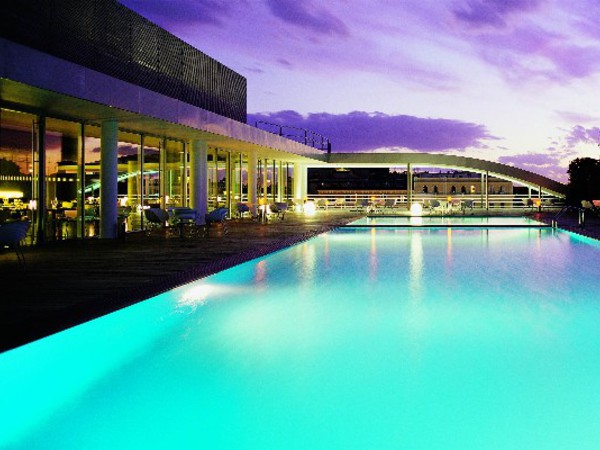
The rooftop and panoramic pool quickly became defining features. They were not secondary amenities; they were positioning tools. They communicated modernity, lifestyle, visibility and openness to an international clientele.
The conference facilities also reinforced the asset’s vocation. Its proximity to Termini made the hotel well suited to business demand, events, meetings and corporate travellers. The property was therefore not limited to leisure tourism; from the outset it developed a dual identity: international accommodation and business platform.
The ES Hotel anticipated a transformation that is now central to the market: the hotel as a hybrid destination. Not just rooms, but dining, relationships, events, work, wellbeing, urban content and social experience. In this sense, the asset was ahead of many trends that would only become mainstream years later.
Its original strength lay precisely here: in interpreting hospitality not as a mere real estate function, but as an integrated experience.
3. The move into Radisson: from local project to international product
The move into the Radisson system marked the first major shift in scale. The ES Hotel, originally developed as a local entrepreneurial and architectural initiative, entered a global hotel network and progressively took on the commercial identity of Radisson SAS and later Radisson Blu es. Hotel Rome.
This was not merely a change of name. The international brand changed the way the asset was perceived and made it more readable to foreign markets. For corporate clients, tour operators, distribution platforms and international travellers, the Radisson brand introduced a recognisable promise of standards, service and reliability.
The property thus acquired a dual identity. On one hand, it retained the architectural and urban character of the ES Hotel. On the other, it gained the commercial strength of an international brand. It was precisely this combination that made it competitive: a non-conventional building in a strategic location, supported by a global flag.
The transition to Radisson also confirms a fundamental rule of the hotel industry: the brand is the visible layer, but it does not exhaust the substance of the operation. Behind the sign remain the real estate, the hotel business, the operating company, the contracts, the staff, the licenses, the tax position and the governance structure.
For the guest, the hotel was Radisson. For the investor, it was an asset. For the operator, it was a business. For the lawyer, it was a network of contractual relationships. For the market, it was a positioned product. The history of the ES Hotel shows that all these dimensions can coexist in the same place, yet never fully coincide.
4. The real issue: the hotel as a multi-layered system
The most relevant part of the ES Hotel story is its legal and operational structure. The property did not follow a simple trajectory, because over time several layers of the asset were separated and managed independently.
The first layer is the real estate: the building, the physical complex, cadastral units, parking facilities, property rights, financial arrangements, leasing structures, guarantees and registrations.
The second layer is the hotel business: licenses, goodwill, operating assets, contracts, staff, commercial relationships and the operational organisation.
The third layer is the operation: the entity that runs the day-to-day business, delivers the service, manages costs and revenues, and is responsible for operational obligations.
The fourth layer is the brand: the name under which the product is sold to the market.
In the case of the ES Hotel, these four layers followed different paths. ES Group S.r.l. played a central role in the ownership of the hotel business. Mavip S.r.l., formerly Es Real Estate S.p.A., was connected to the real estate and financial component of the complex. The multi-storey car park was separated and transferred to Interparking S.p.A. Roma Gestioni S.r.l. entered as lessee of the hotel business. JSH Hotel & Resorts S.r.l. was later identified as the operating manager during the Radisson Blu phase.
This structure makes the ES Hotel a perfect example of a complex hotel asset. The hotel visible to the public is one. The economic architecture beneath it is made up of several entities, contracts and functions.
This is where the case becomes particularly instructive. In advanced hospitality, owning the building does not automatically mean operating the hotel. Operating the hotel does not mean owning the hotel business. Using an international brand does not mean being that brand. Controlling one layer of the system does not mean governing the entire asset.
The ES Hotel case clearly shows that hotel value is generated by the coherence between these layers. When they are aligned, the asset creates value. When they separate without strong direction, they generate complexity, risk and loss of control.
5. The lease of the hotel business to Roma gestioni: separating ownership from operations
The lease of the hotel business to Roma Gestioni S.r.l. in May 2012 marked a decisive turning point.
A business lease is a central instrument in the hotel sector. It allows the owner of the business to grant its operation to another party, keeping the ownership of the business complex separate from day-to-day management.
In the case of the ES Hotel, this step reinforced the distinction between the entity holding the hotel business and the entity operating it. The property entered a more industrial phase: it was no longer centred on a single owner-entrepreneur figure, but on a system of separate roles.
This evolution also affected the organisation of staff. Employment relationships and operational management were brought within the structure of the operating lessee, marking the transition from a concentrated entrepreneurial model to a more articulated management framework.
This is typical of mature hotel assets. The larger and more valuable a hotel becomes, the more it tends to distribute functions and responsibilities: ownership, operation, brand, staff, maintenance, distribution, finance and compliance follow their own logic, while needing to remain coordinated.
When this direction works, the asset becomes scalable. When it does not, complexity becomes fragility.
6. JSH and Radisson Blu: The international franchise phase
During the Radisson Blu phase, the property was operated by JSH Hotel & Resorts S.r.l., while the Radisson brand was used under a franchise agreement with Rezidor Hotel APS Denmark.
This configuration is typical of international hospitality. The brand provides the flag, standards, commercial channels, recognition and distribution system. The local operator runs the hotel, organises the service, manages day-to-day operations and bears the responsibilities connected with the business.
Franchising therefore makes it possible to combine global commercial strength with local management. It is a powerful model, but it requires discipline. The brand provides visibility, but the actual guest experience depends on the operator. Standards come from the chain, but their daily execution takes place within the operating structure.
The JSH/Radisson Blu phase captures the hotel at a mature stage: global brand, specialist operation, urban product, business-leisure demand and significant reputational exposure.
This exposure is precisely what makes governance decisive. In such a visible asset, any operational or administrative weakness does not remain confined to the entity that generates it; it reflects on the entire product as perceived by the market.
7. The critical phase: litigation, tax issues and reputation
The ES Hotel story also includes a critical phase that affected the perception of the asset and accompanied its most complex period.
The first thread concerns the insolvency context connected with San Pio s.a.s., formerly C.R. Invest S.r.l., and the request to have the transfer of the hotel business declared ineffective. This links the history of the hotel to the crisis of the entity involved in the original development phase.
The second thread concerns a tax dispute with the Italian Revenue Agency relating to a 2011 tax assessment notice. This too confirms that the asset went through a period of fiscal and administrative tension.
The third and most widely reported thread concerns Rome’s tourist tax. In 2018, press reports described a seizure of more than two million euros in connection with the alleged failure to remit amounts collected from guests as tourist tax. The matter formed part of a national context in which hoteliers’ liability for tourist tax was subject to major legislative changes and judicial interpretation.
These episodes were not marginal incidents. They formed part of the economic history of the asset. A large urban hotel does not live only on occupancy, ADR, RevPAR and brand awareness. It also lives on compliance, taxation, relations with public authorities, financial flows, contracts, licenses and operational accountability.
The critical phase of the ES Hotel offers a fundamental lesson: in modern hospitality, governance is not a secondary matter. It is a component of value. A hotel may have location, demand, brand and architecture; but if governance is not orderly, the asset’s potential is absorbed by risk.
8. The change of cycle: Institutional capital and a new industrial strategy
The next phase opened an entirely different cycle. The former Radisson Blu Es entered a logic of institutional capital, value creation and repositioning. InvestiRE and Blantyre entered the perimeter of the transaction, while Garnet Hospitality Partners played a central role in the relaunch and reorganisation of the asset.
This changed the nature of the story completely.
The hotel was no longer viewed merely as a property to be operated, but as a platform to be reorganised, renovated and repositioned.
Institutional capital brings a different logic. It requires transparency, risk control, capex planning, brand selection, asset management, governance, business planning, operating structure and decision-making discipline.
The issue was not simply reopening the hotel. The issue was rebuilding the value of the asset.
This means acting on the product, spaces, perceived quality, commercial distribution, restaurants, meetings, management team, technology, operating standards and market identity.
The shift is clear: from an iconic yet layered hotel to an institutional product ready to compete again in the upper tier of the Roman hospitality market.
9. Hyatt Regency Rome Central: The new identity
The new commercial phase of the former ES Hotel takes shape as Hyatt Regency Rome Central. The address remains 171 Via Filippo Turati, but the product changes in scale, language and market promise.
The new hotel is presented as a five-star property with 238 accommodations, including 20 suites, a rooftop, outdoor pool, restaurants, bars and more than 1,000 square metres of meeting space.
The choice of the Hyatt Regency brand is consistent with the nature of the asset. Hyatt Regency is suited to sizeable urban hotels with a business-leisure vocation, international demand, meetings, events and full-service positioning. It is not a boutique formula, but a hotel platform capable of supporting volume, corporate demand and premium positioning.
The Hyatt repositioning enhances the property’s historic strengths: centrality, accessibility, critical mass, public spaces, rooftop facilities and architectural identity. At the same time, it introduces a new management grammar: international standards, stronger operational coherence, global distribution and a more clearly defined position in the market.
Hyatt Regency Rome Central does not erase the ES Hotel. It absorbs and surpasses it. It takes an asset born as a design icon, releases it from the fragmentation of the previous phase and reinserts it into a stronger global hospitality ecosystem.
The change of flag is therefore only the visible part of the transformation. The real transformation is industrial: product, operations, brand, capital expenditure and market positioning are brought back within a new strategic architecture.
10. Why this operation matters for Rome
The transformation of the ES Hotel matters beyond the individual property. It speaks to a new phase in Rome’s hotel market.
Rome is undergoing a profound repositioning of its accommodation offering. The arrival of international brands, the growth of the luxury and upper-upscale segments, the recovery of complex assets, the rise of institutional capital and the increasing focus on management quality are reshaping the city’s hospitality map.
The former ES Hotel sits exactly within this trajectory. It is not a historic palazzo converted into a luxury hotel in the monumental centre. It is not a boutique hotel within the most touristic perimeter of the city. It is a large contemporary asset, purpose-built for hospitality, located in a flow-driven district and called upon to turn its complexity into competitive advantage.
Its rebirth as Hyatt Regency Rome Central can also influence the perception of the Esquilino district. A well-managed international hotel with restaurants, rooftop facilities, meetings, services and qualified clientele is not just a place to stay. It is an urban anchor. It generates flows, reputation, relationships, employment and complementary demand.
The Esquilino needs operations capable of moving beyond the logic of mere transit. A strong hotel product can help transform the area from a passageway into a place of permanence, interaction and value.
This is why the former ES Hotel is a strategic asset. Not only for those who own or operate it, but for the entire urban district in which it sits.
11. The five lessons of the ES Hotel
The first lesson is that location is not enough. Via Turati and Termini provide accessibility and flows, but value is created only when location is turned into product. The ES Hotel did this first through design, and now through the Hyatt repositioning.
The second lesson is that a brand increases commercial strength, but does not replace governance. Radisson brought international recognition; Hyatt brings a new global platform. But success depends on coherence between brand, operations, product and ownership structure.
The third lesson is that the separation between real estate, business and operations is normal, but it must be governed. When contractual layers are clear, complexity becomes efficiency. When they are not aligned, complexity becomes risk.
The fourth lesson is that hotel due diligence must be multidisciplinary. It is not enough to analyse rooms, revenue and location. One must read licenses, contracts, staff, taxes, disputes, planning, cadastral records, leases, parking facilities, brand agreements and the financial structure.
The fifth lesson is that repositioning is not cosmetic renovation. It is an industrial discipline. It means redefining the customer, product, spaces, pricing, distribution, restaurants, staff, service, standards and commercial narrative.
The ES Hotel shows that a hotel asset can go through difficult phases without losing its potential. But that potential becomes value only when it is brought back within a coherent strategy.
12. Essential timeline
| Period | Event | Meaning |
|---|---|---|
| 1999-2003 | Design and development of the ES Hotel | Birth of a contemporary hotel in the Esquilino district |
| October 2002 | Opening of the ES Hotel | Launch of the entrepreneurial and hotel project |
| 2004-2005 | Entry into the Radisson SAS system | First international commercial leap |
| 29 December 2006 | ES Group S.r.l. takes on ownership of the hotel business | Key turning point in the business structure of the asset |
| 26 January 2007 | Financial lease relating to the real estate complex | Emergence of a distinct real estate and financial component |
| 30 September 2009 | Transfer of the multi-storey car park to Interparking | Separation of an important functional component |
| 28 May 2012 | Lease of the hotel business to Roma Gestioni S.r.l. | Separation between ownership of the hotel business and operating management |
| 2013 | ES Group-Primesint and Mavip-Primesint preliminary agreements | Snapshot of the asset’s legal complexity |
| 2018 | Tourist tax matter and seizure | Critical phase from a legal and reputational standpoint |
| 2020 | Regulatory developments concerning tourist tax | Change in the relevant criminal and tax framework |
| 2020/2021 | New institutional cycle of the asset | Start of the reorganisation and value-creation phase |
| 2023-2026 | Full repositioning of the former Radisson Blu Es | Renovation of the product, brand and operating structure |
| From 1 September 2026 | Hyatt Regency Rome Central | New international commercial phase |
13. Methodological note
This article reconstructs the history of the ES Hotel through an integrated reading of documentary sources, institutional sources, sector sources and economic-legal reporting. The structure of the article prioritises the solid and strategically relevant passages needed to understand the evolution of the asset, while avoiding secondary details that do not alter the main thesis.
The editorial choice is deliberate: not to produce a fragmented chronology, but to offer a professional interpretation. The aim is not to list every document, but to explain why the ES Hotel represents an exemplary case of hotel, real estate and operational transformation.
14. Concluding assessment
The ES Hotel on Via Turati is one of the most interesting hotel assets in Rome over the past twenty-five years. It was born as an innovative project in a complex district, grew through design and international branding, moved through a phase of corporate and operational layering, entered a critical period from a tax and reputational standpoint, and was ultimately brought back onto a new value trajectory through institutional capital, asset management and a global brand.
Its history shows that a hotel is never merely a building. It is an economic and legal machine in which ownership, business operations, staff, licenses, contracts, debt, maintenance, distribution, standards, reputation and market demand coexist.
In the case of the ES Hotel, these elements first overlapped, then separated, and have now been recomposed within a new industrial thesis. The transformation into Hyatt Regency Rome Central represents the attempt to give order, commercial strength and future value to an asset that has always had location, identity and potential.
The decisive point is this: in today’s hotel market, value does not arise from the simple availability of a building or the application of a brand. It arises from the ability to turn complexity into strategy.
The former ES Hotel is a case study because it shows exactly this process. From architectural icon to international hotel, from fragmented asset to institutional platform, from complex history to renewed market promise.
Its new life as Hyatt Regency Rome Central is therefore not merely a change of flag. It is the industrial recomposition of one of Rome’s most symbolic hotel assets: a place originally designed to challenge the perception of the Esquilino and now ready to return to the market as an international, competitive and finally coherent hospitality product.
This analysis was developed with the support of Hotel Intelligence, the dedicated strategic and documentary analysis division for hotel assets within Hotel Management Group.
For assistance with hotel dossier analysis, real estate hospitality transactions, complex hotel operations or repositioning processes, please contact:
Roberto Necci